
By Kshetez Vinayak, founder of SupaSidebar. Last updated July 3, 2026.
{/* TL;DR */}
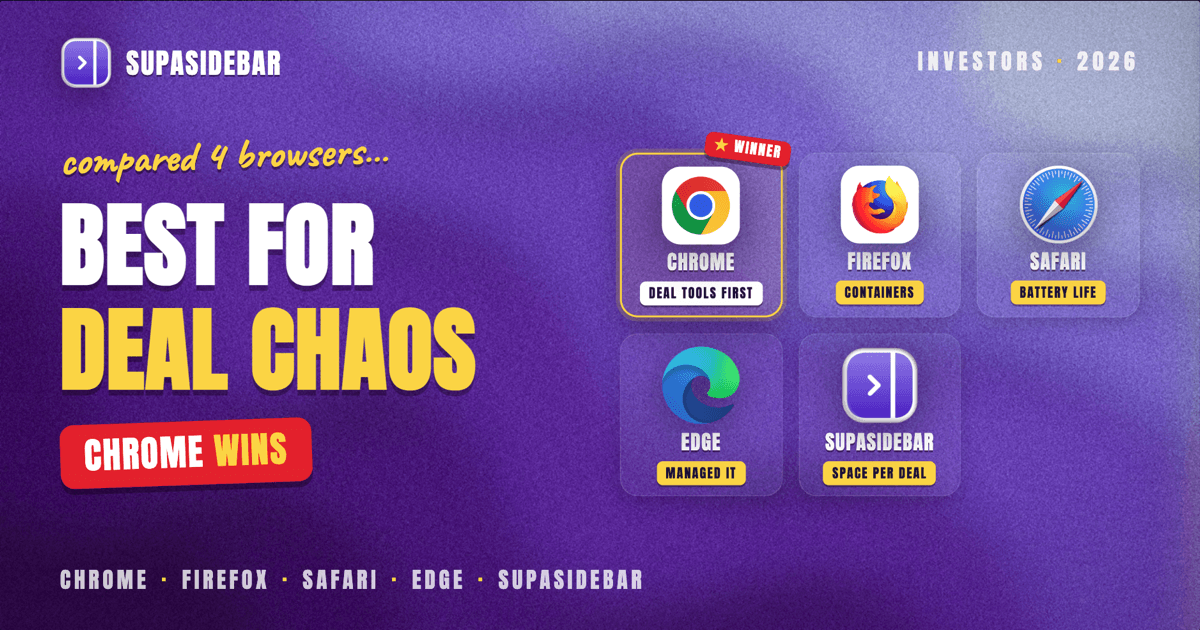
For most real estate investors on a Mac in 2026, Chrome is the best browser for the core of the work, because the listing sites, deal-analysis calculators, lender portals, and data tools an investor lives in (Zillow, Redfin, LoopNet, BiggerPockets, DealCheck, PropStream) are cloud apps tested against Chromium first, and its profile system gives each market or each entity a durable, self-contained login. Firefox is the better pick when an investor keeps many portal and lender logins strictly apart, because Multi-Account Containers isolate each one inside a single window. Safari is the choice for an investor who wants a private default and long battery life on a laptop used all day for property research, since it runs Intelligent Tracking Prevention with no setup and is the most efficient option on Apple Silicon. Edge is the strongest fit inside a Microsoft-run investment shop, with centrally managed profiles, native vertical tabs, and Workspaces. But the browser is rarely the real bottleneck. The harder problem is keeping each deal's listing, underwriting model, financing portal, and diligence documents together and switchable without drowning in a wall of near-identical tabs, and that is a workspace problem no single browser solves. SupaSidebar is the macOS sidebar that fixes it across whichever browser an investor runs.
Quick navigation:
- Comparing every Mac browser, not just the investor angle? → Best Browser for Mac in 2026
- Looking for the full Mac app stack for investing? → Best Mac Apps for Real Estate Investors in 2026
- Buying and selling for clients rather than building a portfolio? → Best Browser for Real Estate Agents on Mac in 2026
- Comparing how a sidebar keeps each deal separated across browsers? You are in the right place. Keep reading.
| Browser | Best for | Tool and portal handling | Multi-deal separation |
|---|---|---|---|
| Chrome | Browser-based listing, analysis, and lender tools | Zillow, LoopNet, BiggerPockets, DealCheck, and PropStream tested against Chromium first | Profiles, durable per-market or per-entity login sets |
| Firefox | Investors keeping many portal and lender logins apart | Reader View for clean listing and contract reading, plus per-container isolation | Multi-Account Containers, per-tab isolation |
| Safari | Private default, long battery-friendly research days | ITP on by default; deep macOS integration; low power draw | Profiles (2022+), one window per profile |
| Edge | Microsoft-run investment shops and small funds | Same Chromium engine, native vertical tabs, project Workspaces | Edge for Business work/personal profiles, central IT control |
| SupaSidebar (layer, not a browser) | Keeping every deal's tabs together across any browser | One Space per deal or market, across all of the above | One Space per deal, across every browser at once |
What real estate investors actually need from a browser on Mac
The best browser for a real estate investor on Mac in 2026 is the one that handles three jobs at once: it runs the browser-based listing sites, deal-analysis calculators, lender portals, and data tools without permission or performance friction, it keeps each market, entity, and lender login separated so one deal's numbers and documents do not bleed into another's, and it holds a day's worth of property research, underwriting, and portfolio checks without the investor losing the deal they are actually working in the noise. This post compares the major Mac browsers on exactly those three jobs. It does not rank the investing platforms themselves (Zillow, LoopNet, BiggerPockets, and the rest run alongside whichever browser you pick), and it is Mac-specific.
An investor's browser session looks nothing like a casual one. Sizing up a single property can mean the listing open in one tab, the county assessor and tax records in another, a rent-comp tool, a deal-analysis calculator running the numbers, a lender or hard-money portal for financing, a couple of inspection or title-document tabs, Google Maps and street view for the area, and market data waiting in the background. Running several deals at once across two or three markets multiplies all of that. The browser has to hold it, keep each deal and each lender strictly separate, and not turn into forty near-identical tabs by mid-afternoon.
Most of an investor's workflow now lives in the browser, and it carries deal figures and financing details the whole time, which raises the stakes on both organization and privacy. Listing portals, underwriting calculators, lender consoles, and property-management dashboards are cloud apps that run in the browser with no local installation, which makes the browser the actual deal desk rather than a place you occasionally look things up. Listings, comps, and loan applications are live pages behind logins rather than saved files, so the browser also holds the reference and document layer. When an investor works multiple markets or wants each entity kept apart, the common setup is a dedicated browser profile or container per context, because it keeps each one's logins and portals strictly separated (Google Chrome Help, add and manage Chrome profiles). That makes browser choice a real decision, but it also exposes the limit: a browser can hold the tabs, it just was not built to keep several deals' worth of them organized.
Chrome: listing sites and the cloud investing stack
Chrome is the best default browser for a real estate investor because the tools that matter most run most reliably there. Listing and data portals such as Zillow, Redfin, and LoopNet, deal-analysis tools like BiggerPockets calculators and DealCheck, and data services like PropStream are cloud apps that get the most testing against Chromium, so map views, financial calculators, and document uploads behave the way they were built to. For an investor whose entire pipeline and reference stack live in the browser, Chrome is the path of least resistance.
Chrome's Profiles also separate markets and entities cleanly. Each profile carries its own cookies, logins, extensions, and bookmarks, so a profile per market or per LLC becomes a durable, self-contained identity rather than an account you have to remember to switch (Google Chrome Help, add and manage Chrome profiles). A weekend investor on one market rarely needs this, but someone running deals in three metros with separate lenders gets clean separation of each one's portals, logins, and saved research.
The catch is resource use. Chrome is known to eat RAM once a day fans out across listing tabs, calculators, and document pages, which matters on a laptop that is also running a video call with a lender or partner. For a browser that runs the listing and analysis tools without fuss, though, Chrome is the reliable default.
Best for:
Investors who work in browser-based listing, analysis, and lender tools and want each market or entity login kept durable.
Firefox: many portal logins kept strictly apart
Firefox is the best browser for an investor who keeps many portal and lender logins separated and cares about privacy defaults. Its standout feature is Multi-Account Containers, which sandbox cookies and logins per container, so one lender's portal, one market's MLS-adjacent login, and a property-management dashboard stay walled off from another's inside a single window (Mozilla Support, Multi-Account Containers). Where Chrome Profiles want a separate window per account, Firefox Containers let an investor run two lenders and a data service as color-coded tabs side by side without logging anyone out.
Firefox also has a capable Reader View that clears a page down to text, which pairs well with investing where many tabs are listing descriptions, disclosure documents, and market reports rather than tools to operate. Between containers and Reader View, a multi-market investor can keep each deal's live workspace separate while still reading long reference documents cleanly.
The cost is effort and, on Apple Silicon, efficiency. Firefox rewards configuration, so an investor gets the most out of containers only by investing setup time, and its on-Mac battery life trails Safari during long research days. One more caveat: if a specific lender or data portal has quirks in a non-Chromium browser, an investor should confirm the console fully supports Firefox before running a live loan application in it.
Best for:
Investors who want each portal and lender login isolated inside one window, with strong privacy defaults.
Safari: the private, battery-friendly research default
Safari is the best browser for an investor who wants the most private out-of-the-box default and a machine that lasts a full day of property research. It runs Intelligent Tracking Prevention with no setup, which quietly limits the cross-site tracking an investor picks up while opening listing links, agent-supplied pages, and market research all day, and it is the most battery-efficient option on Apple Silicon (Intego, most secure browser for Mac 2026). For an investor doing hours of scouting from a laptop, quiet default protection plus all-day battery is a real fit.
Safari is also deeply integrated with macOS, which matters when a listing portal, a calculator, and a dozen document tabs sit open all day. That integration keeps the machine cool and responsive across a long afternoon of underwriting.
The honest limits are cloud-tool predictability and multi-deal scale. Some data and lender consoles are tuned for Chromium first, so an investor whose analysis tool misbehaves in Safari should keep a Chromium browser for that console and use Safari for reading, scouting, and reference. Safari supports Profiles for splitting "Work" from "Personal," but it was not built to hold several distinct deal or market contexts at once, and that ceiling arrives fast for anyone juggling a full pipeline across markets.
Best for:
Investors who value privacy defaults, battery, and macOS integration through long days of property research.
Edge: the managed browser for Microsoft-run investment shops
Edge is the best browser for an investor inside a Microsoft-run shop or small fund, where IT deploys and secures the browser centrally. Because Edge is built on Chromium, it runs the same listing, analysis, and lender web apps and Chrome extensions an investor already relies on, so nothing in the stack breaks. On top of that, it has the strongest built-in tab management of any mainstream browser: native vertical tabs keep a wall of deal and research tabs readable down the side, and Workspaces save each deal's or each market's set of tabs so they reopen together and stay separated from the next (Microsoft, Edge Workspaces).
Edge for Business adds separate work and personal profiles with automatic switching by site, which suits a fund whose whole toolchain sits inside a Microsoft tenant with central controls. For an investor already signed into Microsoft 365, the work profile keeps the listing portals, the data services, and the internal deal tracker in one managed identity.
The trade-off is that Edge's advantages are strongest inside the Microsoft ecosystem. A solo investor not on Microsoft 365 gets Chromium compatibility and vertical tabs but less of the managed-identity payoff, and Workspaces organize tabs inside Edge only, not across the other browsers an investor might still open.
Best for:
Investment shops inside a Microsoft-managed environment that want a centrally secured, Chromium-compatible browser with built-in vertical tabs.
The real problem: one browser cannot hold every deal
Here is the part the browser comparison misses. Pick the browser with the most reliable data-tool support, the cleanest containers, and the best vertical tabs, and an investor running several deals across two markets still ends up with forty tabs, a separate listing, model, and lender login per deal, and no fast way to jump from one deal's tool set to another's. Profiles and containers help, but switching profiles means switching whole windows, and the bookmarks bar fills with deal folders nobody opens mid-analysis. The friction is not the browser, it is the lack of a workspace layer on top of it.
SupaSidebar is the macOS sidebar that solves this across any browser. It is a native Mac app, not a browser and not an extension, that adds a persistent sidebar beside whatever browser an investor runs. The relevant feature for investors is Spaces: one Space per deal or market, each holding that deal's pinned listing and underwriting model, its saved lender portal, county records, and inspection documents, and the map and comp tools that belong to it. Switching from one deal to another becomes switching a Space, not hunting through a wall of near-identical tabs.
Because SupaSidebar's Live Tabs can show open tabs from supported browsers in one list, an investor running Chrome for a listing portal and Firefox containers for two lenders sees both in a single sidebar instead of alt-tabbing between windows. The Command Panel (⌘⌃K) then searches saved links, recent pages, and live tabs across every browser at once, so pulling up a specific deal's model is one keystroke rather than a memory test. SupaSidebar supports every major Mac browser, 32+ in total including Chrome, Firefox, Safari, Edge, Brave, Arc, and Vivaldi, so the investor's browser choice and the organization layer stay independent.
A concrete setup for an investor working a new deal while managing owned rentals might look like this:
| Space | What lives in it |
|---|---|
| 123 Oak St (new deal) | the zillow.com listing, the loopnet.com comps, the dealcheck.io underwriting model, the county assessor record, the lender portal, the inspection-report folder |
| My Rentals (owned) | the appfolio.com property-management portal, the banking login, the insurance account, the biggerpockets.com portfolio tracker, the tax-document folder |
Switching from "123 Oak St" to "My Rentals" swaps the whole set of tabs and pinned tools in one click, so the investor lands back in the right deal instead of rebuilding the analysis session from memory. It organizes the work, not the deal data inside it: SupaSidebar is not an analysis or property-management tool and does not run the numbers, store records, or track portfolios, it groups the tabs and links around each deal. It also saves nothing about the pages themselves, so it inherits whatever privacy and login posture the underlying browser provides.
As one r/macapps user described why it fits a multi-browser workflow, SupaSidebar "is built for exactly this use case: people who use multiple browsers and need a way to consolidate browser context without paying a constant productivity tax every time they switch" (amerpie, r/macapps). That per-context separation is the most-requested SupaSidebar workflow across its users.
Why SupaSidebar fits an investing workflow
SupaSidebar is a macOS app that brings Arc's sidebar to every browser - one sidebar for tabs, bookmarks, files, and apps across 32+ browsers including Chrome, Firefox, Safari, Edge, Brave, Arc, Vivaldi, Dia, and Orion. For a real estate investor, that means the browser decision (Chrome for data-tool reliability, Firefox containers for separated lender logins, Safari for a private battery-friendly default, Edge for a managed Microsoft environment) and the organization decision (one Space per deal or market) stop competing. Pick the browser that meets the listing and analysis needs, then let SupaSidebar keep each deal's context together on top of it. It runs on macOS 14 and later, syncs across Macs through iCloud with no account required, and a free version is available to try the per-deal Space workflow before committing.
The bottom line
For most real estate investors on a Mac in 2026, run Chrome as the daily browser when the core problem is browser-based listing, analysis, and lender tools, because those tools are built and tested against Chromium first and its Profiles give each market or entity a durable login. Choose Firefox when the priority is keeping many portal and lender logins strictly apart, because Multi-Account Containers isolate each one inside a single window. Reach for Safari when a private default and long battery are the priority through long research days, and Edge when the shop lives inside a Microsoft-managed environment that wants central control, vertical tabs, and per-project Workspaces. Whichever browser wins, the deal-juggling problem remains, and that is the gap SupaSidebar closes: one Space per deal or market across every browser at once. Investors weighing the full picture can start with Best Browser for Mac in 2026 for the general ranking, then Try SupaSidebar (free tier) to test the per-deal workflow.
Written by Kshetez Vinayak, founder of SupaSidebar.
FAQ
What is the best browser for real estate investors on a Mac in 2026?
For most real estate investors, Chrome is the best browser because the listing sites, deal-analysis calculators, and data tools they work in, such as Zillow, LoopNet, BiggerPockets, and PropStream, are built and tested against Chromium first, and its Profiles give each market or entity a durable, self-contained login. Firefox is the better pick when an investor keeps many portal and lender logins strictly apart, because Multi-Account Containers isolate each one inside one window, and Safari suits investors who want a private default and long battery life. The browser choice matters less than having a workspace layer that keeps each deal's tabs separated, which SupaSidebar provides across any of them.
How do real estate investors manage multiple markets and lender logins in one browser?
Investors working more than one market usually give each context its own browser profile (Chrome Profiles) or container (Firefox Multi-Account Containers) so their portals, data logins, and lender records do not collide. Profiles want a separate window per account, while Firefox Containers keep each account's logged-in tabs isolated inside one window. To keep each deal's listing, model, and documents grouped rather than just its login separated, a sidebar app like SupaSidebar assigns one Space per deal or market across whichever browsers the investor uses.
Which browser is best for property research on a Mac?
Safari is a strong choice for property research because it runs Intelligent Tracking Prevention with no setup and is the most battery-efficient option on Apple Silicon, which matters during long days of scouting listings, county records, and map tools. Chrome is the more compatible pick when the research relies on data services and calculators tested against Chromium first, and Firefox Reader View is useful for reading long disclosure and market documents cleanly. Whichever browser handles the pages best, a sidebar with one Space per deal keeps each property's research tabs together instead of scattered across windows.
Do browser profiles fully separate my deals and entities?
Browser profiles and containers separate cookies, logins, and sessions, so one lender's portal and one market's data login stay unmixed from another's, but they share the machine's browser fingerprint and do not provide true account isolation. That is fine for keeping your own legitimate, separate deals and entities organized; it is not an anti-detection setup. If the goal is simply staying organized across deals, a sidebar with one Space per deal or market keeps each one's tabs and tools together on top of whatever profile or container you use.
Does SupaSidebar work with my listing sites and browser?
SupaSidebar works alongside your listing, analysis, and lender tools and any supported browser rather than inside them. It is a macOS sidebar app that supports 32+ Mac browsers, so it can pin each deal's listing, underwriting model, and lender portal in its own Space, show live tabs from every browser in one list, and search across all of them with the Command Panel. It does not run the numbers, store records, or track portfolios, and it saves nothing about the pages themselves, so it inherits your browser's privacy and login behavior.