
By Kshetez Vinayak, founder of SupaSidebar. Last updated 2026-06-29.
TL;DR
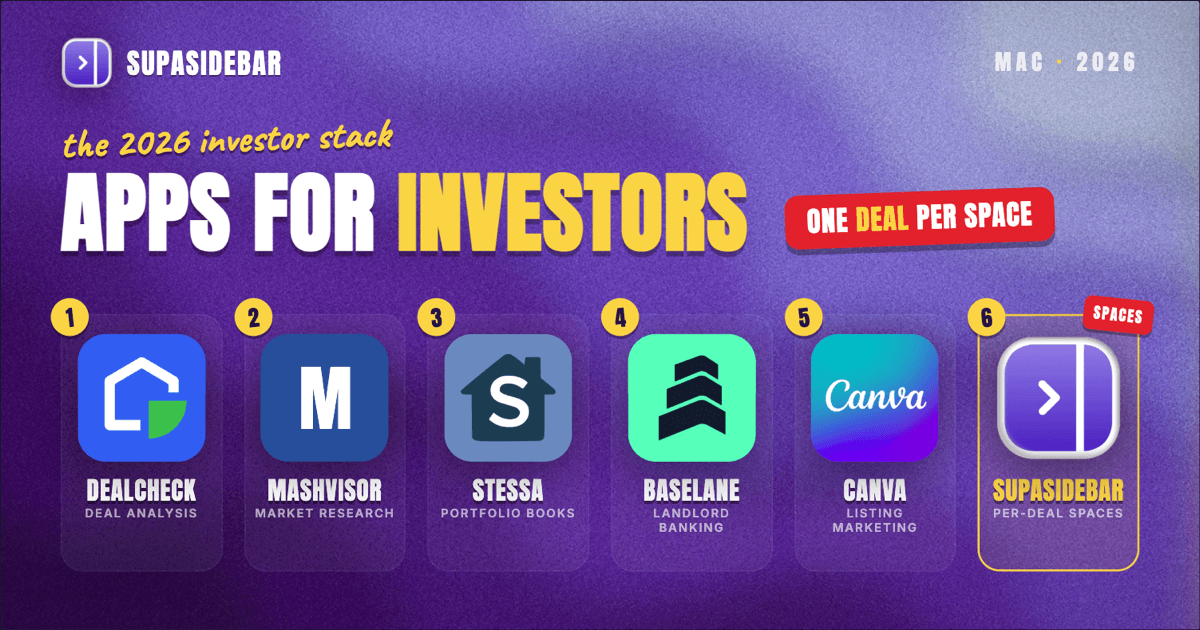
The best Mac apps for real estate investors in 2026 are a focused stack built around the deal lifecycle: SupaSidebar to keep each deal and property's tabs separated across browsers, DealCheck to run the numbers on a rental, flip, or BRRRR before making an offer, Mashvisor for neighborhood and rental-market research, Stessa for free portfolio bookkeeping and tax-ready reports, Baselane for free landlord banking and rent collection, Canva for rental and listing marketing, and Apple Calendar plus Notes for the day-to-day. The job that ties them together is tab chaos across many deals at once: an investor runs a listing portal, a deal calculator, a market-data site, a lender login, and a property-management dashboard, often across two or three browsers, and the single biggest daily friction is finding the right tab. The category-by-category picks, the honest limits, and the comparison table are below.
Quick navigation:
- Selling homes rather than buying and holding them? → Best Mac Apps for Real Estate Agents 2026
- Setting up a Mac workspace that keeps deals organized? → Mac Workspace Setup for Deep Work 2026
- Drowning in listing, analysis, and lender tabs? → Too Many Tabs Open on Mac
- Property investor building a Mac app stack? You are in the right place. Keep reading.
At a glance: the real estate investor Mac stack
| App | Category | Cost | Best for |
|---|---|---|---|
| SupaSidebar | Tab and workspace organization | Free version available | Keeping each deal or property's tabs separated across every browser |
| DealCheck | Deal analysis | Free Starter; Plus from $10/mo; Pro from $20/mo | Underwriting rentals, flips, and BRRRR deals before you offer |
| Mashvisor | Market and neighborhood research | Lite from $17.99/mo; Standard from $49.99/mo | Finding markets and estimating rental income |
| Stessa | Portfolio bookkeeping | Free; Pro around $20/mo | Income, expenses, and tax-ready reports across a portfolio |
| Baselane | Landlord banking and rent collection | Free; Smart $20/mo | Separate banking and automated rent per property |
| Canva | Rental and listing marketing | Free; Pro $15/mo | Rental listings, flyers, and investor social posts |
| Apple Calendar + Notes | Scheduling and quick capture | Free, built in | Showings, closings, and fast notes from a walkthrough |
Why an investor's real problem is tab sprawl, not a missing app
Most "best apps for real estate investors" lists hand you twenty tools and stop there. The working truth is narrower. An investor's stack is a deal analyzer, a market-data source, a bookkeeping system, a banking layer, and a marketing tool, and the rest is noise. The harder problem is not which apps to install. It is that nearly all of them live in the browser, open at the same time, for several deals at once.
A typical buy-and-hold investor has a Zillow or Realtor.com listing in one tab, a DealCheck analysis in another, a county records or rent-comp site in a third, a lender or hard-money portal in a fourth, and a property-management dashboard in a fifth, repeated for every property under contract and every rental already owned. By midweek there are forty tabs and no way to tell which window belongs to which deal. That is the friction this stack is built to remove, and it is why the organization layer comes first.
SupaSidebar: keeping each deal and property separated across browsers
SupaSidebar is the workspace layer for an investor juggling several deals and rentals at once: one Space per deal or property keeps that property's listing, analysis, lender login, and management portal together and out of the way of every other deal. It is a macOS app that adds a floating sidebar to any browser, so the separation holds whether a listing opened in Chrome, the lender portal only works in Safari, or a wholesaler sent a link that opened somewhere else.
The reason this matters for investing specifically is the cross-browser reality. Investors rarely standardize on one browser: a bank or lender works best in one, a portal or PM tool in another, a county records site in a third. SupaSidebar's Live Tabs section shows the open tabs from every browser in one list, grouped and clickable, across 33 browsers in total including Safari, Chrome, Firefox, Edge, Brave, and Arc. Air Traffic Control rules can route a saved listing link to the right Space automatically, and the Command Panel (opened with a keyboard shortcut) searches every saved page, recent page, and live tab in under a second, so a property's inspection report is one search away instead of buried in a window somewhere.
What this looks like in practice is one Space per active deal and one for the rentals already owned, each holding only that context's links. A two-Space setup for an investor working a new purchase while managing a portfolio:
| Space | What lives in it |
|---|---|
| 123 Oak St (new deal) | zillow.com listing for the property, app.dealcheck.io analysis, the lender portal (rocketmortgage.com), county assessor records page, the inspection report PDF in drive.google.com |
| My Rentals (owned) | app.stessa.com portfolio dashboard, app.baselane.com banking and rent collection, the property-management portal (appfolio.com), and the insurance login (lemonade.com) |
Switching from the deal Space to the rentals Space swaps the whole set of tabs at once, so the new purchase's lender portal is never tangled up with last month's rent reports. Add a third Space the day a second deal comes in, and it stays just as clean.
The honest scope: SupaSidebar organizes the tabs around a deal, it does not run the deal. It is not a deal analyzer and does not calculate cash flow or store property records, that is what DealCheck and Stessa are for. Its search covers titles and URLs, not the numbers inside a spreadsheet. It is macOS 14 or later, and a free version is available.
Best for:
any investor running more than two or three active deals or rentals at once across more than one browser, which is most of them.
DealCheck: underwriting a deal before you offer
DealCheck is the deal-analysis tool for running the numbers on a property before making an offer, covering rentals, flips, rehabs, BRRRR deals, wholesale, and multi-family. It calculates a full analysis from a few inputs, including closing costs, mortgage payment, cash flow, cap rate, ROI, and projected profit, and it produces customizable PDF reports an investor can brand and send to a lender or partner.
DealCheck is widely used in this niche, trusted by over 350,000 real estate investors and agents as a leading analysis platform. Pricing runs from a free-forever Starter plan, with Plus at $14 per month ($10 billed annually) and Pro at $29 per month ($20 billed annually), plus a 14-day trial of the premium features. The free tier is enough to analyze occasional deals; an investor underwriting many properties a week moves to a paid plan for unlimited analyses and reports.
The trade-off is that DealCheck analyzes a single property's economics, it does not find the deal or track the portfolio after you buy. For sourcing markets, pair it with a market-data tool; for the books after closing, pair it with bookkeeping.
Best for:
investors who underwrite every deal on the numbers and want a fast, repeatable analysis with a shareable report.
Mashvisor: finding markets and estimating rental income
Mashvisor is the market-research tool for deciding where to invest and what a property could rent for, aggregating property-level data, neighborhood analytics, and long-term and short-term rental projections in one interface. It is built to surface markets, neighborhoods, and individual properties that match an investor's return targets, which is the step before underwriting a specific deal.
Mashvisor's Lite plan starts at $17.99 per month billed quarterly, and the Standard plan at $49.99 per month billed annually adds deeper search and analytics; annual billing carries a discount. The platform covers both long-term and short-term rental analysis, so an investor comparing a buy-and-hold rental against a vacation rental can model both from one login.
The honest note: Mashvisor's projections are estimates, not guarantees, and rent comps and occupancy figures should be sanity-checked against local data before an offer. Treat it as the research layer that narrows the field, then run the chosen property through a dedicated analyzer.
Best for:
investors choosing a market or estimating rental income before committing to a specific property.
Stessa: free bookkeeping across the portfolio
Stessa is the free bookkeeping and accounting platform for tracking income, expenses, and performance across rental properties, with tax-ready financial reports at the end of the year. It connects bank and mortgage accounts, categorizes transactions automatically, and reports on each property and the portfolio as a whole, which replaces a sprawl of spreadsheets for most landlords.
The Essentials tier is free and supports an unlimited number of properties, and a Pro tier (around $20 per month) adds advanced reporting, budgeting, and pro-forma analysis. For an investor with a handful of rentals, the free tier alone covers the bookkeeping a tax preparer needs.
The trade-off is that Stessa is built around accounting and reporting, not active property management. It tracks the money cleanly, but for full tenant management and banking, it pairs with a tool like Baselane.
Best for:
investors who want clean, tax-ready books across a portfolio without paying for accounting software.
Baselane: landlord banking and rent collection
Baselane is the landlord banking and rent-collection platform that gives an investor a business checking account, automated rent collection, and bookkeeping built for rental property, with no account fees and the core banking, rent collection, and bookkeeping offered free. It lets an investor keep separate accounts per property, automate rent from tenants, and tag transactions for the books in one place.
Banking is provided through a partner bank with FDIC insurance, and a paid Baselane Smart tier ($20 per month) adds advanced auto-tagging, automated transfers, and faster rent deposits. For a landlord who currently runs rent through a personal account and reconciles by hand, the free tier alone is a meaningful upgrade.
The honest scope: Baselane is a banking and rent layer, not a deal analyzer or a market-research tool. It manages the money once a property is owned; it does not help decide whether to buy it.
Best for:
landlords who want per-property banking and automated rent collection without monthly fees.
Canva: rental listings and investor marketing
Canva is the design tool for producing rental listing graphics, flyers, and social posts without a designer. Templates sized for a rental listing photo set, a "for rent" flyer, or an investor's social update turn a blank page into a finished asset in minutes, and the brand kit keeps colors and a logo consistent. The free tier covers a lot, and Canva Pro is $15 per month or $120 per year for the larger library, background remover, and brand controls.
The honest note: Canva is general-purpose, not real-estate-specific, so an investor builds or buys the listing templates rather than getting them out of the box. For most investors that is a one-time setup, not an ongoing cost.
Best for:
investors who market their own rentals or flips and want professional graphics without hiring out.
Apple Calendar and Notes: scheduling and quick capture
The two apps already on the Mac handle more of an investor's day than most paid tools. Apple Calendar manages walkthroughs, inspection windows, financing deadlines, and closing dates, and syncs to the iPhone for the half of the job that happens on site. Apple Notes captures a contractor's quote or a property's red flag in the seconds before it is forgotten, and the notes sync to every Apple device through iCloud. Neither costs anything, and for a small portfolio they often cover scheduling and quick capture completely.
Best for:
every investor, as the free baseline before paying for anything heavier.
Which real estate investor setup should you pick?
- If you are a new investor analyzing your first deals: DealCheck for the numbers, Mashvisor or free public comps for the market, Stessa for the books once you close, and SupaSidebar to keep each prospect's tabs separated. Skip the paid tiers until volume justifies them.
- If you buy and hold a growing rental portfolio: add Baselane for per-property banking and rent collection and Stessa Pro for deeper reporting, and let SupaSidebar keep each property's portal and bank login in its own Space.
- If you flip or run BRRRR deals: DealCheck Pro for repeated underwriting and PDF reports, Canva for marketing the finished property, and SupaSidebar to separate each project's contractor, lender, and listing tabs.
- If your single biggest daily pain is finding the right tab: start with SupaSidebar regardless of the rest of the stack. It is the layer that organizes everything else.
Conclusion
The best Mac apps for real estate investors in 2026 are a focused stack, not a sprawling list: SupaSidebar for cross-browser organization, DealCheck for deal analysis, Mashvisor for market research, Stessa for bookkeeping, Baselane for landlord banking, Canva for marketing, and Apple Calendar plus Notes for the day-to-day. The tools an investor picks matter less than the fact that all of them run in the browser at once, for several deals and properties at the same time.
New investors can run lean and free with DealCheck, Stessa, and public comps. Portfolio landlords add Baselane and a Pro bookkeeping tier. Every investor, regardless of which analyzer or banking tool they choose, hits the same wall by midweek: too many tabs across too many browsers and no way to tell which belongs to which deal. That is the problem the organization layer solves first.
Try SupaSidebar (free tier) to keep each deal and property's tabs in their own Space across every browser.
Why we recommend SupaSidebar
SupaSidebar is a macOS app that brings Arc's sidebar to every browser - one sidebar for tabs, bookmarks, files, and apps across 33 browsers including Safari, Chrome, Firefox, Edge, Brave, Arc, Vivaldi, Dia, and Comet. For a real estate investor, that means one Space per deal or property, Live Tabs that show every open tab from every browser in one list, and a Command Panel that finds any saved page or live tab in under a second. It does not replace a deal analyzer or a bookkeeping tool, it organizes the tabs around the deals so the right page is always one search away. More than 3,000 Mac users have tried SupaSidebar, and a free version is available on macOS 14 and later.
FAQ
What is the best app for analyzing real estate deals on a Mac?
DealCheck is the most widely used deal-analysis app, calculating cash flow, cap rate, ROI, and projected profit for rentals, flips, and BRRRR deals from a few inputs. It runs in the browser, so it works on a Mac, with a free Starter plan and paid plans (Plus from $10/mo annual, Pro from $20/mo annual) for unlimited analyses and branded PDF reports.
What is the best free accounting software for rental properties?
Stessa offers free bookkeeping for an unlimited number of properties, tracking income and expenses and producing tax-ready reports. Baselane also offers free landlord banking, rent collection, and bookkeeping with no monthly fees. Both run in the browser and work on a Mac, and many investors use them together.
Do real estate investors need both a deal analyzer and a market-research tool?
They serve different steps. Mashvisor helps find markets and estimate rental income before you pick a property, while DealCheck underwrites the economics of a specific deal before you offer. New investors often start with DealCheck plus free public comps and add a market tool like Mashvisor as they scale.
How can an investor stop losing track of tabs across different deals?
SupaSidebar lets an investor create one Space per deal or property, keeping that property's listing, analysis, lender login, and management portal together and separated from other deals. It works across 33 browsers, so the separation holds even when the lender, the portal, and a records site each open in a different browser. A free version is available on macOS 14 and later.
Does SupaSidebar replace property management or accounting software?
No. SupaSidebar does not manage tenants, store property records, or run the books, that is what tools like Stessa, Baselane, and a deal analyzer are for. It organizes the browser tabs around each deal so the right page is one search away, and it shows open tabs from every browser in one Live Tabs list.
What does a real estate investor's Mac app stack cost in 2026?
A lean stack can be nearly free: DealCheck's free Starter plan, Stessa's free bookkeeping, Baselane's free banking, and SupaSidebar's free version. Investors who scale add paid tiers, DealCheck Pro (from $20/mo annual), Mashvisor (from $17.99/mo), Stessa Pro (around $20/mo), or Baselane Smart ($20/mo), so a serious portfolio stack runs roughly $40 to $90 per month depending on which paid tiers you choose.
Written by Kshetez Vinayak, founder of SupaSidebar.