
By Kshetez Vinayak, founder of SupaSidebar. Last updated 2026-06-28.
TL;DR
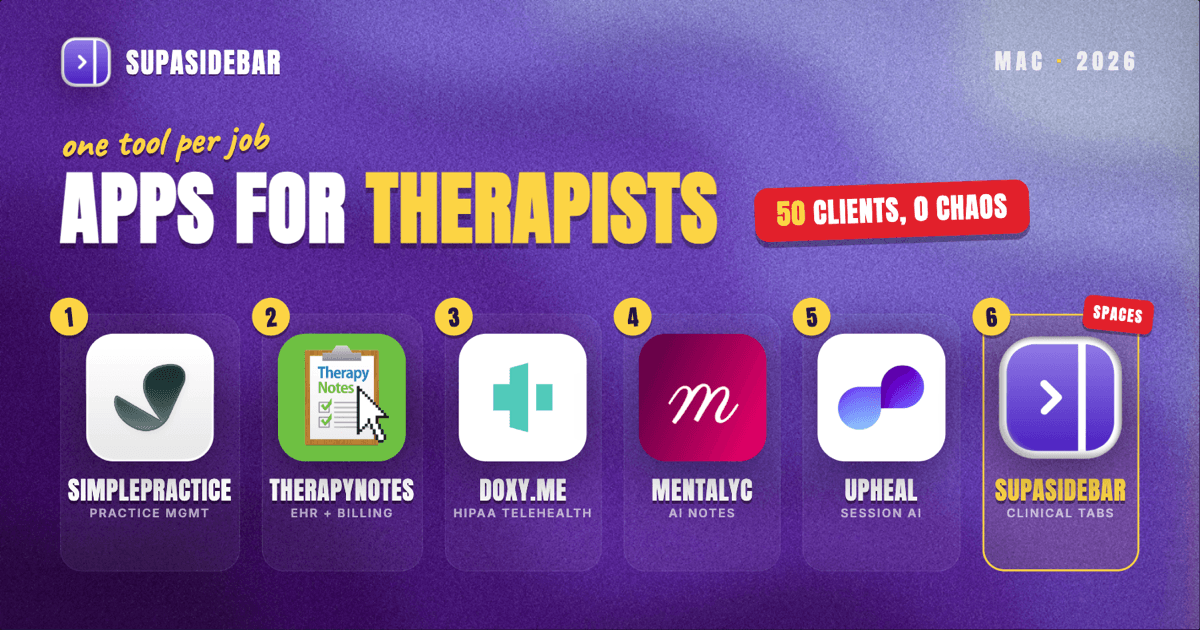
The best Mac apps for therapists in private practice in 2026 are organized by the job in front of you, not by brand: SimplePractice as the all-in-one practice-management EHR for solo and small-group clinicians, TherapyNotes when the practice is insurance-heavy and needs deep claims management, Doxy.me for browser-based HIPAA telehealth that starts free, Mentalyc or Upheal for AI progress notes that cut documentation time, and SupaSidebar to keep the EHR, telehealth portal, and admin tabs from collapsing into one undifferentiated pile across browsers. Almost all of this work happens in a browser tab rather than a native Mac window, so the practical Mac question for a therapist is what to run between sessions: a practice system that handles scheduling, notes, and billing, a secure video room, a faster way to write notes, and a way to keep client-facing work separate from admin. Several of these have real free or low-cost entry points, Doxy.me and Upheal both have free tiers, Reframe and Mentalyc start cheap, and SupaSidebar has a free version, while the full EHR platforms are monthly subscriptions. The comparison table and per-tool breakdown are below.
Quick navigation:
- Setting up a focused work environment? → Mac Workspace Setup for Deep Work 2026
- Drowning in open tabs specifically? → Too Many Tabs Open on Mac
- A physician rather than a therapist? → Best Mac Apps for Doctors 2026 (coming soon)
- Setting up a Mac for a private therapy practice? You are in the right place. Keep reading.
| App | Job in the stack | Pricing model | Best for |
|---|---|---|---|
| SimplePractice | All-in-one practice management EHR | Starter ~$29/mo, Essential ~$59/mo, Plus ~$99/mo | Solo and small-group therapists who want scheduling, notes, billing, and telehealth in one polished system |
| TherapyNotes | EHR built around insurance billing | Solo ~$59/mo; group ~$69/mo + ~$40/mo per added clinician | Insurance-heavy practices that need deep claims management |
| Doxy.me | Browser-based HIPAA telehealth | Free tier; paid from ~$35/mo (BAA on paid plans) | A no-install secure video room that starts free |
| Mentalyc | AI progress notes (SOAP/DAP/BIRP) | ~$29/mo solo; ~$16/mo per user on teams | Cutting documentation time with privacy-first AI notes |
| Upheal | AI notes plus session analytics | Free tier; paid plans add session capture and analytics | Therapists who want note generation plus treatment-trend insight |
| SupaSidebar | Clinical vs admin tab separation | Free version available | Keeping EHR, telehealth, and admin tabs apart across browsers |
A therapist's Mac is mostly a window onto web tools, the EHR, the telehealth room, the scheduling page, the AI note-taker, none of which is "an app you install and own." So this list mixes the practice systems clinicians live in with the supporting tools around them, and it ends with the one thing that keeps those tabs from turning into chaos between back-to-back sessions. Pricing for the paid tools is in US dollars and was checked in June 2026; EHR pricing in particular shifts with practice size, add-ons, and processing fees, so treat the figures as starting points and confirm current rates and the BAA terms before committing.
SimplePractice: scheduling, notes, billing, and telehealth in one system
SimplePractice is the most polished all-in-one EHR for solo and small-group private practice in 2026, combining scheduling, documentation, client portal, billing, and built-in telehealth in a single system with a gentle learning curve. Pricing runs roughly $29/month for the Starter plan, $59/month for Essential (which adds insurance billing and custom forms), and $99/month for Plus, with realistic total cost higher once credit-card processing, SMS reminders, and additional users are added (ClinikEHR, SimplePractice pricing 2026 breakdown).
SimplePractice opens in a browser, so on a Mac it lives as the tab a therapist returns to all day, not as an app sitting in the Dock.
The reason SimplePractice keeps its spot despite the add-on costs is that it does the boring parts well: a clean client portal, reliable telehealth, and a documentation flow that does not fight the clinician. For a private-pay solo practice that wants one system to handle the whole client lifecycle, SimplePractice is the default recommendation, with the largest peer community and the most support resources of the solo-focused platforms (Crown Counseling, best EHR for therapists 2026).
The honest scope limit: heavily insurance-based practices often find SimplePractice's claims workflow thinner than a billing-first competitor.
Best for:
solo and small-group private-pay therapists who want scheduling, notes, billing, and telehealth in one polished system.
TherapyNotes: the EHR for insurance-heavy practices
TherapyNotes is the better EHR pick when a practice runs mostly on insurance, built around claims management with scheduling, notes, and billing tied together for clinicians who file regularly. Pricing starts around $59/month for a solo practitioner, with group practices around $69/month for the first clinician plus roughly $40/month per added clinician, and the AI notes and treatment-plan add-on (TherapyFuel) costs about $40/month per clinician on top (G2, SimplePractice vs TherapyNotes comparison). Like the rest of this category, TherapyNotes runs in the browser.
TherapyNotes earns its place specifically on the billing side: practices that live in insurance claims tend to find its claims handling deeper than SimplePractice's. The trade-off some clinicians report is a heavier, occasionally slower interface than the more design-led platforms (Berries, top teletherapy platforms).
For a private-pay-only practice, the extra billing depth is weight without benefit, which is why the SimplePractice-vs-TherapyNotes choice comes down to how insurance-heavy the caseload is.
Best for:
insurance-heavy practices that need deep claims management tied to scheduling and notes.
Doxy.me: a secure video room that starts free
Doxy.me is the browser-based HIPAA-compliant video room therapists reach for first, with a free tier that supports unlimited one-on-one sessions and no software for the client to download. Paid plans start around $35/month and add screen sharing, group calls, and custom branding (Capterra, Doxy.me pricing and alternatives 2026). The important caveat: the signed Business Associate Agreement that HIPAA requires is included on the paid Professional and Clinic tiers, so a practice relying on the BAA should plan for a paid plan rather than the free one.
The reason Doxy.me works as a standalone telehealth tool, even for therapists whose EHR already bundles video, is friction: the client clicks a link and joins in the browser, with nothing to install and no account to create. For a solo clinician who does not need a full EHR yet, or who wants a backup video room, Doxy.me is the lowest-effort secure option.
The alternative many practices use is Zoom for Healthcare, which requires the healthcare tier and a signed BAA rather than the standard free Zoom plan (Berries, top teletherapy platforms). Whichever is chosen, the BAA is the part that actually makes it HIPAA-compliant, not the video itself.
Best for:
a no-install, browser-based secure video room that starts free for one-on-one sessions.
Mentalyc: AI progress notes built for clinicians
Mentalyc is the privacy-first AI note-taker built specifically for therapists, generating SOAP, DAP, and BIRP progress notes from a session and ranking highest among 2026 AI note tools for automation, accuracy, and privacy (Mentalyc, best AI notetaker for therapists 2026). Pricing is about $29/month for a solo clinician and roughly $16/month per user on teams.
Therapists specifically note that Mentalyc transcripts can be anonymized to limit subpoena exposure, which is part of why it comes up so often in privacy-conscious discussions.
What makes Mentalyc worth a dedicated spot rather than leaning on the AI add-on inside an EHR is that it generates documentation in the exact formats insurance companies and licensing boards expect, with minimal editing. For a private practice whose real bottleneck is the two-plus hours of daily documentation, Mentalyc is the tool that buys back time.
The honest scope limit: Mentalyc writes notes, it is not a full practice-management system, so it sits alongside an EHR rather than replacing one.
Best for:
cutting documentation time with privacy-first AI notes in board- and insurer-ready formats.
Upheal: AI notes plus session analytics
Upheal is the AI documentation platform that pairs progress notes with session analytics, transcribing in-person or telehealth sessions and surfacing conversational patterns, emotional dynamics, and session metrics alongside the notes (Crown Counseling, best EHR for therapists 2026). Upheal offers a free tier with unlimited typed and dictated notes, while AI session capture and the analytics layer require a paid plan, with annual billing discounts available.
Upheal earns its place for clinicians who want more than a transcript: the analytics give treatment planning and supervision a data layer that a plain note tool does not.
For therapists who only need fast, clean documentation, Mentalyc's format-matching is the simpler pick; for those who want trend tracking across a course of treatment, Upheal's session insight is the differentiator. Both are documentation tools, not EHRs, so they layer on top of SimplePractice or TherapyNotes rather than replacing the practice system.
Best for:
therapists who want note generation plus session analytics for treatment-trend insight.
SupaSidebar: keeping clinical and admin contexts in separate Spaces
SupaSidebar is a Mac sidebar app that keeps a therapist's separate contexts, the EHR and telehealth room in one, scheduling and billing admin in another, clinical research and CE in a third, organized as Spaces instead of one undifferentiated wall of browser tabs. The specific problem SupaSidebar answers is the one most of the tools above create: the EHR, the Doxy.me room, the AI note-taker, the scheduling page, and a billing portal are all browser tabs, and across a day of back-to-back clients they pile into a strip of favicons where finding the right one between sessions takes longer than the click itself. Past 20 tabs, the titles shrink to icons you cannot tell apart.
That tab problem is what Arc browser solved with a vertical sidebar and Spaces before The Browser Company put Arc into maintenance mode on May 27, 2025 (The Browser Company, "A Letter About Arc"). Since then the other browsers have shipped partial versions, Chrome and Edge have vertical tabs as a flat list with no spaces, Firefox added vertical tabs without workspaces, and Safari does the least. None of them carry a workspace model across every browser at once, which matters for a therapist who keeps the EHR in one browser and personal or research logins in another.
SupaSidebar takes a different approach: it is a standalone macOS app, not a browser or an extension, that adds a persistent sidebar working across every major Mac browser through a single Command Panel and per-Space organization. A therapist can keep one Space for client-facing tabs (EHR, telehealth, intake forms) and a separate Space for admin and billing, switch between them with a shortcut, and use Live Tabs to see and jump to open tabs from every browser at once.
SupaSidebar is honest about its scope: it organizes the tabs around the work, it does not store, query, or transmit any client data, and it requires macOS 14 or later. There is a free version. More than 3,000 Mac users have tried SupaSidebar, and the cross-browser separation is the reason it fits a practice where the clinical system and personal browsing deliberately stay apart.
Best for:
keeping EHR, telehealth, and admin tabs in separate Spaces across browsers between back-to-back sessions.
Which therapist Mac setup should you pick?
If you run a private-pay solo or small-group practice:
make SimplePractice the core for scheduling, notes, billing, and telehealth in one polished system, and add an AI note-taker if documentation time is the bottleneck.
If your caseload is mostly insurance:
build around TherapyNotes for the deeper claims management, and accept the slightly heavier interface as the cost of better billing.
If you mainly need a secure video room:
start with Doxy.me free for one-on-one telehealth, and move to a paid Doxy.me or Zoom for Healthcare plan for the signed BAA before relying on it for protected sessions.
If your bottleneck is writing notes:
add Mentalyc for fast SOAP/DAP/BIRP notes in the formats boards and insurers expect, or Upheal if session analytics matter alongside the notes.
If you split client-facing work and admin across more than one browser:
add SupaSidebar so the EHR and telehealth tabs stay in one Space and scheduling, billing, and research in another, instead of one merged tab pile.
Conclusion
The best Mac apps for therapists in 2026 are a practice-management core plus a telehealth layer plus a way to keep the documentation moving: SimplePractice (or TherapyNotes for insurance-heavy practices) as the EHR, Doxy.me for secure video that starts free, and Mentalyc or Upheal to cut note-writing time. Most of this work happens in browser tabs rather than native apps, which is the quiet productivity tax of private-practice software. Solo private-pay therapists should build around SimplePractice; insurance-heavy practices should build around TherapyNotes; both should add an AI note-taker once daily documentation becomes the bottleneck. Therapists who run client-facing work and admin across more than one browser will get the most from adding SupaSidebar (free version) to keep each context in its own Space instead of one overloaded tab bar. For setting up the broader workspace around all of this, the Mac workspace setup for deep work guide goes deeper.
Why we recommend SupaSidebar
SupaSidebar is a macOS app that brings Arc's sidebar to every browser - one sidebar for tabs, bookmarks, files, and apps across 33 browsers including Safari, Chrome, Firefox, Edge, Arc, Brave, Vivaldi, Dia, and Comet. For a therapist, the value is context separation: one Space holds the EHR and telehealth tabs, another holds scheduling and billing admin, and a shortcut flips between them without hunting through a single overloaded tab bar between sessions. Live Tabs shows open tabs from every browser at once, so a portal opened in Safari and a video room opened in Chrome both surface in the same sidebar. It is not an EHR and does not touch client data; it organizes the browser tabs around the clinical and admin work. There is a free version, and it requires macOS 14 or later.
FAQ
What are the best apps for therapists on a Mac in 2026?
The core stack is SimplePractice or TherapyNotes for practice management and EHR, Doxy.me for HIPAA-compliant telehealth, and Mentalyc or Upheal for AI progress notes. SupaSidebar is useful on top to keep the EHR, telehealth, and admin tabs organized across browsers. Most of these run in a browser rather than as a native Mac window.
What is the best practice management software for a solo therapist?
SimplePractice is the most common pick for solo and small-group private practice, bundling scheduling, notes, billing, a client portal, and telehealth in one system, with pricing from around $29 to $99 per month plus processing and add-on fees. Insurance-heavy practices often prefer TherapyNotes for its deeper claims management.
Is there a free HIPAA-compliant telehealth tool for therapists?
Doxy.me has a free tier that supports unlimited one-on-one video sessions in the browser with nothing for the client to install. The signed Business Associate Agreement that HIPAA requires is included on Doxy.me's paid plans, so a practice relying on the BAA should budget for a paid tier rather than the free one.
Can a Mac app keep my clinical and admin tabs separated?
Yes. SupaSidebar organizes tabs into Spaces, so EHR and telehealth tabs can sit in one Space and scheduling, billing, and research in another, even when they are open in different browsers. It is a standalone macOS app, not a browser extension, and it has a free version. It organizes the tabs around the work; it does not store or query client data.
Do AI therapy note tools save real time?
For practices where documentation is the main bottleneck, tools like Mentalyc and Upheal generate SOAP, DAP, or BIRP notes from a session with minimal editing, which can cut the two-plus hours many clinicians spend on notes each day. Mentalyc focuses on format-matched notes that meet insurer and board expectations; Upheal adds session analytics on top of the notes.
Do these therapist apps work natively on macOS?
Most do not. SimplePractice, TherapyNotes, Doxy.me, Mentalyc, and Upheal are reached primarily in a browser. On a Mac they live as browser tabs, which is why a tab-organization tool like SupaSidebar fits into the stack to keep those tabs sorted between sessions.
By Kshetez Vinayak, founder of SupaSidebar. Last updated 2026-06-28.