
By Kshetez Vinayak, founder of SupaSidebar. Last updated May 7, 2026.
Is Arc Browser dead?
No - but it is frozen. Arc has been in maintenance mode since May 27, 2025. Security patches and Chromium engine updates still ship. No new features will ever be added. The Browser Company was acquired by Atlassian for $610 million on October 21, 2025, and the entire team has shifted to Dia, an AI-first browser. As of May 2026, Arc still works, still receives Chromium security updates, and has no announced shutdown date - but the browser is effectively a finished product.
If you came here for the short answer: Arc still launches, still browses the web, still gets security patches. It will not get new features again. For Arc users who built their workflow around the sidebar, Spaces, and Cmd+T command bar, the practical question is no longer "is Arc dead" - it is "what replaces the workflow."
Key Takeaways
- Arc Browser entered maintenance mode May 27, 2025 - security and Chromium updates only, no new features
- Atlassian acquired The Browser Company for $610 million; deal closed October 21, 2025
- The team shifted entirely to Dia, an AI-first browser that launched publicly October 9, 2025
- As of May 2026, Arc is still installed, still updates security patches, no end-of-life date announced
- Arc's sidebar, Spaces, and command bar are the features users actually miss - not the browser engine
- SupaSidebar recreates Arc's sidebar workflow as a standalone Mac app that works with Safari, Chrome, Firefox, Arc, Zen, Vivaldi, Brave, Helium, and Dia
Arc Browser Status in 2026 (Updated May 2026)
Here is the current state, verified May 2026:
| Status item | Current value |
|---|---|
| Maintenance mode start date | May 27, 2025 |
| Owner | Atlassian (acquired The Browser Company October 21, 2025) |
| New features | None since May 2025 |
| Chromium engine updates | Yes, still shipping |
| Security patches | Yes, still shipping |
| Bug fixes | Critical only |
| End-of-life date | None announced |
| Download still available | Yes, via thebrowser.company/download |
| Active development team | No - team is on Dia |
| User data sync | Working as of May 2026 |
What "maintenance mode" actually means in practice: Arc keeps the lights on but does not invest in the product. Chromium upstream pushes out security and engine fixes; The Browser Company applies them. Anything that breaks because of a macOS or Chromium update gets patched. Nothing else gets built. There is no roadmap, no upcoming features, no team building Arc improvements. The team that used to build Arc is now building Dia.
This is the same posture that a long-tail Atlassian product takes when it gets de-prioritized. The product is supported until support becomes unprofitable, then end-of-life is announced.
Is Arc Browser Dying?
Arc isn't dying in the sense of "gradually getting worse" - it's frozen. Software in maintenance mode doesn't decay linearly; it works fine until a Chromium upstream change or a macOS update breaks something the team no longer maintains expertise to fix. As of May 2026, that hasn't happened. Arc still launches, browses, and syncs without issue.
The realistic concern is not "is Arc dying right now" but "when will it stop working." Nobody knows. Could be six months. Could be three years. The Browser Company hasn't announced an end-of-life date, and the team has moved entirely to Dia.
If you're asking "is Arc dying" because you're trying to decide whether to migrate, the answer is: not urgently, but start your migration plan now while Arc still works. The worst case is migrating under pressure later instead of on your own terms.
Is Arc Still Supported in 2026?
Yes, but the support is mechanical, not strategic. Arc receives:
- Chromium engine version bumps (the underlying browser engine that powers Arc, also used by Chrome, Edge, Brave)
- Security patches for known CVEs
- Critical bug fixes when something breaks the app
- Existing infrastructure - login, sync, Easels, Boosts continue to work
Arc does not receive:
- New features
- Performance optimizations beyond Chromium upstream
- UI improvements
- New platform support (the Windows beta, for example, was discontinued before maintenance mode)
- Active developer attention
The Browser Company has not announced an end-of-life date. But the team that knew Arc's codebase is building Dia. Over time, the engineering knowledge to maintain Arc decays. Eventually, a Chromium upstream change will break something that nobody on the current team knows how to fix, and that will be the moment Arc effectively dies in user-facing terms.
For now, in May 2026, Arc still works.
What Happened to Arc Browser? The Full Timeline
May 27, 2025
The Browser Company published the Letter to Arc members 2025 on Substack, the company's first public update in nearly two years. CEO Josh Miller wrote that Arc fell short because "for most people, Arc was simply too different, with too many new things to learn, for too little reward." The team announced Arc was entering maintenance mode and that focus was shifting to Dia.
June 2025
Dia entered private beta on macOS, available by invitation only.
September 4, 2025
Atlassian announced its agreement to acquire The Browser Company for $610 million in cash. CNBC reported that the conversations had been going on for about a year - many Atlassian employees were Arc users, and the company reached out to discuss how to make the browser more enterprise-ready. The pitch became "AI browser for knowledge work" with Dia as the main product.
October 9, 2025
Dia launched publicly on macOS, available without invitation.
October 21, 2025
Atlassian completed the acquisition. The Browser Company - which had last raised $50 million at a $550 million valuation in March 2024, led by Pace Capital - officially became a subsidiary of Atlassian.
Late 2025 onward
The team's full focus is on Dia. Arc continues in maintenance mode under Atlassian's ownership. For users still wanting Arc's specific workflow, see our Arc Browser comparison page.
May 2026 (now)
Arc still receives Chromium security updates. No new features have shipped since May 2025. Dia is the team's active product.
As tech journalist John Gruber covered the deal on Daring Fireball, many observers questioned whether enterprise software DNA was compatible with building innovative, user-focused browsers.
Three Reasons Arc Couldn't Survive
I've thought about this a lot. I build SupaSidebar, a Mac sidebar app in a similar space, and Arc genuinely changed how I think about browser organization. Here's what went wrong:
The innovation penalty.
Arc asked users to completely rethink how a browser works. No traditional tab bar. A sidebar instead. Spaces for context switching. Boosts for customization. Every one of these ideas was good. But asking someone to change everything at once is a losing bet for mainstream adoption. Most people just want their browser to open web pages without a learning curve.
No sustainable business model.
A free browser with no clear monetization path is a hard sell to investors long-term. The Browser Company raised $50 million at a $550 million valuation, but the pressure to find revenue was real. Enterprise was always the logical next step, and that's exactly what the Atlassian deal represented.
The Dia pivot burned trust.
When Arc went into maintenance mode and Dia became the focus, the core community felt betrayed. The people who had evangelized Arc - who had convinced friends and colleagues to switch - were told the thing they loved wasn't viable. As one former user put it: "For a lot of Arc users, the whole Browser Company situation feels like a betrayal."
What Arc Users Actually Miss
Here's what gets missed in most "Arc is dead" discussions: people don't miss Arc the browser. They miss three specific features that no other browser has fully replicated.
| Feature | What It Did | Why Users Loved It |
|---|---|---|
| Sidebar | Persistent panel for pinned tabs, bookmarks, quick-access links | Always visible, no digging through menus |
| Spaces | Separate browsing contexts (Work, Personal, Research) | One-click context switching without browser profiles |
| Command Bar | Universal fuzzy search across tabs, bookmarks, history | Keyboard-first, faster than any bookmark manager |
One Arc user captured it well: "I miss Arc's sidebar the most. Everything else I can live without."
Another former Arc user said: "Switching from Arc was heartbreaking until I found this" - referring to finding a sidebar replacement that didn't require changing browsers entirely.
The sidebar was Arc's core value proposition. Losing it is what actually hurts.
What to Switch To
If you're ready to leave Arc, the alternatives landscape splits into two paths: switch to a different browser (Zen, SigmaOS, Vivaldi, Brave, or Dia) or keep your current browser and add a sidebar tool. The right choice depends on what you actually used in Arc - the sidebar workflow, browser-specific features, or both.
For the full feature-by-feature comparison of every Arc alternative with pricing, platform support, and migration paths, see the Arc Browser alternative guide - the canonical comparison.
If you've already decided to leave and want the migration playbook, see Switching from Arc Browser.
The Sidebar Pattern Lives On
Arc proved something important: the sidebar is a better organizing metaphor than the tab bar for people who live in their browser. The tab bar was designed in the 1990s when people had 3-5 tabs open. It breaks down at 15+ tabs, and most knowledge workers blow past that number before lunch.
The Atlassian acquisition killed Arc's implementation of this idea. It didn't kill the idea itself.
I started building SupaSidebar because I was one of those Arc users who couldn't find a replacement for the sidebar workflow. Instead of building another browser, I built a standalone Mac sidebar app that works with whatever browsers you already use - Safari, Chrome, Firefox, Arc, Zen, Vivaldi, Brave, Helium, and Dia, all of them simultaneously.
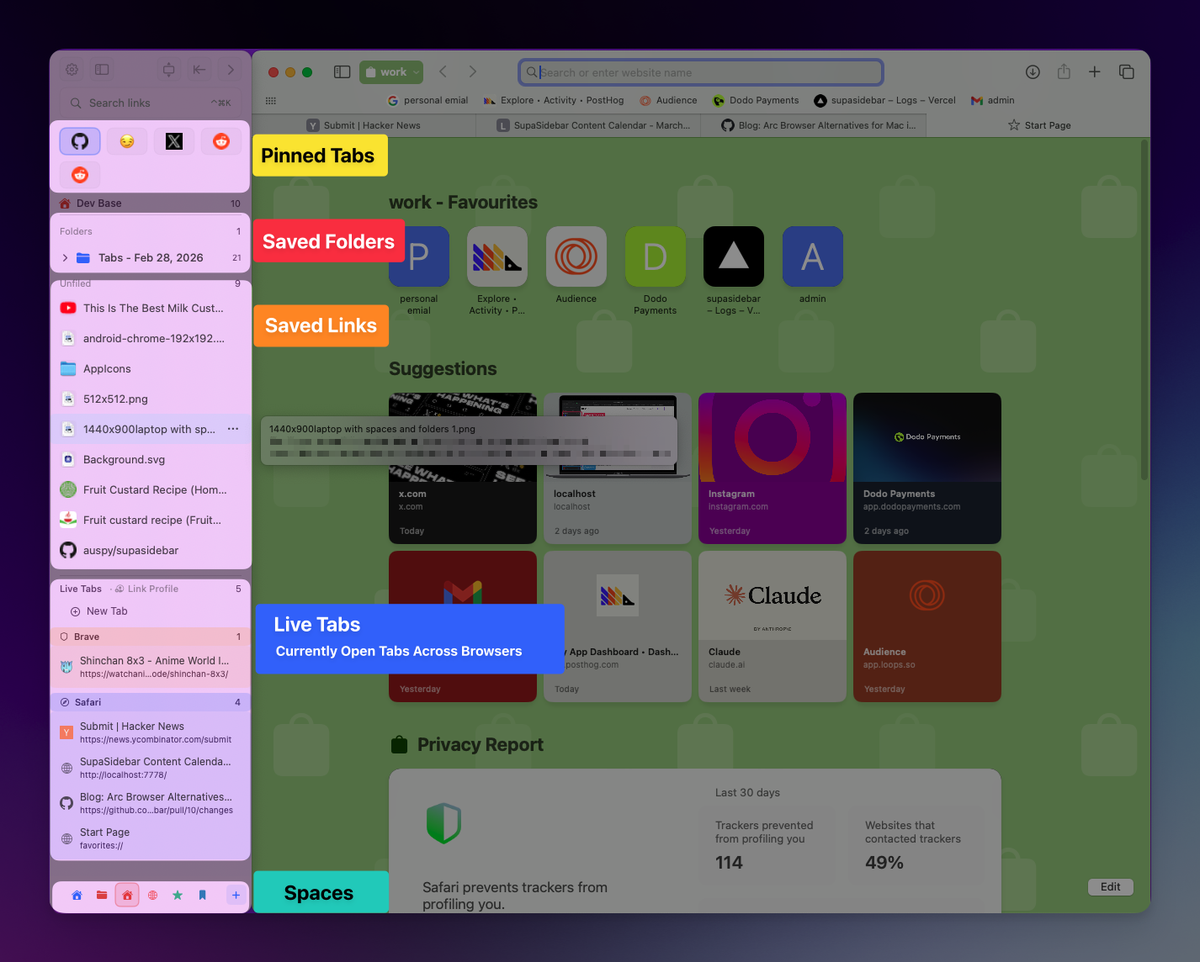
SupaSidebar is a macOS app that brings Arc's sidebar to every browser - one sidebar for tabs, bookmarks, files, and apps across Safari, Chrome, Firefox, Arc, Zen, Vivaldi, and Brave. It handles the three things Arc users miss most:
- A persistent sidebar with saved links, bookmarks, pinned tabs, folders, and Smart Folders
- Spaces for context switching, with iCloud sync and no account required
- A Command Panel (⌘⌃K) - an upgrade over Arc's Cmd+T with cross-browser search, Air Traffic Control routing to Spaces and profiles, 7 search scopes, and an Ask AI mode
If you're coming from Arc, you can import your Arc sidebar data directly. The flow is 3 clicks: Preferences → Import and Export → Arc → Import. Your Spaces, links, folders, and organization transfer in seconds.
"I just found this today and love the fact that I can have the only thing I liked about Arc straight into the comfort of my Safari - AND have it sync'd via iCloud," one user said after migrating from Arc.
What Arc Taught Us
Arc's legacy isn't the browser itself. It's the proof that people want more from their browsing experience than tabs and bookmarks. The sidebar, Spaces, keyboard-first navigation - these were genuine improvements that a dedicated user base relied on daily.
The $610 million acquisition and Dia pivot showed that building a standalone browser is brutally hard as a business. But the features Arc pioneered don't need to live inside a browser. They can live alongside any browser.
If you're still running Arc on maintenance mode, it'll keep working for a while. But if you're ready to move on without losing the sidebar workflow, SupaSidebar has a free version. It's a native Mac app built in Swift, so it's fast, integrates with macOS natively, syncs across Macs via iCloud with no account required, and works with every Mac browser you already use.
Arc showed us what browsers could be. The sidebar is the part worth keeping.
Conclusion: Is Arc Browser Dead in 2026?
Arc is not dead. It is frozen. As of May 2026, Arc still launches, still browses the web, and still receives Chromium security patches under Atlassian's ownership. What is gone is the development team, the roadmap, and any chance of new features - all of that has moved to Dia. No end-of-life date has been announced, but the practical lifespan of Arc now depends on how long Atlassian funds maintenance for a product its team is no longer building.
For most Arc users, the question "is Arc dead" is really a question about the workflow, not the engine. The sidebar, Spaces, and Cmd+T command bar are the parts that hurt to lose - and you do not need to wait for Arc to officially shut down before replacing them. If you want to keep the Arc workflow without picking a new browser, SupaSidebar imports your Arc data in 3 clicks and runs alongside Safari, Chrome, Firefox, Brave, Zen, Vivaldi, Helium, and Dia. If you want a full browser replacement that mirrors Arc's design, Zen Browser is closest. Either way, the sidebar pattern Arc proved out is not going anywhere - just the browser that introduced it.
Why we recommend SupaSidebar
SupaSidebar is a macOS app that brings Arc's sidebar to every browser - one sidebar for tabs, bookmarks, files, and apps across Safari, Chrome, Firefox, Arc, Zen, Vivaldi, and Brave. It is the closest 1-to-1 replacement for the Arc workflow that does not require switching browsers, and it imports Arc data in 3 clicks.
For a deeper feature-by-feature comparison, see our Arc Browser alternative guide, switching from Arc Browser, and how to replicate Arc features in any browser.
Frequently Asked Questions
Is Arc Browser completely dead?
No, Arc Browser is not completely shut down. It entered maintenance mode on May 27, 2025, meaning it still receives Chromium security updates and critical bug fixes. As of May 2026, Arc still works and is still downloadable. However, no new features are being developed - the team is fully focused on Dia, an AI-first browser owned by Atlassian.
Is Arc Browser dying?
Arc Browser is not dying in the sense of gradually getting worse - it is frozen in maintenance mode. The software still works as of May 2026, but receives no new features. The realistic concern is not when Arc will start failing today, but when a future Chromium or macOS update will break something the maintenance team no longer has expertise to fix. No end-of-life date has been announced.
Is Arc Browser still supported in 2026?
Yes, Arc is still supported as of May 2026, but the support is limited to Chromium engine updates, security patches, and critical bug fixes. There are no new features, no roadmap, and no active product development. The Browser Company has not announced an end-of-life date.
Is Arc Browser shutting down?
Not currently. Arc is in maintenance mode under Atlassian ownership, not in shutdown. As of May 2026, no shutdown date has been announced. However, since the team is fully on Dia, the practical lifespan of Arc depends on how long Atlassian continues to fund maintenance.
What does Arc Browser maintenance mode mean?
Maintenance mode means The Browser Company keeps Arc running but does not build new features. Specifically: Chromium engine versions are kept current, security CVEs are patched, and critical bugs are fixed. No new features, performance work, or UI changes ship. The development team that built Arc is now building Dia, an AI-first browser.
Is Arc Browser still being developed in 2026?
No, Arc is not being actively developed in 2026. It has been in maintenance mode since May 27, 2025. The Browser Company team is fully focused on Dia, an AI-first browser owned by Atlassian since October 2025. Arc receives only mechanical maintenance: Chromium updates, security patches, and critical bug fixes.
Why did Arc Browser stop development?
The Browser Company's CEO Josh Miller wrote in his May 2025 letter to Arc members that "for most people, Arc was simply too different, with too many new things to learn, for too little reward." Despite a devoted user base, the browser couldn't scale past a few million users. The team pivoted to Dia and was acquired by Atlassian for $610 million in cash, with the deal closing October 21, 2025.
What is Dia Browser?
Dia is an AI-first browser built by The Browser Company, now a subsidiary of Atlassian. It launched publicly on macOS on October 9, 2025. Dia is designed around AI assistance for knowledge workers - you chat with an AI assistant about your tabs and tasks. It does not emphasize the Arc-style sidebar workflow, so it is not a 1-to-1 Arc replacement.
What is the best alternative to Arc Browser's sidebar?
Arc alternatives split into two paths: switch to a different browser (Zen, SigmaOS, Vivaldi, Brave, or Dia) or keep your current browser and add a sidebar tool like SupaSidebar (which adds the Arc-style sidebar to 25 browsers including Safari, Chrome, Firefox, Arc, Zen, Vivaldi, Brave, Helium, and Dia). The full comparison guide covers every option with pricing and migration paths.
Can I still use Arc Browser in 2026?
Yes. Arc is still installable and still works as of May 2026. It receives Chromium security patches and critical bug fixes. Long-term support is uncertain given Atlassian's full focus on Dia, but no end-of-life date has been announced.