
By Kshetez Vinayak, founder of SupaSidebar. Last updated July 1, 2026.
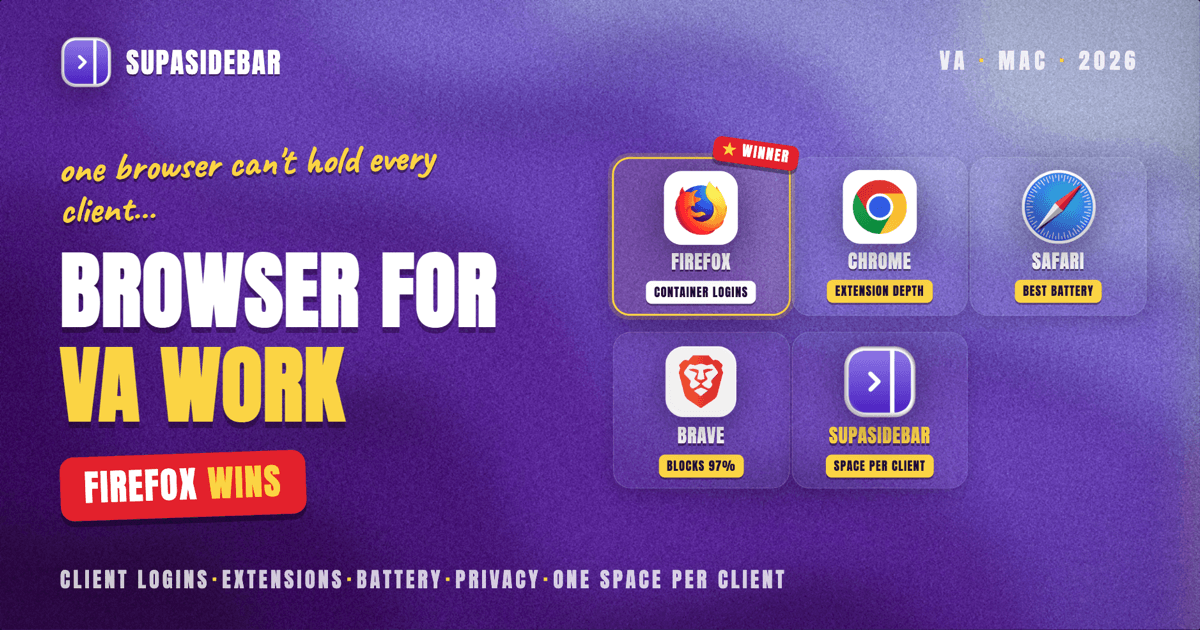
For most virtual assistants on a Mac in 2026, Firefox is the best browser for the core problem of the job: its Multi-Account Containers isolate each login at the tab level, so a VA can stay signed into five clients' Gmail, project tools, and dashboards live in one window without any account leaking into another. Chrome is the better default when the work runs on Google Workspace and browser extensions, because it has the deepest extension library and its Profiles give each client a durable, fully separated set of logins. Safari is the efficiency pick for a VA who supports one or two clients and wants the longest battery on Apple Silicon. But the browser is rarely the real bottleneck. The harder problem is keeping each client's inbox, calendar, files, and tool tabs separated and switchable across a dozen logins, and that is a workspace problem no single browser solves. SupaSidebar is the macOS sidebar that fixes it across whichever browser a VA runs.
Quick navigation:
- Comparing every Mac browser, not just the VA angle? → Best Browser for Mac in 2026
- Mainly fighting the multiple-Google-accounts problem? → How to Manage Multiple Google Accounts in a Browser on Mac
- Want the full Mac app stack for VA work? → Best Mac Apps for Virtual Assistants in 2026
- Comparing how a sidebar fixes tab chaos across browsers? You are in the right place. Keep reading.
| Browser | Best for | Multi-account separation | Extension and tool support |
|---|---|---|---|
| Firefox | Many client logins live at once | Multi-Account Containers, per-tab isolation in one window | Good, most major productivity extensions ported |
| Chrome | Google Workspace and extension-heavy clients | Profiles, durable per-client login sets | The deepest extension library, every major tool tested on it |
| Safari | Solo VAs on battery | Profiles (2022+), one window per profile | Thin, few professional-tooling extensions |
| Brave | Privacy-conscious VAs | Profiles, plus per-profile Shields | Runs the Chrome extension library on Chromium |
| SupaSidebar (layer, not a browser) | Keeping every client's tabs together across any browser | One Space per client, across all of the above at once | Inherits the browser's extensions; saves nothing about page content |
What virtual assistants actually need from a browser on Mac
The best browser for virtual assistants on Mac in 2026 is the one that handles three jobs at once: it keeps each client's logins cleanly separated so one client's email never sends from another's account, it runs the tools the work depends on, and it survives the twenty-plus tabs a single working day spreads across several clients. This post compares the major Mac browsers on exactly those three jobs. It does not rank the VA tools themselves (the project boards, schedulers, and inboxes run alongside or inside whichever browser you pick), and it is Mac-specific.
A virtual assistant's browser session looks nothing like a casual one. A single afternoon can mean one client's Gmail and Google Calendar open in two tabs, that client's project board in a third, a second client's inbox and CRM in a fourth and fifth, a scheduling link, an invoicing page, and a separately logged-in identity for every client under management. The browser has to hold all of that without mixing one client's logged-in session into another's, and without choking when the tab strip fills.
Most VA work is now browser-based, which makes the browser the workplace. Inboxes, calendars, project tools, and CRMs are web apps tied to a login, and the standard professional setup is a dedicated browser profile or container per client precisely because it keeps cookies, sessions, and login state strictly separated (Google Chrome Help, add and manage Chrome profiles). That makes browser choice a real decision, but it also exposes the limit: a browser can hold the logins, it just was not built to keep ten clients' worth of them organized.
Firefox: many client logins at once
Firefox is the best browser for a virtual assistant who needs several client sessions live at the same time. Its standout feature is Multi-Account Containers, which sandbox cookies and logins per container, so one client's logged-in Gmail or CRM session stays completely walled off from another's inside a single window (Mozilla Support, Multi-Account Containers). Where Chrome Profiles want a separate window per client, Firefox Containers let a VA run client A, client B, and client C as color-coded tabs side by side without logging anyone out.
The isolation is real but has a ceiling worth naming. Containers separate cookies and storage, not the browser fingerprint, so on platforms that aggressively detect multiple accounts from one device, containers alone are not an anti-detection setup (Sendwin, multi-account management guide 2026). For ordinary client work, where the accounts are legitimate and just need to stay unmixed, that limit rarely bites; for running many accounts on one platform at scale, it does.
The other cost is effort and, on Apple Silicon, efficiency. Firefox rewards configuration, so a VA gets the most out of containers only by investing the setup time, and its on-Mac battery life trails Safari.
Best for:
virtual assistants who run many client logins concurrently and want per-client isolation inside one window.
Chrome: the Google Workspace and extension workhorse
Chrome is the best default browser for virtual assistants whose clients live in Google Workspace and whose work leans on extensions, because Chrome has the deepest extension library of any browser. The everyday VA toolkit lives there: the scheduling helpers, screenshot and clipping tools, password managers, and time-tracking add-ons that surface on the page. For VAs who run a lot of tooling, the breadth of the Chrome Web Store is the single biggest reason the browser stays open all day.
Chrome's Profiles also separate accounts cleanly: each profile carries its own cookies, logins, extensions, and bookmarks, so a profile per client becomes a durable, self-contained identity rather than an account you have to remember to log out of (Google Chrome Help, add and manage Chrome profiles). Profiles isolate at the profile level rather than the tab level, which is why the standard advice is one window per client, and why a VA moving between five clients ends up switching whole windows (MakeUseOf, the Firefox productivity feature Chrome lacks).
The catch is resource use and switching speed. Chrome is known to eat RAM once a working day fans out across many tabs and windows, and switching Chrome Profiles means switching whole windows, so a VA juggling several clients in an afternoon is opening, closing, and hunting through separate windows all day.
Best for:
virtual assistants whose clients run on Google Workspace and who want durable, strictly separated per-client profiles.
Safari: the efficient solo default
Safari is the best browser for a solo virtual assistant who supports one or two clients and wants the machine to stay cool and the battery to last. It is the most battery-efficient option on Apple Silicon, deeply integrated with macOS, and runs Intelligent Tracking Prevention with no setup, which quietly limits the cross-site tracking picked up while checking links and landing pages for clients (Surfshark, the best browsers for privacy in 2026).
The honest limits are extensions and scale. Safari's extension catalog is thin on professional tooling compared with Chrome, so a VA who leans on a particular scheduler helper or time-tracking bar will hit gaps. Safari supports Profiles for splitting "Work" from "Personal," but it was not built to hold a dozen distinct client contexts at once, and that ceiling arrives fast for anyone managing a full client roster.
Best for:
solo VAs with one or two clients who value battery and simplicity over extension depth.
Brave: the privacy-conscious option
Brave is the best browser for virtual assistants who want strong tracker and fingerprint protection while keeping the tools they already use. Brave Shields block trackers, cross-site cookies, and fingerprinting by default, and Brave reports blocking roughly 97% of trackers out of the box, compared with about 85% for Firefox's Enhanced Tracking Protection (Brave Shields). For a VA handling sensitive client accounts and logins, aggressive default blocking is a real advantage.
Brave is built on Chromium, so it runs the same Chrome extension library VAs already rely on and the web apps the tools are tested against, while randomizing the browser fingerprint between sessions. That makes it the rare privacy-first browser that does not cost the VA their toolkit.
The trade-off is that Brave's default blocking can occasionally interfere with a script-heavy client dashboard or a login flow, so a VA who hits a broken page should be ready to lower Shields per-site.
Best for:
privacy-conscious VAs who want maximum tracker protection while keeping the Chrome extension library.
The real problem: one browser cannot hold every client
Here is the part the browser comparison misses. Pick the browser with the cleanest containers and the best profiles, and a virtual assistant managing ten active clients still ends up with thirty tabs, a separate login for each client, and no fast way to jump from one client's inbox to another client's project board. Containers and profiles help, but switching profiles means switching whole windows, and the bookmarks bar fills with client folders nobody opens. The friction is not the browser, it is the lack of a workspace layer on top of it.
SupaSidebar is the macOS sidebar that solves this across any browser. It is a native Mac app, not a browser and not an extension, that adds a persistent sidebar beside whatever browser a VA runs. The relevant feature for client work is Spaces: one Space per client, each holding that client's pinned inbox and dashboards, its saved tool and document links, and the tabs that belong to it. Switching clients becomes switching a Space, not hunting through a wall of identical-looking inbox tabs.
Because SupaSidebar's Live Tabs can show open tabs from supported browsers in one list, a VA running Firefox containers for separated client logins and Safari for a quick battery-friendly check sees both in a single sidebar instead of alt-tabbing between windows. The Command Panel (⌘⌃K) then searches saved links, recent pages, and live tabs across every browser at once, so finding the right client's scheduler is one keystroke rather than a memory test. SupaSidebar supports every major Mac browser, 32+ in total including Chrome, Firefox, Safari, Brave, Edge, Arc, and Vivaldi, so the VA's browser choice and its organization layer stay independent.
A concrete setup for a VA managing several clients might look like this:
| Space | What lives in it |
|---|---|
| Acme Co (client) | that client's mail.google.com inbox, its calendar.google.com, the project board on asana.com, the shared drive folder |
| Bright LLC (client) | Bright's inbox, its CRM login, the scheduling page on calendly.com, the invoicing tool |
| My Business | the VA's own inbox, harvest.com or the time tracker, the proposals folder, the contracts |
Switching from "Acme Co" to "Bright LLC" swaps the whole set of tabs and pinned logins in one click, so the VA is never replying from one client's inbox while thinking it belongs to another. It organizes the work, not the content inside it: SupaSidebar is not an inbox or a project tool and does not send mail, track time, or store client data, it groups the tabs and links around each client. It also saves nothing about the pages themselves, so it inherits whatever privacy and login posture the underlying browser provides.
As one r/macapps user described why it fits a multi-browser workflow, SupaSidebar "is built for exactly this use case: people who use multiple browsers and need a way to consolidate browser context without paying a constant productivity tax every time they switch" (amerpie, r/macapps). That per-client separation is the most-requested SupaSidebar workflow across its users.
Why SupaSidebar fits a virtual assistant workflow
SupaSidebar is a macOS app that brings Arc's sidebar to every browser - one sidebar for tabs, bookmarks, files, and apps across 32+ browsers including Chrome, Firefox, Safari, Edge, Brave, Arc, and Vivaldi. For a virtual assistant, that means the login-separation decision (Firefox containers for many concurrent sessions, Chrome profiles for durable per-client identities, Safari for battery, Brave for privacy) and the organization decision (one Space per client) stop competing. Pick the browser that meets the work's login and tooling needs, then let SupaSidebar keep each client's context together on top of it. It runs on macOS 14 and later, syncs across Macs through iCloud with no account required, and a free version is available to try the per-client Space workflow before committing.
The bottom line
For most virtual assistants on a Mac in 2026, run Firefox as the daily browser when the core problem is juggling many client logins at once, because Multi-Account Containers isolate each session inside a single window. Choose Chrome when the clients live in Google Workspace and the work leans on the deepest extension library and durable per-client Profiles. Keep Safari for solo VAs supporting one or two clients who want the best battery on Apple Silicon. Reach for Brave when tracker protection across sensitive client accounts is the priority. Whichever browser wins, the client-juggling problem remains, and that is the gap SupaSidebar closes: one Space per client across every browser at once. VAs evaluating the full picture can start with Best Browser for Mac in 2026 for the general ranking, then Try SupaSidebar (free tier) to test the per-client workflow.
Written by Kshetez Vinayak, founder of SupaSidebar.
FAQ
What is the best browser for virtual assistants on a Mac in 2026?
For most virtual assistants, Firefox is the best browser when the core problem is running many client logins at once, because Multi-Account Containers isolate each session inside one window. Chrome is the better default when the clients run on Google Workspace and the work depends on the full extension library and durable per-client Profiles, and Safari suits a solo VA who wants the longest battery on Apple Silicon. The browser choice matters less than having a workspace layer that keeps each client separated, which SupaSidebar provides across any of them.
Which browser is best for managing multiple client accounts without mixing them up?
Firefox is strong here because Multi-Account Containers sandbox cookies and logins per container, so several client accounts can stay logged in side by side in one window without colliding. Chrome Profiles also separate accounts cleanly but isolate at the profile level, meaning one window per client. For VAs who switch between many clients in a day, a sidebar app like SupaSidebar adds one Space per client on top of whichever browser they use, so the tabs and pinned logins for each client travel together.
Do virtual assistants need a separate browser profile for each client?
A separate profile or container per client is the standard professional setup, because it keeps each client's cookies, sessions, and logins strictly separated and prevents accidentally acting in the wrong account. Chrome Profiles and Firefox Multi-Account Containers both do this; Firefox keeps the containers in one window, while Chrome uses a window per profile. The downside is that switching between many clients gets slow, which is why a sidebar app like SupaSidebar adds a per-client Space layer to make switching one click.
How can a virtual assistant keep client tabs and logins organized on a Mac?
Most browsers offer Profiles to separate accounts, and Firefox adds Multi-Account Containers to sandbox logins inside one window. For VAs moving between many clients in a day, switching whole profiles is slow, so a sidebar app like SupaSidebar uses one Space per client to keep each client's inbox, calendar, files, and tool tabs grouped and switchable across any browser without changing windows.
Is SupaSidebar a browser or a VA tool?
SupaSidebar is neither a browser nor a VA tool. It is a native macOS app that adds a persistent sidebar beside whatever browser a virtual assistant already uses, so it complements Chrome, Firefox, Safari, or Brave rather than replacing them. It organizes tabs and links around each client and does not send mail, track time, or store client data, inheriting the underlying browser's privacy and login behavior.