
By Kshetez Vinayak, founder of SupaSidebar. Last updated 2026-06-21.
TL;DR
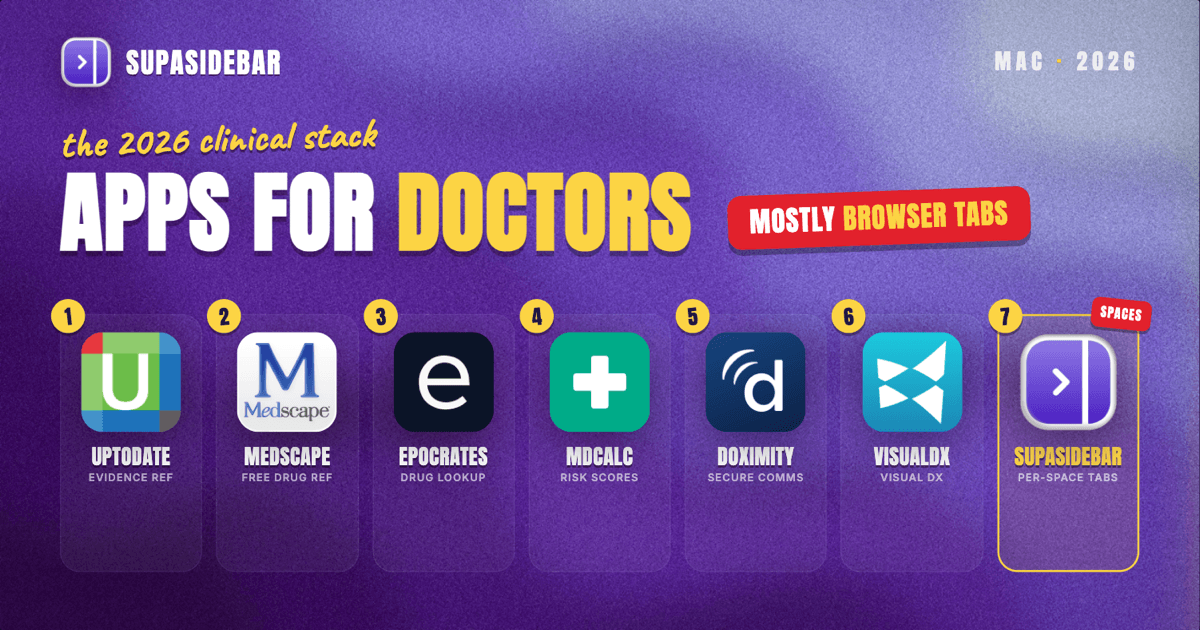
The best Mac apps for doctors in 2026 are organized by the job in front of you, not by brand: UpToDate for evidence-based answers to a real clinical question, Medscape as the free drug-and-disease reference with a built-in interaction checker, Epocrates for fast everyday drug lookups, MDCalc for the risk scores and dosing calculations that should never be done by hand, Doximity for HIPAA-compliant messaging, calls, fax, and telehealth, VisualDx for image-based diagnosis support, and SupaSidebar to keep EHR, reference, research, and telehealth tabs from collapsing into one pile across browsers. Most clinical work happens in a browser tab or a phone app rather than a native Mac window, so the practical Mac question for a physician is what to run between patients and during research: a reference that is current, a calculator that is always right, a secure way to reach patients and colleagues, and a way to keep a clinical context separate from a research context. Several of these are genuinely free, Medscape, MDCalc, and Doximity cost nothing for individual clinicians, Epocrates has a strong free tier, and SupaSidebar has a free version, while UpToDate is the paid reference most physicians reach through an institutional login.
Quick navigation:
- Doing literature work or a study? → Best Mac Apps for Researchers 2026
- Building a focused work setup? → Mac Workspace Setup for Deep Work 2026
- Drowning in open tabs specifically? → Too Many Tabs Open on Mac
- Setting up a Mac for clinical work and research? You are in the right place. Keep reading.
| App | Job in the stack | Pricing model | Best for |
|---|---|---|---|
| UpToDate | Evidence-based clinical reference | Individual ~$559/yr; usually institutional | Finding the actual answer to a clinical question |
| Medscape | Free drug and disease reference | Free, ad-supported | A no-paywall drug reference plus free CME |
| Epocrates | Fast drug and interaction lookup | Free tier; Plus ~$174.99/yr | Quick everyday drug checks and pill ID |
| MDCalc | Clinical calculators and risk scores | Free | Risk scores, dosing, and formulas done right |
| Doximity | Secure messaging, calls, fax, telehealth | Free for individual clinicians | Reaching patients and colleagues HIPAA-compliantly |
| VisualDx | Image-based diagnosis support | Paid, usually institutional | Working through a visual differential |
| SupaSidebar | Clinical vs research tab separation | Free version available | Keeping EHR, reference, and research tabs apart across browsers |
A doctor's Mac is mostly a window onto web tools, the EHR, a clinical reference, a research database, a telehealth portal, none of which is "an app you install and own." So this list mixes the few native or semi-native tools that matter with the web-based references doctors live in, and it ends with the one thing that keeps those tabs from turning into chaos. Pricing for the paid tools is in US dollars and was checked in June 2026; reference and EHR pricing in particular shifts with institutional contracts, so treat the individual figures as starting points.
UpToDate: when a clinical question needs a sourced answer
For looking up the evidence behind a clinical decision, UpToDate is the reference most physicians reach for first, with graded recommendations and full topic reviews across more than 12,000 topics, maintained by a large physician-editor network. The trade-off is cost: an individual physician subscription runs around $559 per year as of 2026, which is why most clinicians access it through a hospital or university institutional license rather than paying out of pocket (SelectHub, UpToDate pricing and reviews 2026). It opens in a browser, so in practice it lives as a tab that needs to stay reachable through a long clinic day, not as a Mac app sitting in the Dock.
The reason UpToDate keeps its place despite the price is the depth and the grading. A free reference can tell you a drug's dose; UpToDate tells you the strength of the evidence behind a recommendation and walks through the reasoning, which is the part that matters when two reasonable options exist. For a resident or a physician without institutional access, the annual cost is the real barrier, and the free references below cover most day-to-day lookups.
Medscape: a free drug and disease reference
Medscape is the free clinical reference doctors keep on the home screen, and unlike most "free tier" tools it puts no paywall in front of the drug data. Search a generic or brand name and the entry returns dosing, mechanism, contraindications, adverse effects, and pregnancy category in one place; a built-in interaction checker accepts multiple medications and flags severity tiers (Medscape point-of-care reference). WebMD funds it through pharma advertising, so ads are visible, but they never gate the reference content.
Beyond drugs, Medscape carries disease and condition references, 450+ medical calculators grouped by specialty, a medical news feed, and free CME/CE credits with an activity tracker, including ABIM MOC points for eligible clinicians (App Comrade, Medscape review). For a physician who wants one free, broad reference plus a way to bank continuing-education credit without a separate subscription, Medscape covers more ground than any single paid tool at the everyday-lookup level. The 2026 version cleaned up CME tracking, the news feed, and the calculator library.
Epocrates: fast everyday drug checks and pill identification
For quick drug lookups and interaction screening during a clinic day, Epocrates has a free tier that genuinely covers the basics: drug monographs, a multi-drug interaction checker, and pill identification, used by over a million healthcare professionals (GetApp, Epocrates pricing 2026). The paid Plus tier, around $174.99 per year, adds disease content, lab references, clinical guidelines, and calculators on top.
Epocrates and Medscape overlap heavily on free drug data, so most physicians settle on one as the muscle-memory default rather than running both. Epocrates is often the faster pure-drug lookup and pill ID; Medscape is broader and bundles CME. The honest scope limit on both: they are drug and reference tools, not decision-support engines that reason through a case the way UpToDate does.
MDCalc: risk scores, dosing, and formulas done right
For the calculations that should never be done from memory, MDCalc is the definitive clinical calculator, free to download, with 700+ evidence-based decision tools, risk scores, dosing calculators, formulas, and classifications, each built by board-certified clinicians and shown alongside the original research and practical pearls (MDCalc on the App Store). Eligible users can even earn AMA PRA Category 1 CME credit by reviewing the evidence behind many of the calculators.
What makes MDCalc worth a dedicated spot rather than leaning on the calculators inside Medscape is the sourcing: every score links the study it came from and the creator's notes on when to use it and when not to. That turns a calculator from a black box into something defensible at the bedside. It runs on iPhone and in the browser, so on a Mac it is another tab worth keeping pinned.
Doximity: reaching patients and colleagues without breaking HIPAA
For secure communication, Doximity is the largest network of US clinicians and is free for individual clinicians, bundling HIPAA-compliant messaging, a dialer that connects to patients by voice and video while masking your personal number, cloud-based DocFax faxing with real-time alerts, a telehealth tool, and a clinician directory (Doximity mobile app; Doximity DocFax). Its 2026 build also includes an AI Scribe that drafts clinical notes from a visit, and Doximity reports the platform is used by over 85% of US physicians (Emitrr, Doximity pricing 2026).
The practical win is consolidation: secure messaging, a privacy-preserving call line, fax, and telehealth in one free tool, instead of stitching together a separate fax service, a separate video platform, and a personal cell number. Doximity runs as an app and in the browser, so on a Mac the telehealth and fax pieces typically live in a browser tab alongside the EHR.
VisualDx: working through a visual differential
For dermatology, rashes, and any presentation where seeing variations matters, VisualDx is the image-based diagnosis tool physicians reach for, a library of over 32,000 medical images covering common and rare presentations, reviewed by medical experts to keep the content accurate (Doximity, top medical AI apps for doctors 2026). It is a paid tool, and like UpToDate it is most often reached through an institutional license rather than an individual subscription, so confirm access through your hospital before paying out of pocket.
VisualDx earns its place for primary care, emergency medicine, and dermatology specifically, where a labeled image library shortens the path from an uncertain visual to a working differential. For specialties that rarely hit a visual diagnosis, it is reasonable to skip it and lean on UpToDate plus Medscape.
SupaSidebar: keeping clinical and research contexts in separate Spaces
SupaSidebar is a Mac sidebar app that keeps a physician's separate contexts, EHR and clinical reference in one, literature search and a study in another, telehealth and admin in a third, organized as Spaces instead of one undifferentiated wall of browser tabs. The specific problem it answers is the one most clinical tools create: UpToDate, Medscape, the EHR, a journal database, and a telehealth portal are all browser tabs, and by mid-afternoon they pile into a strip of favicons where finding the right one takes longer than the lookup itself. Past 20 tabs, the titles shrink to icons you cannot tell apart.
That tab problem is what Arc browser solved with a vertical sidebar and Spaces before The Browser Company put Arc into maintenance mode on May 27, 2025 (The Browser Company, "A Letter About Arc"). Since then the other browsers have shipped partial versions, Chrome and Edge have vertical tabs as a flat list with no spaces, Firefox added vertical tabs in version 136 without workspaces, and Safari does the least. None of them carry a workspace model across every browser at once, which matters for a doctor who keeps the EHR in one browser and research logins in another.
SupaSidebar takes a different approach: it is a standalone macOS app, not a browser or an extension, that adds a persistent sidebar working across every major Mac browser through a single Command Panel and per-Space organization. A physician can keep one Space for clinical reference and EHR tabs and a separate Space for literature and research, switch between them with a shortcut, and use Live Tabs to see and jump to open tabs from every browser at once. It is honest about its scope: it organizes the tabs around the work, it does not query patient data, store records, or replace the EHR, and it requires macOS 14 or later. There is a free version. More than 3,000 Mac users have tried SupaSidebar, and the cross-browser separation is the reason it shows up in a clinical stack where the EHR and research portals deliberately live in different browsers.
Which doctor Mac setup should you pick?
If you have institutional access to UpToDate:
make it the default for clinical questions, add Medscape and MDCalc free for fast drug checks and calculations, and Doximity free for secure messaging. That covers most of a clinic day at no personal cost beyond what the hospital already provides.
If you are a resident or have no institutional UpToDate access:
lean on Medscape (free, no paywall, plus free CME) as the broad reference, Epocrates free for drug lookups, and MDCalc free for calculations. Add UpToDate only if the depth is worth the ~$559/yr out of pocket.
If you do telehealth or a lot of patient and colleague messaging:
put Doximity at the center for the HIPAA-compliant dialer, fax, and telehealth in one free tool, with Medscape and MDCalc alongside for reference.
If you split clinical work and research across more than one browser:
add SupaSidebar so the EHR and reference tabs stay in one Space and the literature and study tabs in another, instead of one tab pile across browsers.
If you work in primary care, emergency medicine, or dermatology:
add VisualDx (through your institution) for image-based diagnosis on top of the reference stack.
Conclusion
The best Mac apps for doctors in 2026 are a reference layer plus a communication layer plus a way to keep them organized: UpToDate (or free Medscape without institutional access) for evidence-based answers, Epocrates for fast drug checks, MDCalc for calculations, Doximity for secure messaging and telehealth, and VisualDx where visual diagnosis matters. Most of this work happens in browser tabs rather than native apps, which is the quiet productivity tax of clinical software. Physicians with institutional access should build around UpToDate; those without should build around free Medscape, Epocrates, MDCalc, and Doximity, which together cover nearly every everyday lookup at no cost. Doctors who run clinical work and research across more than one browser will get the most from adding SupaSidebar (free version) to keep each context in its own Space instead of one merged tab pile. For the literature and research side of the work, the best Mac apps for researchers goes deeper on reference managers and writing tools.
Why we recommend SupaSidebar
SupaSidebar is a macOS app that brings Arc's sidebar to every browser - one sidebar for tabs, bookmarks, files, and apps across 33 browsers including Safari, Chrome, Firefox, Edge, Arc, Brave, Vivaldi, Dia, and Comet. For a physician, the value is context separation: one Space holds the EHR and clinical-reference tabs, another holds literature search and a research project, and a shortcut flips between them without hunting through a single overloaded tab bar. Live Tabs shows open tabs from every browser at once, so a reference opened in Safari and a portal opened in Chrome both surface in the same sidebar. It is not an EHR and does not touch patient data; it organizes the browser tabs around the clinical and research work. There is a free version, and it requires macOS 14 or later.
FAQ
What are the best apps for doctors on a Mac in 2026?
The core stack is UpToDate or free Medscape for clinical reference, Epocrates for drug lookups, MDCalc for clinical calculators, Doximity for secure messaging and telehealth, and VisualDx for image-based diagnosis. SupaSidebar is useful on top to keep the EHR, reference, and research tabs organized across browsers. Most of these run in a browser or as a phone app rather than as a native Mac window.
Is UpToDate worth the cost for an individual physician?
UpToDate runs around $559 per year for an individual subscription in 2026, which is why most physicians access it through a hospital or university institutional license instead. The depth and graded evidence are the draw; for clinicians without institutional access, free Medscape covers most everyday lookups, and UpToDate is worth paying for only if the deeper reasoning is needed regularly.
What is the best free app for doctors?
Medscape is the strongest free option, with a no-paywall drug and disease reference, a multi-drug interaction checker, 450+ calculators, and free CME credit. MDCalc is free for clinical calculators and risk scores, and Doximity is free for individual clinicians for HIPAA-compliant messaging, calls, fax, and telehealth.
Can a Mac app keep my clinical and research tabs separated?
Yes. SupaSidebar organizes tabs into Spaces, so EHR and clinical-reference tabs can sit in one Space and literature search and research in another, even when they are open in different browsers. It is a standalone macOS app, not a browser extension, and it has a free version. It organizes the tabs around the work; it does not store or query patient data.
Do these medical apps work natively on macOS?
Some do and some do not. UpToDate, Medscape, and Doximity are reachable in a browser and as iPhone or iPad apps; MDCalc runs on iPhone and in the browser; VisualDx is typically browser- and institution-based. On a Mac, most of them live as browser tabs, which is why a tab-organization tool like SupaSidebar fits into the stack.
Is Doximity free for physicians?
Yes. The basic Doximity plan is free for individual clinicians and includes secure messaging, a privacy-preserving dialer for voice and video, HIPAA-compliant DocFax faxing, a telehealth tool, and a clinician directory. Doximity reports it is used by over 85% of US physicians.
By Kshetez Vinayak, founder of SupaSidebar. Last updated 2026-06-21.