
By Kshetez Vinayak, founder of SupaSidebar. Last updated 2026-06-29.
TL;DR
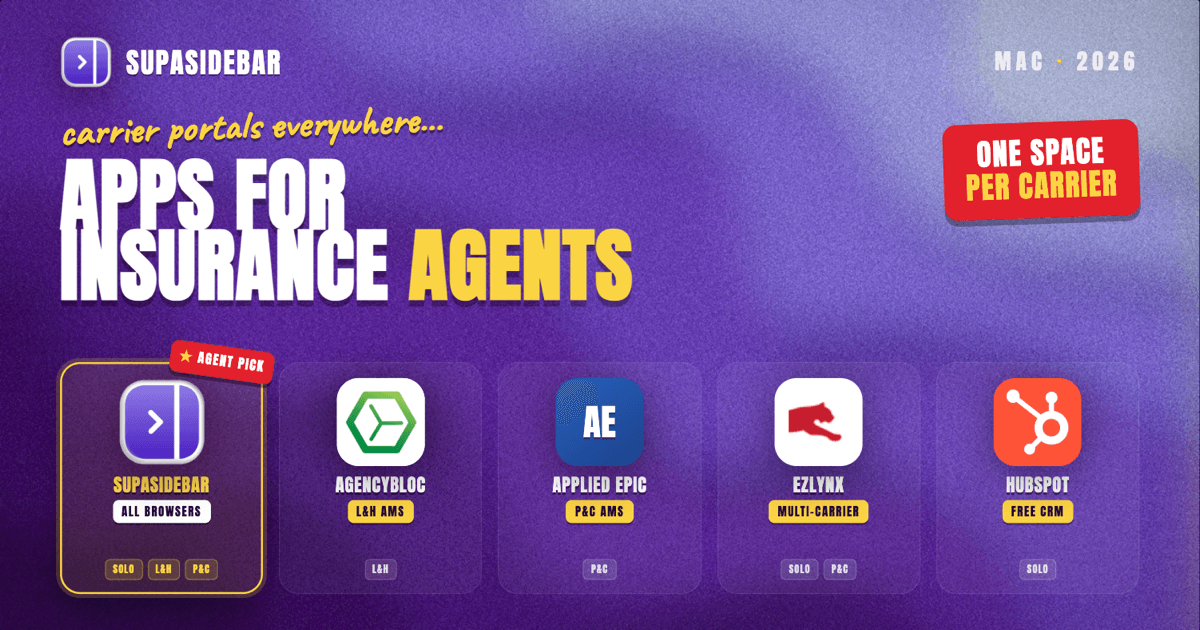
The best Mac apps for insurance agents in 2026 are a focused stack built around the quote-to-bind-to-service cycle: SupaSidebar to keep each carrier and client's tabs separated across browsers, an agency management system (AgencyBloc AMS+ for life and health, Applied Epic for property and casualty) to run policies and clients, EZLynx as the comparative rater for fast multi-carrier quotes, HubSpot CRM for lead and pipeline tracking at smaller agencies, DocuSign for signed applications and policy documents, and Apple Calendar plus Notes for the day-to-day. The job that ties them together is tab chaos across many carriers at once: an agent keeps several carrier portals, a quoting engine, the agency system, and a client's email open at the same time, often across two or three browsers, and the single biggest daily friction is finding the right portal. The category-by-category picks, the honest limits, and the comparison table are below.
Quick navigation:
- Selling financial plans rather than policies? → Best Mac Apps for Financial Advisors 2026 (coming soon)
- Running outbound sales across many accounts? → Best Mac Apps for Sales Reps 2026
- Drowning in carrier portal and quoting tabs? → Too Many Tabs Open on Mac
- Insurance agent building a Mac app stack? You are in the right place. Keep reading.
At a glance: the insurance agent Mac stack
| App | Category | Cost | Best for |
|---|---|---|---|
| SupaSidebar | Tab and workspace organization | Free version available | Keeping each carrier or client's tabs separated across every browser |
| AgencyBloc AMS+ | Agency management (life and health) | Grow from $109/user/mo | Life, health, and senior agencies with commission tracking |
| Applied Epic | Agency management (property and casualty) | Custom pricing | Mid-to-large P&C agencies needing carrier connectivity |
| EZLynx | Comparative rating and quoting | Custom pricing | Personal-lines agents quoting many carriers at once |
| HubSpot CRM | Lead and pipeline tracking | Free; Starter from $9/seat/mo | Smaller agencies wanting a free CRM to start |
| DocuSign | E-signature | Personal $10/mo; Standard $25/mo annual | Getting applications and policy documents signed |
| Apple Calendar + Notes | Scheduling and quick capture | Free, built in | Renewals, appointments, and fast notes from a call |
Why an agent's real problem is portal sprawl, not a missing app
Most "best apps for insurance agents" lists hand you twenty tools and stop there. The working truth is narrower. An agent's stack is an agency management system, a comparative rater, a CRM, an e-signature tool, and the carrier portals themselves, and the rest is noise. The harder problem is not which apps to install. It is that nearly all of them live in the browser, open at the same time, across many carriers and clients at once.
A typical independent agent has a carrier portal for the auto quote in one tab, a second carrier's portal for the home quote in another, the comparative rater in a third, the agency management system in a fourth, and the client's email thread in a fifth, repeated for every prospect being quoted and every policyholder being serviced. By midday there are forty tabs spread across two browsers because one carrier portal only behaves in Chrome and another insists on Safari, and there is no way to tell which window belongs to which client. That is the friction this stack is built to remove, and it is why the organization layer comes first.
SupaSidebar: keeping each carrier and client separated across browsers
SupaSidebar is the workspace layer for an agent juggling many carriers and clients at once: one Space per carrier or per client keeps that account's portal logins, quotes, and policy documents together and out of the way of every other one. It is a macOS app that adds a floating sidebar to any browser, so the separation holds whether a carrier portal opened in Chrome, the agency system runs best in Safari, or a client's link opened somewhere else.
The reason this matters for insurance specifically is the multi-carrier, multi-login reality. Agents rarely standardize on one browser, because carrier portals each behave differently and some force a particular browser to render correctly. SupaSidebar's Live Tabs section shows the open tabs from every browser in one list, grouped and clickable, across 33 browsers in total including Safari, Chrome, Firefox, Edge, Brave, and Arc. Air Traffic Control rules can route a saved carrier link to the right Space automatically, and a Space can be linked to a separate browser profile so a carrier login that needs its own session stays in its own context. The Command Panel, opened with a keyboard shortcut, searches every saved page, recent page, and live tab in under a second, so a client's declarations page is one search away instead of buried in a window somewhere.
The honest scope: SupaSidebar organizes the tabs around the work, it does not run the policies. It is not an agency management system and does not store client records, rate a risk, or track commissions, that is what AgencyBloc, Applied Epic, and EZLynx are for. Its search covers titles and URLs, not the contents inside a policy PDF. It is macOS 14 or later, and a free version is available.
Best for:
any agent running more than two or three carriers across more than one browser, which is most of them.
AgencyBloc AMS+: agency management for life and health
AgencyBloc AMS+ is the agency management system built for life, health, and senior-market agencies that need to manage clients, policies, commissions, and compliance from one place. It pairs a CRM with automation, reporting, and commission tracking, which is the piece general CRMs miss, and it is aimed at agencies with several agents and real commission-reconciliation work.
Pricing starts at $109 per user per month for the AMS+ Grow tier, with Accelerate and Elevate tiers quoted custom for premium features and no setup fee. Add-ons cover commissions, group quoting, and email campaigns, so a senior-market agency drowning in commission splits and hierarchies can consolidate that work rather than running it in spreadsheets.
The trade-off is that AgencyBloc is specialized for life and health. A property-and-casualty agency is a better fit for a P&C-focused system like Applied Epic, and a very small shop may not need the commission machinery at all.
Best for:
life, health, and senior-market agencies that need commission tracking alongside client and policy management.
Applied Epic: agency management for property and casualty
Applied Epic is the agency management system for property-and-casualty agencies that need to manage the full customer lifecycle across every line of business and staff member. It is best suited to mid-market and enterprise agencies that need deep carrier connectivity and policy data management, and it is one of the most widely used P&C agency systems in the market.
Applied Epic's strength is breadth: policy data management, compliance reporting, and carrier integration for agencies running many carriers and complex books. Pricing is quoted per agency rather than published, which is normal for systems at this tier and a sign it is built for larger operations rather than a solo producer.
The honest note: Applied Epic is heavier than a small agency needs. A two-person personal-lines shop will get more value from a comparative rater plus a lighter CRM than from a full enterprise AMS.
Best for:
mid-to-large P&C agencies that need carrier connectivity and lifecycle management across many lines.
EZLynx: comparative rating and fast multi-carrier quotes
EZLynx is the comparative rater for personal-lines agents who need to quote many carriers at once from a single entry of client data. Instead of logging into each carrier portal and re-keying the same information, an agent enters the risk once and EZLynx returns side-by-side quotes, which is the difference between quoting one carrier and quoting a dozen in the same minutes.
EZLynx connects to over 330 carriers across 48 states through its rating engine, and it is positioned as a leading comparative rater for personal lines specifically. Pricing is quoted per agency. For an auto-and-home shop, the rater is often the single highest-leverage tool in the stack because it collapses the most repetitive part of the day.
The trade-off is that EZLynx is strongest on personal lines; commercial and specialty quoting still leans on individual carrier portals. It rates and quotes, but the bind, the service, and the commission work still live in the agency management system.
Best for:
personal-lines agents who quote auto and home across many carriers and want one entry, many quotes.
HubSpot CRM: a free CRM to start with
HubSpot CRM is the general-purpose CRM for a smaller agency or independent agent who wants lead and pipeline tracking without paying for a specialized system on day one. It tracks contacts, deals, and email in a clean interface, and the core CRM is free for unlimited contacts, with paid Starter seats from $9 per month when more automation is needed.
For an agent who is not yet ready for AgencyBloc or Applied Epic, HubSpot covers the lead-to-client pipeline, follow-up reminders, and email tracking that a spreadsheet cannot. It runs entirely in the browser, so it works the same on a Mac as anywhere else.
The honest note: HubSpot is not insurance-specific. It does not rate risks, track commissions, or store policy data, so an agency that grows into real policy and commission management eventually moves the book into a dedicated AMS and keeps HubSpot, or replaces it.
Best for:
smaller agencies and independent agents who want a free, capable CRM before committing to a specialized system.
DocuSign: getting applications and documents signed
DocuSign is the e-signature tool for getting applications, policy change requests, and disclosures signed without printing, scanning, or chasing a client by mail. An agent sends a document, the client signs from any device, and the completed file comes back with an audit trail, which turns a multi-day paper loop into minutes.
DocuSign's Personal plan is $10 per user per month (or $15 month-to-month) with five envelopes a month, and the Standard plan is $25 per user per month billed annually with a larger envelope allowance for agents sending many documents. For a solo agent the Personal plan often covers the volume; a busy office moves to Standard.
The honest scope: DocuSign signs documents, it does not generate them or store the client relationship. It pairs with the agency system that produces the application and the CRM that holds the client.
Best for:
any agent who needs signed applications and policy documents returned fast, without paper.
Apple Calendar and Notes: scheduling and quick capture
The two apps already on the Mac handle more of an agent's day than most paid tools. Apple Calendar manages appointments, renewal dates, and follow-up windows, and syncs to the iPhone for the half of the job that happens away from the desk. Apple Notes captures a client's coverage question or a carrier's underwriting note in the seconds before it is forgotten, and the notes sync to every Apple device through iCloud. Neither costs anything, and for a small agency they often cover scheduling and quick capture completely.
Best for:
every agent, as the free baseline before paying for anything heavier.
Which insurance agent setup should you pick?
- If you are a new or solo agent: HubSpot's free CRM for the pipeline, a comparative rater if you write personal lines, DocuSign Personal for signatures, and SupaSidebar to keep each carrier's portal in its own Space. Skip the enterprise AMS until volume justifies it.
- If you run a life or health agency: AgencyBloc AMS+ for client, policy, and commission management, DocuSign for applications, and SupaSidebar to separate each carrier portal and client file across browsers.
- If you run a property and casualty agency: Applied Epic for lifecycle and carrier connectivity, EZLynx for fast multi-carrier quoting, and SupaSidebar to keep each quote's carrier tabs together.
- If your single biggest daily pain is finding the right carrier portal: start with SupaSidebar regardless of the rest of the stack. It is the layer that organizes everything else.
Conclusion
The best Mac apps for insurance agents in 2026 are a focused stack, not a sprawling list: SupaSidebar for cross-browser organization, an agency management system (AgencyBloc for life and health, Applied Epic for property and casualty), EZLynx for comparative rating, HubSpot CRM for smaller-agency pipelines, DocuSign for signatures, and Apple Calendar plus Notes for the day-to-day. The tools an agent picks matter less than the fact that all of them run in the browser at once, across many carriers and clients at the same time.
New and solo agents can run lean with a free CRM, a rater, and DocuSign Personal. Life and health agencies center the stack on AgencyBloc; property and casualty agencies center it on Applied Epic plus EZLynx. Every agent, regardless of line of business, hits the same wall by midday: too many carrier portals across too many browsers and no way to tell which belongs to which client. That is the problem the organization layer solves first.
Try SupaSidebar (free tier) to keep each carrier and client's tabs in their own Space across every browser.
Why we recommend SupaSidebar
SupaSidebar is a macOS app that brings Arc's sidebar to every browser - one sidebar for tabs, bookmarks, files, and apps across 33 browsers including Safari, Chrome, Firefox, Edge, Brave, Arc, Vivaldi, Dia, and Comet. For an insurance agent, that means one Space per carrier or client, Live Tabs that show every open tab from every browser in one list, a Space that can be linked to a separate browser profile so a carrier login keeps its own session, and a Command Panel that finds any saved page or live tab in under a second. It does not replace an agency management system or a comparative rater, it organizes the tabs around the work so the right portal is always one search away. More than 3,000 Mac users have tried SupaSidebar, and a free version is available on macOS 14 and later.
FAQ
What is the best agency management system for an insurance agent on a Mac?
It depends on the line of business. AgencyBloc AMS+ is built for life, health, and senior-market agencies and adds commission tracking, while Applied Epic is built for mid-to-large property-and-casualty agencies needing deep carrier connectivity. Both run in the browser, so they work on a Mac.
What is a comparative rater and do insurance agents need one?
A comparative rater lets an agent enter a client's information once and get side-by-side quotes from many carriers instead of logging into each portal separately. EZLynx connects to over 330 carriers across 48 states and is a leading rater for personal lines, so auto-and-home agents benefit most. Commercial and specialty lines still rely more on individual carrier portals.
Is there a free CRM for insurance agents?
HubSpot's core CRM is free for unlimited contacts and covers lead and pipeline tracking, which is enough for a smaller agency or independent agent to start. It is not insurance-specific, so it does not rate risks or track commissions, and agencies that grow into real policy management usually move into a dedicated agency management system.
How can an insurance agent stop losing track of carrier portal tabs?
SupaSidebar lets an agent create one Space per carrier or client, keeping that account's portals, quotes, and documents together and separated from every other one. It works across 33 browsers and can link a Space to its own browser profile, so a carrier login that needs its own session stays in its own context. A free version is available on macOS 14 and later.
Does SupaSidebar replace an agency management system or a rater?
No. SupaSidebar does not store client records, rate risks, or track commissions, that is what AgencyBloc, Applied Epic, and EZLynx are for. It organizes the browser tabs around each carrier and client so the right portal is one search away, and it shows open tabs from every browser in one Live Tabs list.
What does an insurance agent's Mac app stack cost in 2026?
A solo agent can start lean: HubSpot's free CRM, DocuSign Personal at $10 per month, and SupaSidebar's free version, with a rater added as quoting volume grows. A full agency stack centered on AgencyBloc (from $109 per user per month) or Applied Epic and EZLynx (both quoted per agency) costs more and scales with agency size and carrier count.
Written by Kshetez Vinayak, founder of SupaSidebar.