
By Kshetez Vinayak, founder of SupaSidebar. Last updated 2026-06-19.
TL;DR
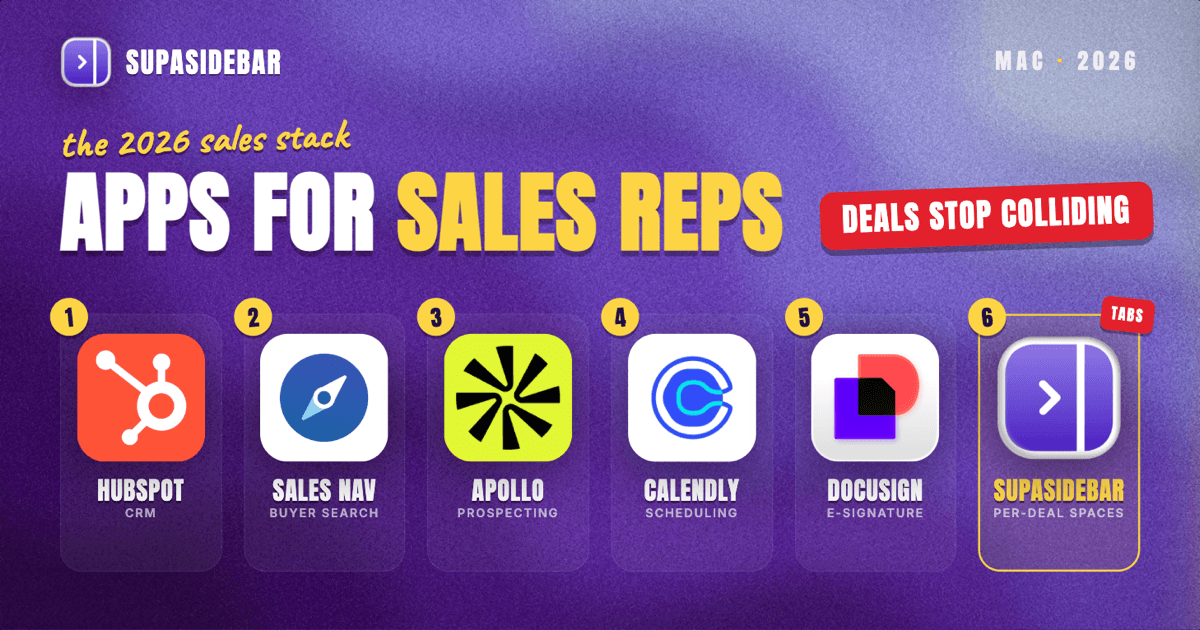
The best Mac apps for sales reps in 2026 are organized by the selling job, not by suite: HubSpot Sales Hub as the CRM that holds every deal, SupaSidebar for keeping each account's pile of CRM, prospect-research, and demo tabs separated across every browser, LinkedIn Sales Navigator for finding and warming the right buyers, Apollo for prospecting and outbound sequences, Calendly for booking demos without the email ping-pong, and DocuSign for getting contracts signed. A rep's real problem is rarely a missing tool, it is the sprawl: every open deal drags in its own CRM record, a Sales Navigator search, the prospect's site and LinkedIn, a demo environment, and a proposal tab, and half of them live in a different browser because that is where the work login sits. That sprawl is why the workspace layer earns a spot near the top of this list rather than the bottom. Several of these start free, HubSpot's CRM has a free tier, Calendly has a permanent free plan, Apollo has a free plan, and SupaSidebar has a free version, while the CRM seats and prospecting credits are where a sales budget actually goes.
Quick navigation:
- Working remotely or across time zones? → Best Mac Apps for Remote Workers 2026
- Building a focused, distraction-free setup? → Mac Workspace Setup for Deep Work 2026
- Drowning in open tabs specifically? → Too Many Tabs Open on Mac
- Selling and prospecting from a Mac? You are in the right place. Keep reading.
| App | Job in the stack | Pricing model | Best for |
|---|---|---|---|
| HubSpot Sales Hub | CRM and deal tracking | Free CRM; Starter ~$15/seat/mo | One system of record for every deal |
| SupaSidebar | Per-account workspace across browsers | Free version available | Several open deals whose tabs live across browsers |
| LinkedIn Sales Navigator | Buyer search and warm intros | Core ~$99.99/mo | Finding and tracking the right buyers |
| Apollo | Prospecting data and outbound sequences | Free plan; Basic ~$49/user/mo | Building lists and running cold outreach |
| Calendly | Demo and meeting scheduling | Free plan; Standard ~$10/seat/mo | Killing the scheduling back-and-forth |
| DocuSign | Contract e-signature | Personal/Standard from ~$10-25/mo | Getting deals signed fast |
Why a sales rep's app stack isn't a generic "best apps" list
A salaried analyst lives inside one company's tools and one set of logins. A sales rep runs several open deals in parallel, and each one drags in its own CRM record, its own prospect research, its own demo environment, and its own deadline. The apps that matter for a rep are not the flashiest, they are the ones that keep all those moving deals visible without burying the day in browser tabs: the enterprise opportunity's Sales Navigator search, the CRM record for the deal closing this week, a prospect's site and pricing page, the demo tab, and the proposal waiting on a signature.
So this list is organized by the jobs a rep actually does every week - track deals, find buyers, prospect, demo, schedule, and close - and keep it all from collapsing into tab chaos. The tools are picked for individual and small-team sales use, a sensible free-to-paid path, and Mac-native polish where it exists. The list leads with the CRM where every deal lives and the workspace layer that keeps the accounts from colliding, then works through prospecting, scheduling, and signing.
The multi-deal tab problem (and the workspace layer)
Here is the problem no CRM or prospecting tool solves, and for a rep working several deals at once it is the daily one. A rep's browser is several deals deep at once: the enterprise opportunity has its CRM record, a Sales Navigator search, the prospect's website and pricing page, and a demo tab in one pile; the mid-market deal has its own CRM record and a proposal in another; the new lead has Apollo, a LinkedIn profile, and three research tabs in a third. Some of it sits in Chrome because the company CRM and email logins live there, some in Safari for personal browsing and quick research, and some in a second profile or browser used only for a specific client account. Finding "that one pricing page from the enterprise deal" turns into a window-by-window hunt, and closing a window to clean up means losing a research trail built over the week.
Tab groups inside one browser do not fix this, because the tabs span browsers and profiles. Bookmarks do not fix it either, because half the value is the live, logged-in state of an active CRM and prospecting session that vanishes the moment the browser restarts.
Keeping each open deal's tabs separated across browsers
SupaSidebar is the cross-browser workspace layer for sales reps: one Space per open deal or account that holds that deal's CRM record, Sales Navigator search, prospect research, and demo tabs, separated from every other deal and from personal browsing. It is a native Mac app that adds one persistent sidebar across every major Mac browser - Safari, Chrome, Firefox, Edge, Arc, Brave, Vivaldi, Comet, Dia, and more (33 browsers counting channel variants). For a rep the unit of organization is the account or deal, and that maps directly to Spaces. Live Tabs shows the open tabs from every running browser in one list, so the Chrome CRM pile and the Safari research pile stop being separate hunts, and Command Panel (⌘⌃K) searches saved links and live tabs across all Spaces in one keystroke, which is the fastest way back to a buried prospect page.
For a rep juggling several deals whose tabs live across browsers and profiles, this is arguably the most differentiated tool in the stack - the only one aimed squarely at the sprawl problem, which is why it sits near the top of this list rather than the end. Two sales-specific details earn that placement. Air Traffic Control rules route links by URL pattern, so a rule can send every CRM or Sales Navigator link to the work profile automatically, which keeps the company sales account from opening logged in as a personal LinkedIn account. And Save All Browser Tabs (⌘⌃T) captures an entire research session into a folder in one shortcut, which turns "all those tabs from this morning's account research" into a saved, reopenable trail inside that deal's Space.
A freelance web developer who runs client projects the same way described the habit plainly: "I really like where you're going with this - I can see this becoming my go-to bookmarking tool. The ability to flick between browsers is so liberating." For a rep that maps to one Space per deal and one click between the browser where the CRM lives and the browser where research happens. A free version is available, and 3,000+ Mac users have tried SupaSidebar. SupaSidebar is not a CRM and does not track deal stages or store records - it organizes the tabs and tools around each deal, not the pipeline data itself.
Best for: sales reps running two or more open deals whose CRM records, prospect research, and demo tabs live across different browsers and profiles and keep bleeding into each other.
Tracking every deal in one system of record
HubSpot Sales Hub is the CRM that gives a rep on a Mac one system of record: every contact, every deal, every stage in one place instead of scattered across a spreadsheet and inbox. Selling is won or lost on follow-up, and the CRM is what keeps the next step in front of the rep instead of slipping through the cracks. HubSpot's core CRM is free for individual reps and small teams, with the paid Sales Hub Starter tier running about $15 per seat per month and Professional jumping to roughly $90 per seat per month (billed annually) when a team needs sequences, forecasting, and deeper automation, per HubSpot's Sales Hub pricing guide. Professional also carries a one-time onboarding fee, which is worth modeling before committing.
The honest line on the free tier: it covers contacts, deals, and basic tracking for a solo rep well, but email sequences, automation, and reporting are gated behind the paid tiers, which is exactly when a growing pipeline justifies paying.
Best for: reps and small teams who want one system of record and a free starting point before paying for sequences and automation.
Finding and warming the right buyers
LinkedIn Sales Navigator is the buyer-search surface most reps on a Mac start prospecting in: it adds advanced lead and company filters, saved searches, alerts when a prospect changes jobs, and InMail to the standard LinkedIn account. Selling starts with reaching the right person at the right account, and LinkedIn is where the largest professional buyer pool keeps an up-to-date profile. The Core plan runs about $99.99 per month per license (or roughly $80 per month billed annually) and includes advanced search, custom lists, alerts, and 50 InMail credits a month, per Skrapp's Sales Navigator pricing guide. Advanced and Advanced Plus tiers add team features and CRM integration at higher per-seat prices that only larger sales teams need.
The honest line on Core: the 50-InMail cap is a real limit once outreach volume climbs, which is exactly when a dedicated prospecting tool earns its place alongside it.
Best for: reps who prospect primarily on LinkedIn and want advanced search, alerts, and InMail without the team-tier price.
Building lists and running outbound past LinkedIn
Apollo is the prospecting and outbound platform for reps whose pipeline needs more than LinkedIn can supply: it provides a contact and company database, surfaces verified emails and phone numbers, and runs outbound email sequences, usually alongside the CRM. The top of the funnel needs volume and accurate contact data, and a prospecting tool with its own database is where reps build lists and run sequences at scale. Apollo's free plan covers basic search and limited credits, with the Basic tier at about $49 per user per month (billed annually, roughly $59 monthly) unlocking unlimited email credits, advanced filters, and sequencing, per CloudTalk's Apollo pricing guide. Professional and Organization tiers add more credits and team features.
The trade-off worth naming: Apollo's value lives in its data and sequencing, not in pipeline management - it feeds the CRM rather than replacing it, and contact-data accuracy varies by region and industry, so verify before a big send.
Best for: reps who need a contact database and outbound sequencing to prospect beyond their LinkedIn network.
Killing the demo scheduling back-and-forth
Calendly removes the scheduling tax from a rep's week on a Mac: a single booking link lets prospects pick an open slot for a demo or call, syncing straight to the calendar without the email ping-pong. Coordinating demo times by hand across prospects and internal stakeholders is pure overhead, and Calendly deletes it. Its free plan covers basic one-on-one scheduling, one connected calendar, and booking links, per Cal.com's Calendly pricing breakdown, which is enough for a rep booking demos solo. The Standard plan at about $10 per seat per month (annual billing) adds unlimited event types and multiple calendar connections, and the Teams plan at roughly $16 per seat per month adds round-robin scheduling for splitting inbound demos across a team.
Round-robin on the Teams tier is the sales-team-specific upgrade: it spreads inbound demo requests across reps automatically so no single calendar becomes the bottleneck.
Best for: reps who lose hours every week to booking demos and calls by email.
Getting deals signed without the back-and-forth
DocuSign is the e-signature layer that closes the loop on a Mac: send a contract or order form, the buyer signs from any device, and the signed copy lands back automatically. A deal is not closed until the paperwork is signed, and chasing signatures over email and PDF attachments is where momentum dies. DocuSign's Personal plan runs about $10 to $15 per month for a single user with a small monthly envelope cap, and the Standard plan at roughly $25 per user per month (billed annually) adds shared templates, branding, and up to five users with around 100 envelopes per user per year, per Signeasy's DocuSign pricing breakdown. The envelope caps are the detail to watch - a high-volume rep can hit them.
The honest line on DocuSign: it is the category standard and integrates with most CRMs, but for a rep sending only a handful of contracts a month, the Personal tier or a cheaper e-signature alternative may cover the job at a lower cost.
Best for: reps who close on contracts or order forms and want signing to be a link, not a PDF email thread.
Using Claude with MCP to work the CRM and tools by chat
The 2026 shift for reps who use Claude is the Model Context Protocol (MCP), an open standard from Anthropic that lets an AI assistant connect directly to a tool and act in it through plain conversation instead of an exported report. Several of the tools above already ship MCP servers, so a rep running Claude on a Mac can ask it to query and update those systems without switching tabs. HubSpot's remote CRM MCP server went generally available in April 2026, exposing contacts, deals, and engagements over an authenticated connection, per HubSpot's MCP documentation. Apollo runs as a native MCP connector inside Claude so a rep can search prospects, enrich contacts, and add them to sequences in one conversation, per Apollo's MCP product page. Salesforce ships hosted MCP servers and MCP Apps that pull CRM context into Claude and push the result back, per Salesforce's developer blog, and DocuSign's MCP server is in open beta for managing envelopes and sending documents for signature, per DocuSign's MCP server docs. The practical payoff: "summarize the last six months on this account and draft the follow-up" becomes one prompt instead of an afternoon of tab-hopping.
That workflow is exactly where SupaSidebar fits for a Claude-using rep, because it has its own MCP server too. With the SupaSidebar MCP connected, Claude can control the rep's browser workspace the same way it controls the CRM: switch to a deal's Space, pull up that account's saved links, open a specific tab, or set an Air Traffic Control rule, all by chat. So a rep can ask Claude to update the HubSpot deal through HubSpot's MCP and, in the same session, switch SupaSidebar to that deal's Space and surface its research links, keeping the AI workflow and the browser workspace in sync instead of split across two motions. SupaSidebar's MCP works with Claude, Cursor, and other MCP clients. It is not a CRM connector and does not touch deal data, it controls the tabs and links around the deal, which is the half of the workflow the CRM MCPs do not cover.
Best for: reps who already run Claude with their CRM and prospecting tools connected over MCP and want the browser workspace driven from the same conversation.
Which sales rep setup should you pick?
- If you are a solo or early-stage rep: pair the free HubSpot CRM with a free Calendly for demos, a free Apollo plan for prospecting, and the free version of SupaSidebar to keep each deal's tabs separated.
- If you run many deals across browsers and profiles: the workspace layer is your biggest win - tab sprawl is otherwise your daily tax, and SupaSidebar groups each deal's CRM, research, and demo tabs by Space.
- If you need real automation: step HubSpot up to Sales Hub Starter or Professional for sequences, forecasting, and deeper pipeline tooling.
- If prospecting is your bottleneck: add LinkedIn Sales Navigator for buyer search and Apollo for contact data and outbound sequences.
- If you run team demos: step Calendly up to the Teams tier for round-robin scheduling.
- If you already use Claude with MCP: connect your CRM's MCP server (HubSpot, Salesforce) plus Apollo and DocuSign, and add SupaSidebar's MCP so Claude drives the browser workspace from the same chat.
- If you also work remotely: pair this with the remote-worker Mac stack.
Conclusion: Picking the sales rep Mac setup
The 2026 verdict: track every deal in HubSpot, find buyers with LinkedIn Sales Navigator, prospect and run outbound through Apollo, book demos with Calendly, close on DocuSign, and keep the whole multi-deal browser sprawl from collapsing into tab chaos with SupaSidebar grouping each account's tabs by Space. Spend real budget where the pipeline actually moves - the CRM seats and prospecting credits - and lean on the free tiers for the CRM starting point, scheduling, and the workspace layer.
Try SupaSidebar (free tier) if deal tabs are scattered across browsers right now.
Why we recommend SupaSidebar
SupaSidebar is a macOS app that brings Arc's sidebar to every browser - one sidebar for tabs, bookmarks, files, and apps across 33 browsers including Safari, Chrome, Firefox, Edge, Arc, Brave, Vivaldi, Comet, and Dia. For sales reps, it turns each open deal into a Space holding that account's CRM record, Sales Navigator searches, prospect research, and demo tabs, searchable in one keystroke with Command Panel (⌘⌃K) no matter which browser they are open in. iCloud sync keeps the setup identical across an office Mac and a laptop, with no account required. macOS 14+ required.
FAQ
What apps do sales reps use on a Mac in 2026?
A common individual or small-team sales stack is HubSpot Sales Hub as the CRM, LinkedIn Sales Navigator for buyer search, Apollo for prospecting and outbound sequences, Calendly for booking demos, DocuSign for e-signature, and SupaSidebar for keeping each open deal's tabs organized across browsers. Several of these start free, so the stack scales with pipeline volume and team size rather than a fixed subscription bill.
What is the best CRM for sales reps on a Mac?
HubSpot Sales Hub is a common pick because its core CRM is free for individuals and small teams and grows into paid Sales Hub tiers (Starter around $15 per seat per month) when a rep needs sequences and automation. The CRM runs in the browser on a Mac rather than as a native app, so it works the same on macOS as anywhere else, and the free tier covers contacts, deals, and basic tracking before any paid commitment.
Is there a free CRM for sales reps on Mac?
Yes - HubSpot's core CRM has a free tier that covers contacts, deals, and basic pipeline tracking for individual reps and small teams. Free sales setups usually pair it with a free Calendly plan for scheduling and a free Apollo plan for limited prospecting, then add paid CRM tiers and prospecting credits once volume justifies the spend.
How do sales reps manage dozens of deal tabs on a Mac?
The reliable method is per-deal workspaces plus cross-browser search. SupaSidebar creates one Space per open deal or account that holds its CRM record, prospect research, and demo tabs, and its Live Tabs view plus Command Panel (⌘⌃K) search every running browser at once, so a CRM record in Chrome and a prospect's pricing page in Safari are found in the same keystroke. Air Traffic Control rules can route each platform's links to the right browser profile automatically, which prevents opening a company sales account in a personal session.
Do sales reps need LinkedIn Sales Navigator?
Sales Navigator earns its cost for reps who prospect heavily on LinkedIn - it adds advanced lead and company filters, saved searches, job-change alerts, and 50 InMail credits a month on the Core plan (around $99.99 per month). Reps who prospect mostly through inbound, referrals, or a contact database like Apollo can often skip it, since the value is concentrated in active outbound search and outreach on LinkedIn.
What is the best way to schedule demos on a Mac?
Calendly is the standard pick: a single booking link lets prospects self-select an open demo slot that syncs to the rep's calendar, removing the email back-and-forth, and its free plan covers basic one-on-one scheduling. For teams splitting inbound demos, the Teams tier (around $16 per seat per month) adds round-robin scheduling that spreads demo requests across reps automatically so no single calendar becomes the bottleneck.
Can sales reps use Claude and MCP with their CRM and tools?
Yes. The Model Context Protocol (MCP) lets Claude connect directly to a tool and act in it by chat, and several sales tools now ship MCP servers: HubSpot's remote CRM MCP server went generally available in April 2026, Apollo runs as a native MCP connector inside Claude, Salesforce offers hosted MCP servers, and DocuSign's MCP server is in open beta. A rep can ask Claude to summarize an account and update the deal through the CRM's MCP, then add SupaSidebar's own MCP so Claude also switches to that deal's Space and surfaces its saved links, keeping the AI workflow and the browser workspace in one conversation.
By Kshetez Vinayak, founder of SupaSidebar. Last updated 2026-06-19.