
By Kshetez Vinayak, founder of SupaSidebar. Last updated 2026-06-21.
TL;DR
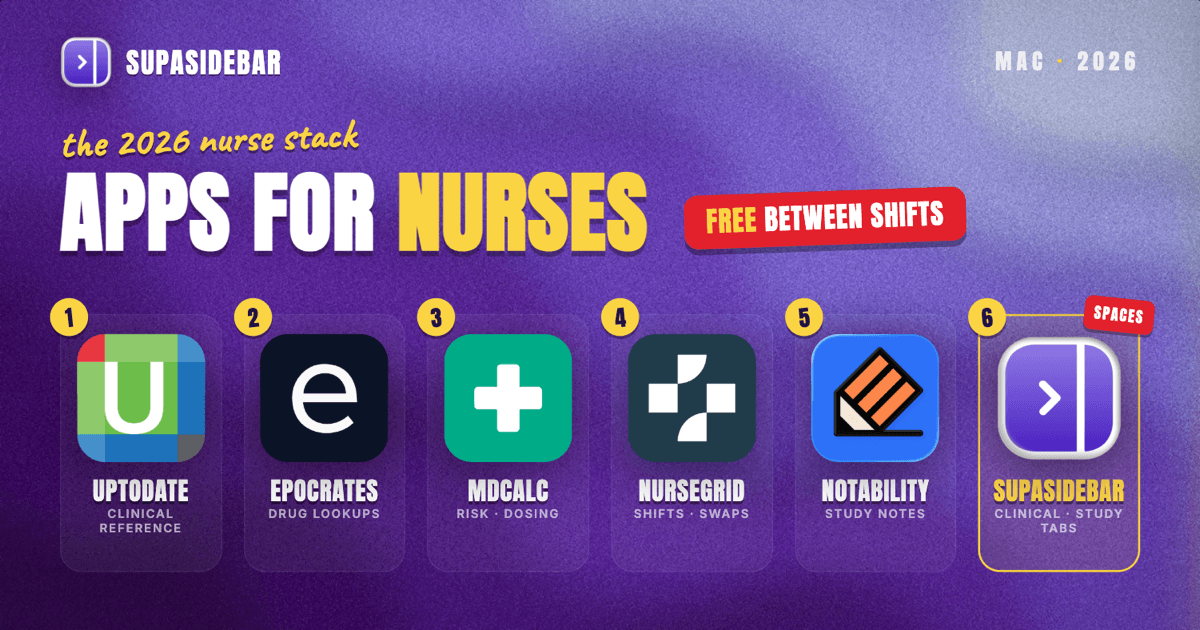
The best Mac apps for nurses in 2026 are organized by the job at hand, not by brand: UpToDate as the evidence-based clinical reference when a question needs a real answer, Epocrates as the fast drug and interaction lookup with a genuinely useful free tier, MDCalc for the dosing and risk calculations that should never be done by hand, NurseGrid for tracking shifts and swaps, Notability for nursing-school lectures and care-plan notes, and SupaSidebar to keep the reference, scheduling, and study tabs from collapsing into one tab pile across browsers. Most clinical reference and drug work happens in a browser or a phone app, so the real Mac question for a nurse is what to run between shifts and during study: a calculator that is always right, a scheduler that survives a swap, a note app that handles handwriting, and a way to keep clinical-reference tabs separate from study tabs. Several of these start free, MDCalc is free, Epocrates has a strong free tier, NurseGrid is free for individual nurses, Notability is free, and SupaSidebar has a free version, while UpToDate is the one that usually rides on an institutional login.
Quick navigation:
- Still in nursing school? → Best Mac Apps for Students 2026
- Building a focused study setup? → Mac Workspace Setup for Deep Work 2026
- Drowning in open tabs specifically? → Too Many Tabs Open on Mac
- Setting up a Mac for nursing work and study? You are in the right place. Keep reading.
| App | Job in the stack | Pricing model | Best for |
|---|---|---|---|
| UpToDate | Evidence-based clinical reference | Individual from ~$60/mo; usually institutional | Looking up the actual answer to a clinical question |
| Epocrates | Drug and interaction lookup | Free tier; Plus ~$174.99/yr | Fast drug checks and interaction screening |
| MDCalc | Clinical calculators and risk scores | Free | Dosing, risk scores, and formulas done right |
| NurseGrid | Shift schedule and swaps | Free for individual nurses | Tracking your own shifts and trading them |
| Notability | Lecture and care-plan notes | Free; Plus ~$19.99/yr | Nursing-school notes and handwriting |
| SupaSidebar | Reference vs study tab separation | Free version available | Keeping clinical and study tabs apart across browsers |
Why a nurse's app stack isn't a generic "best apps" list
A nurse's relationship with a Mac is different from a knowledge worker's. The bedside tools, the EHR, the barcode scanner, the call system, live on hospital hardware that a personal Mac never touches. What a nurse actually runs on a Mac is the work that happens around the shift: looking up a drug or a protocol, double-checking a dose, tracking which shifts are coming, and, for the large share of nurses who are also in school, taking notes and studying for the next exam or certification.
So this list is organized by those jobs rather than by suite. The picks lean toward tools with a real free tier (a new grad's budget is thin), Mac-and-mobile availability (a nurse checks a drug on a phone at work and reviews notes on a Mac at home), and accuracy where accuracy is non-negotiable, which for clinical calculators means a tool built and maintained by clinicians. The list leads with the clinical reference and drug tools that carry the most weight, moves through calculators and scheduling, and ends with the study and organization layer.
UpToDate: the evidence-based clinical reference
UpToDate is the evidence-based clinical reference nurses reach for when a question needs a real, sourced answer rather than a quick fact: graded recommendations, full topic reviews, and drug content maintained by a large physician-editor network. When the question is "what is the current protocol" rather than "what is this pill," a point-of-care reference that cites its evidence is what keeps practice current. UpToDate's individual subscription starts around $60 per month for those who pay out of pocket, per SelectHub's UpToDate pricing overview, but most nurses reach it through a hospital or school login rather than a personal plan.
The honest line on UpToDate: it is the depth standard, but the individual price is hard to justify on a nurse's budget without an institution behind it. Many nurses use it only while it is covered by their employer or program and lean on free tools for everyday lookups.
Best for: nurses who want sourced, evidence-graded answers and have institutional access to the subscription.
Epocrates: fast drug and interaction checks
Epocrates is the fast drug-lookup app for nurses who need a monograph or an interaction check in seconds, not a full topic review: dosing, adverse effects, a pill identifier, and a multi-drug interaction checker. A huge share of bedside questions are drug questions, and a reference that answers them in a few taps beats one built for deep reading. The free tier covers drug monographs, the interaction checker, and pill identification at no cost, while the Plus tier at about $174.99 per year adds disease content, lab references, and clinical guidelines, per GetApp's Epocrates pricing breakdown.
The honest line on Epocrates: the free tier is genuinely useful and is all most nurses ever need for drug checks, so treat Plus as optional unless the disease and lab content earns its keep. It is a quick-reference tool, not a substitute for the deeper clinical guidance in something like UpToDate.
Best for: nurses who want fast drug and interaction lookups with a free tier that actually covers the daily need.
MDCalc: getting the dose and risk score right
MDCalc is the free clinical-calculator app every nurse should have on hand: hundreds of evidence-based calculators, risk scores, and dosing tools built and maintained by clinicians. Any calculation done by hand at 3 a.m. is a calculation that can go wrong, and a vetted calculator removes the arithmetic from the equation. MDCalc provides more than 270 clinical decision tools, is free to download, and was built for use by nurses, nurse practitioners, physicians, and students, per its App Store listing. It also lets eligible users earn continuing-education credit by reviewing the evidence behind many calculators.
There is no real trade-off to name here beyond scope: MDCalc calculates, it does not diagnose or prescribe, and it is only as good as the inputs a nurse enters. That is exactly why it belongs in the stack as the dedicated calculation tool rather than as a feature buried in something else.
Best for: every nurse and nursing student who wants vetted calculators and risk scores instead of doing the math by hand.
NurseGrid: tracking shifts and trading them
NurseGrid is the scheduling app built specifically for how nurses work shifts: a personal calendar of upcoming shifts, shift-swap requests, and visibility into who else is on. A nursing schedule is not a 9-to-5, it is rotating days, nights, and weekends that change as swaps go through, and a tool built for that beats a generic calendar. The individual NurseGrid app is free for nurses to track and manage their own shifts, while NurseGrid Manager, the team scheduling product for unit managers, is priced at about $5 per team member per month with a 30-day trial, per GetApp's NurseGrid Manager listing.
The honest line on NurseGrid: the free personal app covers an individual nurse's needs well, and the paid tier is aimed at managers building the unit's master schedule, not at the nurse tracking their own. A nurse whose unit does not use it can still run the free personal calendar solo.
Best for: nurses who want a shift calendar and swap tool designed for rotating hospital schedules rather than a generic one.
Notability: nursing-school and care-plan notes
Notability is the note-taking app that fits nursing-school study and care-plan work on a Mac: typed and handwritten notes, PDF annotation for lecture slides and clinical handouts, and audio recording that syncs to the notes as they are written. A large share of nurses are also students, and lectures, care plans, and study guides are a mix of typing, sketching, and marking up PDFs that a plain text editor handles poorly. Notability is free with most features available, and its Plus subscription runs about $19.99 per year (or $7.99 per month) adding unlimited editing, handwriting recognition, and math conversion, usable across up to 10 iPad, iPhone, and Mac devices, per GetApp's Notability listing.
The honest line on Notability: the free tier limits editing, so a nursing student who lives in the app will likely want Plus, but the annual price is modest and the cross-device sync between an iPad at lecture and a Mac at home is the real draw.
Best for: nursing students who annotate lecture slides and mix typed and handwritten notes across an iPad and a Mac.
The reference-and-study tab problem (and the workspace layer)
Here is the problem that sits underneath all of the above for a nurse who also studies. The clinical-reference tabs (UpToDate, a drug database, a hospital protocol page) want to stay open and logged in. The study tabs (a nursing-school portal, lecture videos, a certification-prep site, a question bank) want their own pile. And the personal tabs are mixed in with both. Some of it lives in Chrome because the school portal works best there, some in Safari for quick reference, and a clinical login may sit in a third browser or profile entirely.
Finding "that protocol tab from this morning" turns into a window-by-window hunt, and closing a browser window to tidy up means losing a logged-in reference session built earlier. Tab groups inside one browser do not fix this, because the reference set and the study set often span different browsers and profiles.
SupaSidebar: clinical and study tabs in separate Spaces
SupaSidebar is a native Mac app that adds one persistent sidebar across every major Mac browser, so a nurse can keep one Space for clinical reference and one for study instead of letting both pile into the same browser window. It works across Safari, Chrome, Firefox, Edge, Arc, Brave, Vivaldi, Comet, Dia, and more (33 browsers counting channel variants). The unit of organization here is the context, clinical versus study versus personal, and that maps directly to Spaces, each holding its own set of tabs and saved links. Live Tabs shows the open tabs from every running browser in one list, and Command Panel (⌘⌃K) searches saved links and live tabs across all Spaces in one keystroke, which is the fastest way back to a protocol or lecture page opened earlier.
For a nurse this is a real but modest add: the clinical tools above do the actual nursing work, and SupaSidebar's job is only the organization around them, keeping the reference set from drowning in study tabs and back again. Two details make that organization concrete. Save All Browser Tabs (⌘⌃T) captures a whole pile of reference tabs into a folder in one shortcut, so a set of protocol pages opened during a shift becomes a saved, reopenable trail. And iCloud sync keeps the setup identical across a Mac at home and a second Mac, with no account required. SupaSidebar is not a clinical tool, it does not store patient data, look up drugs, or do any calculation, it organizes the browser tabs and links around the work, not the clinical content itself.
Best for: nurses who also study and want their clinical-reference tabs and study tabs kept in separate, one-click contexts across browsers.
Which nurse Mac setup should you pick?
- If you are a new grad on a budget: lean on the free tools - MDCalc for calculations, Epocrates' free tier for drug checks, the free NurseGrid app for shifts, and the free version of SupaSidebar to keep reference and personal tabs apart.
- If your hospital or school covers it: use UpToDate while you have institutional access for the evidence-graded clinical answers it does best.
- If you are in nursing school: pair Notability for lectures and care plans with the student Mac stack, and keep study tabs separated from reference tabs with SupaSidebar.
- If your unit schedules through it: NurseGrid keeps your shifts and swaps in sync with the team; if it does not, run the free personal app solo.
- If you juggle clinical reference and study tabs all day: the workspace layer is the small win that stops the tab pileup - one Space for clinical, one for study.
Conclusion: Picking the nurse Mac setup
The 2026 verdict: build the stack around free, accurate clinical tools first - MDCalc for calculations, Epocrates' free tier for drug lookups, NurseGrid for shifts - reach for UpToDate when an institution covers the evidence-graded depth, and add Notability for nursing-school notes. Keep the clinical-reference and study tabs from collapsing into one pile with SupaSidebar grouping them by Space. Spend money only where it earns its keep, the Epocrates or UpToDate upgrade, and lean on the strong free tiers everywhere else.
Try SupaSidebar (free tier) if clinical and study tabs are scattered across browsers right now.
Why we recommend SupaSidebar
SupaSidebar is a macOS app that brings Arc's sidebar to every browser - one sidebar for tabs, bookmarks, files, and apps across 33 browsers including Safari, Chrome, Firefox, Edge, Arc, Brave, Vivaldi, Comet, and Dia. For nurses who also study, it turns clinical reference and study into separate Spaces, each holding its own tabs and saved links, searchable in one keystroke with Command Panel (⌘⌃K) no matter which browser they are open in. iCloud sync keeps the setup identical across a home Mac and a second Mac, with no account required. macOS 14+ required.
FAQ
What apps do nurses use on a Mac in 2026?
A common nurse stack is UpToDate or Epocrates for clinical and drug reference, MDCalc for calculations and risk scores, NurseGrid for shift scheduling, Notability for nursing-school notes, and SupaSidebar for keeping clinical and study tabs organized across browsers. Several of these are free or have free tiers, so the stack scales with whether the nurse is a student, a new grad, or has institutional access to paid references.
What is the best free app for nurses on a Mac?
MDCalc is the strongest fully free pick - hundreds of clinician-built calculators and risk scores at no cost. Epocrates' free tier covers drug monographs, an interaction checker, and pill identification, and the NurseGrid personal app is free for tracking shifts. A free nurse setup usually pairs those with the free version of Notability for notes and SupaSidebar for tab organization.
Is UpToDate worth it for an individual nurse?
UpToDate is the depth standard for evidence-graded clinical answers, but its individual subscription starts around $60 per month, which is hard to justify on a nurse's budget without an employer or school covering it. Most nurses use it through institutional access and rely on free tools like MDCalc and Epocrates for everyday lookups, reserving UpToDate for questions that need a sourced, current protocol.
What is the best note-taking app for nursing students on a Mac?
Notability is a common pick because it handles the mix of typed notes, handwriting, and PDF annotation that nursing lectures and care plans require, and it syncs across an iPad and a Mac. It is free with limited editing, and its Plus tier (about $19.99 per year) unlocks unlimited editing, handwriting recognition, and math conversion. Students who annotate lecture slides on an iPad and review on a Mac get the most from the cross-device sync.
How do nurses keep clinical and study browser tabs organized on a Mac?
The reliable method is separating contexts into workspaces. SupaSidebar creates one Space for clinical-reference tabs and another for study tabs, so a logged-in reference session and a school portal stop competing in the same window. Its Live Tabs view and Command Panel (⌘⌃K) search every running browser at once, so a protocol page in Chrome and a lecture page in Safari are found in the same keystroke, and Save All Browser Tabs (⌘⌃T) captures a pile of reference tabs into a folder in one shortcut.
Are there free clinical calculator apps for nurses?
Yes - MDCalc is free and offers more than 270 evidence-based clinical calculators, risk scores, and dosing tools built and maintained by clinicians, and it is available on iPhone and in the browser. It is designed for nurses, nurse practitioners, physicians, and students, and eligible users can even earn continuing-education credit by reviewing the evidence behind many calculators. It calculates rather than diagnoses, so it complements a clinical reference rather than replacing one.
By Kshetez Vinayak, founder of SupaSidebar. Last updated 2026-06-21.