
By Kshetez Vinayak, founder of SupaSidebar. Last updated 2026-06-20.
Quick navigation:
- Setting up a Mac workspace that keeps deals organized? → Mac Workspace Setup for Deep Work 2026
- Working from listings, the car, and home? → Best Mac Apps for Remote Workers 2026
- Drowning in MLS, portal, and client tabs? → Too Many Tabs Open on Mac 2026
- Real estate agent building a Mac app stack? You are in the right place. Keep reading.
TL;DR
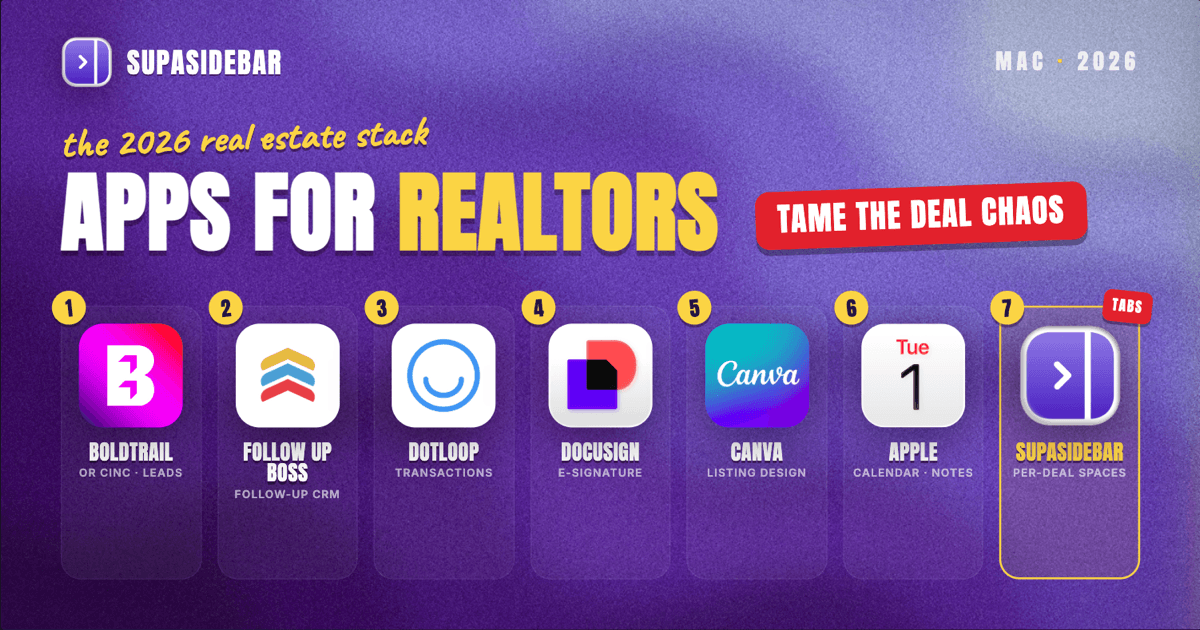
The best Mac apps for real estate agents in 2026 are a seven-tool stack: SupaSidebar to keep each listing and client's tabs separated across browsers, a lead-gen platform like BoldTrail (formerly kvCORE) or CINC for the IDX website plus CRM, Follow Up Boss as the dedicated follow-up CRM, dotloop for end-to-end transaction management, DocuSign for standalone e-signature, Canva for listing graphics and social posts, and Apple's own Calendar and Notes for the day-to-day. The job that ties them together is tab chaos: an agent runs the MLS, a portal, a CRM, a transaction loop, and a client's inbox at once, often across two or three browsers, and the single biggest daily friction is finding the right one. The category-by-category picks, the honest limits, and the comparison table are below.
Scope:
Mac apps for the agent's daily browser-and-desktop workflow - lead generation, client follow-up, transactions, marketing, and keeping the digital sprawl organized. Not covered: MLS access itself (that is your board's system), brokerage-mandated platforms, or photography and videography gear.
At a glance: the real estate agent Mac stack
| App | Category | Cost | Best for |
|---|---|---|---|
| SupaSidebar | Tab and workspace organization | Free version available | Keeping each listing or client's tabs separated across every browser |
| BoldTrail / CINC | Lead-gen platform + IDX + CRM | Platform pricing (team-scale) | Agents and teams running paid lead generation |
| Follow Up Boss | Follow-up CRM | From $69/user/mo | Agents who live and die by lead response time |
| dotloop | Transaction management | From $31.99/mo | End-to-end deal loops, unlimited documents per transaction |
| DocuSign | E-signature | Real Estate plan $45/mo | Standalone signing when a full loop is overkill |
| Canva | Listing and social design | Free; Pro $15/mo | Listing flyers, social posts, just-listed graphics |
| Apple Calendar + Notes | Scheduling and quick capture | Free, built in | Showings, deadlines, and fast notes from the car |
Why an agent's real problem is tab sprawl, not a missing app
Most "best apps for realtors" lists hand you fifteen tools and call it a day. The working truth is narrower. A real estate agent's stack is a lead source, a CRM, a transaction platform, an e-signature tool, and a design app, and the rest is noise. The harder problem is not which apps to install. It is that all of them live in the browser, open at the same time, for several deals at once.
A typical agent has the MLS in one tab, a Zillow or Realtor.com lead in another, BoldTrail's CRM in a third, a dotloop transaction loop in a fourth, and a client's email thread in a fifth, repeated for every active listing and every buyer in escrow. By Wednesday there are forty tabs and no way to tell which window belongs to which deal. That is the friction this stack is built to remove, and it is why the organization layer comes first.
SupaSidebar: keeping each listing and client separated across browsers
SupaSidebar is the workspace layer for an agent juggling several deals at once: one Space per listing or client keeps that deal's MLS page, CRM record, transaction loop, and email thread together and out of the way of every other deal. It is a macOS app that adds a floating sidebar to any browser, so the separation holds whether a lead came in through Chrome, the listing portal opened in Safari, or the brokerage tools only work in a specific browser.
The reason this matters for real estate specifically is the cross-browser reality. Agents rarely get to standardize on one browser, the MLS works best in one, the brokerage intranet in another, a portal in a third. SupaSidebar's Live Tabs section shows the open tabs from every browser in one list, grouped and clickable, across 33 browsers in total including Safari, Chrome, Firefox, Edge, Brave, and Arc. Air Traffic Control rules can route a saved listing link to the right Space automatically, and the Command Panel (opened with a keyboard shortcut) searches every saved page, recent page, and live tab in under a second, so the buyer's pre-approval letter is one search away instead of buried in a window somewhere.
The honest scope: SupaSidebar organizes the tabs around a deal, it does not run the deal. It is not a CRM and does not store contact records or transaction data, that is what BoldTrail and Follow Up Boss are for. Its search covers titles and URLs, not the contents inside a PDF. It is macOS 14 or later, and a free version is available.
Best for: any agent or team running more than two or three active deals at once across more than one browser, which is most of them.
BoldTrail or CINC: lead generation and IDX
For agents and teams who buy leads, the platform layer is BoldTrail (the evolution of kvCORE) or CINC, both combining an IDX home-search website with a built-in CRM. BoldTrail is built around managing the entire client lifecycle in one unified dashboard with an AI-assisted Smart CRM, which removes the need for a separate website subscription and a separate CRM. CINC, by contrast, leans harder into paid lead acquisition, bundling managed Google and Facebook advertising with its IDX site and a conversion-focused CRM for teams that prioritize buying leads.
The choice between them is about volume and budget. CINC is engineered for teams and brokerages running heavy paid ad spend, and its total cost climbs once that ad spend and add-ons are included. BoldTrail suits agents who want the website, CRM, and back-office in one system without stitching subscriptions together. Both are team-scale platforms, not light tools, and both are priced accordingly through their sales teams rather than a public per-seat rate.
Best for: teams and producers running paid lead generation at volume. A solo agent with a referral business can skip the platform and run Follow Up Boss alone.
Follow Up Boss: following up before the lead goes cold
Follow Up Boss is the dedicated follow-up CRM for agents whose business turns on response time: it pulls leads from every source into one inbox and drives the calls, texts, and emails that turn a cold lead into a closing. In real estate, speed-to-lead is the whole game, and Follow Up Boss is built to make the next action obvious. It starts at $69 per user per month on the Grow plan, dropping to $58 per user per month billed annually, with a 14-day free trial, and team plans (Pro at $499/month for up to 10 users) scale from there.
The honest trade-off is overlap. If a team already runs BoldTrail or CINC, those platforms include a CRM, and paying for Follow Up Boss on top is a deliberate choice agents make because its follow-up workflow and integrations are stronger than the bundled options. A solo agent often runs Follow Up Boss as the only CRM and skips the platform entirely.
Best for: agents who treat lead follow-up as their core discipline and want a CRM purpose-built for it.
dotloop: getting the deal to the closing table
dotloop is the transaction management tool built specifically for real estate, guiding agent, buyer, and seller through the entire deal from offer to close in a single loop. Unlike a generic document tool, it handles the forms, the signatures, the task checklist, and the compliance trail in one place, and it charges no per-envelope fees, so an agent can send unlimited documents per transaction without watching a meter. The Premium plan starts at $31.99 per month for an individual agent, with team plans above that.
The trade-off is that dotloop is a full transaction platform, which is more than an agent needs for a one-off signature. When the task is just getting one document signed and the deal lives elsewhere, a standalone e-signature tool is lighter.
Best for: agents who want every closing's documents, signatures, and compliance in one organized loop.
DocuSign: standalone e-signatures
DocuSign is the e-signature tool to reach for when a transaction platform is overkill and the job is simply getting a document signed fast. It is the most widely recognized signing tool, which means clients rarely need an explanation, and its Real Estate plan runs $45 per month. The distinction from dotloop is real: DocuSign signs documents, it does not manage the transaction around them, so it pairs well with a separate CRM and checklist rather than replacing them.
Best for: agents whose brokerage handles transactions elsewhere and who just need reliable, recognizable e-signatures.
Canva: listing marketing and social
Canva is the design tool that lets an agent produce listing flyers, just-listed graphics, and social posts without a designer. Templates sized for Instagram, a yard-sign QR flyer, or an open-house announcement turn a blank page into a finished asset in minutes, and the brand kit keeps colors and logos consistent across a whole listing's marketing. The free tier covers a lot, and Canva Pro is $15 per month or $120 per year for the larger template and asset library, background remover, and brand controls.
The honest note: Canva is general-purpose, not real-estate-specific, so an agent builds or buys the listing templates rather than getting them out of the box. For most agents that is a one-time setup, not an ongoing cost.
Best for: agents who market their own listings and want professional graphics without hiring out.
Apple Calendar and Notes: scheduling and quick capture
The two apps already on the Mac handle more of an agent's day than most paid tools. Apple Calendar manages showings, inspection windows, and closing deadlines, and syncs to the iPhone for the half of the job that happens in the car. Apple Notes captures a buyer's must-haves or a seller's disclosure detail in the seconds before it is forgotten, and the notes sync to every Apple device through iCloud. Neither costs anything, and for a solo agent they often cover scheduling and quick capture completely.
Best for: every agent, as the free baseline before paying for anything heavier.
Which real estate agent setup should you pick?
- If you are a solo agent on a referral business: Follow Up Boss as the CRM, dotloop for transactions, Canva for marketing, and SupaSidebar to keep each deal's tabs separated. Skip the lead-gen platform until you are buying leads.
- If you run paid lead generation: add BoldTrail or CINC for the IDX site and lead funnel, then keep Follow Up Boss if its follow-up workflow beats the bundled CRM. SupaSidebar still does the cross-browser organizing the platforms cannot.
- If your brokerage already mandates a transaction platform: drop dotloop, use DocuSign for one-off signatures, and let SupaSidebar tie the mandated tools and your own CRM together across browsers.
- If your single biggest daily pain is finding the right tab: start with SupaSidebar regardless of the rest of the stack. It is the layer that organizes everything else.
Conclusion
The best Mac apps for real estate agents in 2026 are a focused seven-tool stack, not a sprawling list: SupaSidebar for cross-browser organization, BoldTrail or CINC for lead generation, Follow Up Boss for follow-up, dotloop for transactions, DocuSign for standalone signing, Canva for marketing, and Apple Calendar plus Notes for the day-to-day. The tools an agent picks matter less than the fact that all of them run in the browser at once, for several deals at the same time.
Solo referral agents can run lean with Follow Up Boss, dotloop, and Canva. Teams buying leads add a platform like BoldTrail or CINC. Every agent, regardless of which CRM or transaction tool they choose, hits the same wall by mid-week: too many tabs across too many browsers and no way to tell which belongs to which deal. That is the problem the organization layer solves first.
Try SupaSidebar (free tier) to keep each listing and client's tabs in their own Space across every browser.
Why we recommend SupaSidebar
SupaSidebar is a macOS app that brings Arc's sidebar to every browser - one sidebar for tabs, bookmarks, files, and apps across 33 browsers including Safari, Chrome, Firefox, Edge, Brave, Arc, Vivaldi, Dia, and Comet. For a real estate agent, that means one Space per listing or client, Live Tabs that show every open tab from every browser in one list, and a Command Panel that finds any saved page or live tab in under a second. It does not replace a CRM or a transaction platform, it organizes the tabs around the deals so the right page is always one search away. More than 3,000 Mac users have tried SupaSidebar, and a free version is available on macOS 14 and later.
FAQ
What is the best CRM for real estate agents on a Mac?
Follow Up Boss is the most popular dedicated follow-up CRM, starting at $69 per user per month. Agents and teams who also want an IDX lead-generation website often use a platform like BoldTrail (formerly kvCORE) or CINC, which bundle a CRM with the website. All of them run in the browser, so they work on a Mac without a native app.
Do real estate agents need both a transaction tool and an e-signature tool?
Not always. dotloop is a full transaction management platform that includes e-signature, with no per-envelope fees, so it can cover both. DocuSign is a standalone signing tool at $45 per month on its Real Estate plan, which fits agents whose brokerage manages transactions elsewhere and who just need documents signed.
What is the cheapest way to market real estate listings on a Mac?
Canva covers most listing marketing, and its free tier handles flyers and social posts. Canva Pro at $15 per month or $120 per year adds a larger template library, background remover, and brand controls for agents who market several listings a month.
How can an agent stop losing track of tabs across different deals?
SupaSidebar lets an agent create one Space per listing or client, keeping that deal's MLS page, CRM record, and transaction loop together and separated from other deals. It works across 33 browsers, so the separation holds even when the MLS, the brokerage tools, and a portal each open in a different browser. A free version is available on macOS 14 and later.
Does SupaSidebar work with the MLS and brokerage platforms?
Yes. SupaSidebar does not modify or integrate with those platforms directly, it organizes their browser tabs. Because it works across 33 browsers and shows their open tabs in one Live Tabs list, an agent can keep the MLS in one browser and brokerage tools in another while still finding everything from a single sidebar.
What does a real estate agent's Mac app stack cost in 2026?
A lean solo stack of Follow Up Boss ($69/user/mo), dotloop (from $31.99/mo), and Canva (free or $15/mo), plus SupaSidebar's free version, runs roughly $100 to $135 per month. Teams adding a lead-generation platform like BoldTrail or CINC pay more, priced through those vendors based on team size and ad spend.
Written by Kshetez Vinayak, founder of SupaSidebar.