
By Kshetez Vinayak, founder of SupaSidebar. Last updated June 24, 2026.
No open-source Arc browser exists as of June 2026.
Arc is closed-source, there is no community fork, and The Browser Company has explicitly said it cannot open-source Arc without also giving away ADK, the internal toolkit that now powers Dia. If "open-source" is a hard requirement, the closest match is Zen Browser (Firefox-based, fully open source, built to recreate Arc's sidebar and Spaces). On the Chromium side, no fork ships Arc's workspaces and command bar. This page answers the open-source question specifically; for a full ranked list of Arc replacements, see the Arc Browser alternative guide.
Looking for something specific?
- Wondering if Arc is dead and what maintenance mode means? → Is Arc Browser Dead?
- Already decided, ready to migrate? → Switching from Arc Browser
- Comparing every alternative? → Arc Browser alternative guide
- Looking for an open-source Arc? → You're in the right place. Keep reading.
Is there an open-source version of Arc browser?
There is no open-source version of Arc browser. Arc is, and always has been, closed-source software. The Browser Company has never published Arc's source code, and no community fork of Arc exists because there is no public codebase to fork from.
This page covers one narrow question: does an open-source or community-fork Arc exist, and what are the closest open-source options. It does not rank every Arc alternative. That's the job of the Arc Browser alternative guide. It also doesn't cover whether Arc is dead or in maintenance mode; Is Arc Browser Dead? handles that. If the search that brought you here was "arc fork" or "arc browser open source alternative chromium," this is the page that answers it directly.
Why The Browser Company won't open-source Arc
When The Browser Company put Arc into maintenance mode on May 27, 2025, the community response was immediate and loud. The top-voted thread on r/ArcBrowser at the time was titled, bluntly, "Arc is dying. Make it open source," with 846 upvotes and 148 comments (r/ArcBrowser). The request came up so often that CEO Josh Miller addressed it directly in his May 2025 essay.
The answer was no, and the reason is specific. Arc is built on top of ADK, the Arc Development Kit, an internal SDK The Browser Company describes as its "secret sauce" for building browsers with unconventional interfaces. As Miller put it: "While we'd love to open-source Arc someday, we can't do that meaningfully without also open-sourcing ADK. And ADK is still core to our company's value" (TechCrunch, May 27, 2025).
ADK is also the foundation of Dia, The Browser Company's new AI-focused browser. Open-sourcing Arc would mean handing competitors the toolkit behind the company's actual flagship product. Miller left the door slightly open, noting "that doesn't mean it'll never happen," but as of June 2026, it has not happened. There is no announced timeline, and the company's letter to Arc members framed selling or open-sourcing as possibilities, not commitments.
So the practical situation in 2026: Arc still works, it still gets security patches through its Chromium base, but the source code is not public and no one outside The Browser Company can build on it.
Is there an open-source Chromium browser with Arc-like UI?
This is the more specific version of the question, and the honest answer is: not really, not the way most people mean it.
No Chromium fork ships a product that explicitly positions itself as "open-source Arc for Chromium." The Chromium forks that are open source and actively maintained don't add Arc's defining features: the vertical sidebar with Spaces, the command bar, the workspace model. Here's where the popular open-source Chromium options actually land:
| Browser | Open source | Chromium-based | Arc-style sidebar + Spaces | Command bar |
|---|---|---|---|---|
| Helium | Yes (fully) | Yes | Partial: vertical tabs shipped, no Spaces | No |
| Thorium | Yes | Yes | No: performance fork, no UI changes | No |
| Ungoogled-Chromium | Yes | Yes | No: privacy fork, no UI features | No |
| Brave | Yes | Yes | No: has vertical tabs, no Spaces/command bar | No |
| Vivaldi | No (closed UI) | Yes | Closest workflow coverage, but not open source | Yes (Quick Commands) |
The most interesting recent movement is Helium, a fully open-source Chromium browser (GitHub: imputnet/helium) that shipped experimental vertical tabs in early 2026. An r/browsers thread titled "Finally, Helium is now looking like Arc" captured the reaction at 442 upvotes, with the top comment noting vertical tabs and a hideable address bar were "the last missing piece" (r/browsers). But Helium has vertical tabs, not Arc's full workspace model. It's the closest open-source Chromium browser to Arc's look, not its full workflow.
Vivaldi covers the most Arc workflow ground, with Workspaces, a command palette, and deep customization, but Vivaldi's UI layer is closed source, which disqualifies it for anyone whose requirement is genuinely "must be open source."
The closest "open-source Arc": Zen Browser
If the Chromium requirement is flexible and the open-source requirement is firm, Zen Browser is the closest thing to an open-source Arc that exists in 2026. Zen is Firefox-based, fully open source on GitHub, and built specifically to recreate Arc's sidebar, Spaces, and minimal aesthetic.
The tradeoff is the engine. Zen runs on Gecko (Firefox's engine), not Chromium. For most people that's fine, and for privacy-minded users it's a plus, but it means Chrome-only extensions and any site that quietly assumes a Chromium browser can behave differently. One r/ArcBrowser user named Zen "the closest alternative IMO but the problem is it's not Chromium-based. That's a deal breaker because the web apps I use don't work well on non-Chromium browsers" (r/ArcBrowser). Whether that matters depends entirely on the specific extensions and sites in a given workflow.
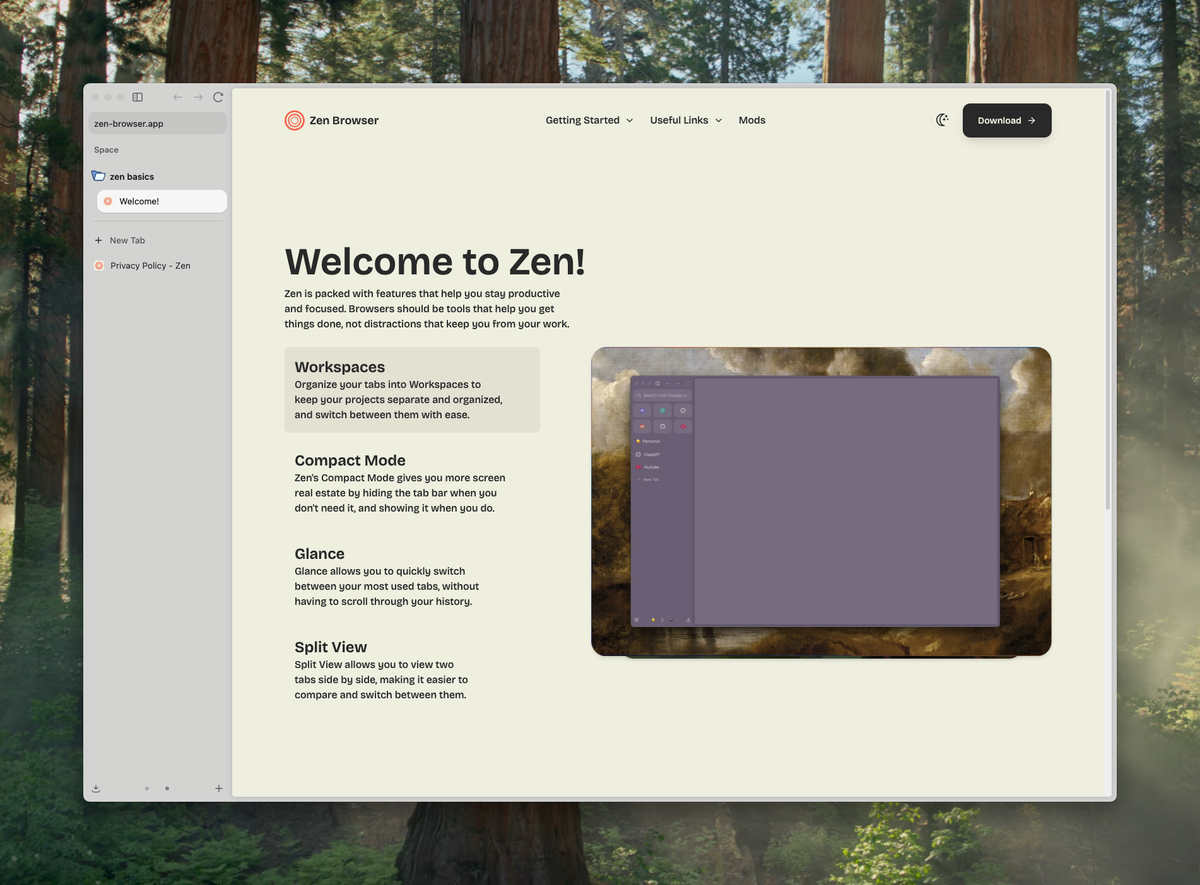
So the open-source picture, summarized: a fully open-source Chromium browser with Arc's complete workspace model does not exist. A fully open-source Firefox-based one does, and it's Zen. There is no in-between as of June 2026.
What to do if no open-source Arc fork ever ships
The community fork that "Arc is dying, make it open source" was asking for cannot happen. There's no public codebase, and The Browser Company has said why. Waiting for a fork is waiting for something that has no path to existing.
That leaves two realistic moves. The first is switching engines: adopt Zen and accept Gecko instead of Chromium. The second works in the opposite direction: keep whatever Chromium browser already fits (Chrome, Brave, Helium, Vivaldi, even Arc itself while it still runs) and add Arc's sidebar workflow on top of it, instead of replacing the browser.
That second approach is what SupaSidebar does. SupaSidebar is a macOS app that brings Arc's sidebar to every browser: one sidebar for tabs, bookmarks, files, and apps across 32+ browsers including Safari, Chrome, Firefox, Arc, Zen, Vivaldi, Brave, Helium, and Dia. Instead of betting on a community fork that has no codebase to start from, it layers the part of Arc people actually miss (the persistent vertical sidebar, Spaces, a command panel, pinned items) onto the Chromium (or any) browser already in use. SupaSidebar's own code is closed-source, but the practical complaint behind "make Arc open source" was usually "don't let the Arc workflow die," and a sidebar app keeps that workflow alive regardless of what happens to Arc's codebase.
For Arc refugees, that's often the lower-friction path. As one Reddit user put it after switching: "Moved from Arc to Safari, only thing I missed was the sidebar. This is it." (Reddit user, r/macapps). Another: "Switching from Arc was heartbreaking until I found this." (Reddit user, r/macapps).
Conclusion: the open-source Arc question, answered
There is no open-source Arc browser and no community fork in 2026. Arc is closed-source, and The Browser Company has stated it cannot open-source Arc without also open-sourcing ADK, the toolkit behind Dia. That's unlikely to change on any near-term timeline.
For users whose requirement is genuinely "must be open source," Zen Browser is the closest match: Firefox-based, fully open source, built to recreate Arc's sidebar and Spaces. For users who specifically need open source and Chromium, that browser does not exist; Helium is the nearest in look (open-source Chromium with vertical tabs) but lacks the full workspace model, and Vivaldi covers the most workflow ground but isn't open source at the UI layer. For users who care less about the source license and more about not losing Arc's workflow, the move is to keep an existing Chromium browser and add the sidebar layer on top with a tool like SupaSidebar.
If the goal is a ranked comparison of every Arc replacement, open source or not, the Arc Browser alternative guide is the next stop. If the decision is already made, Switching from Arc Browser covers the migration.
Why we recommend SupaSidebar
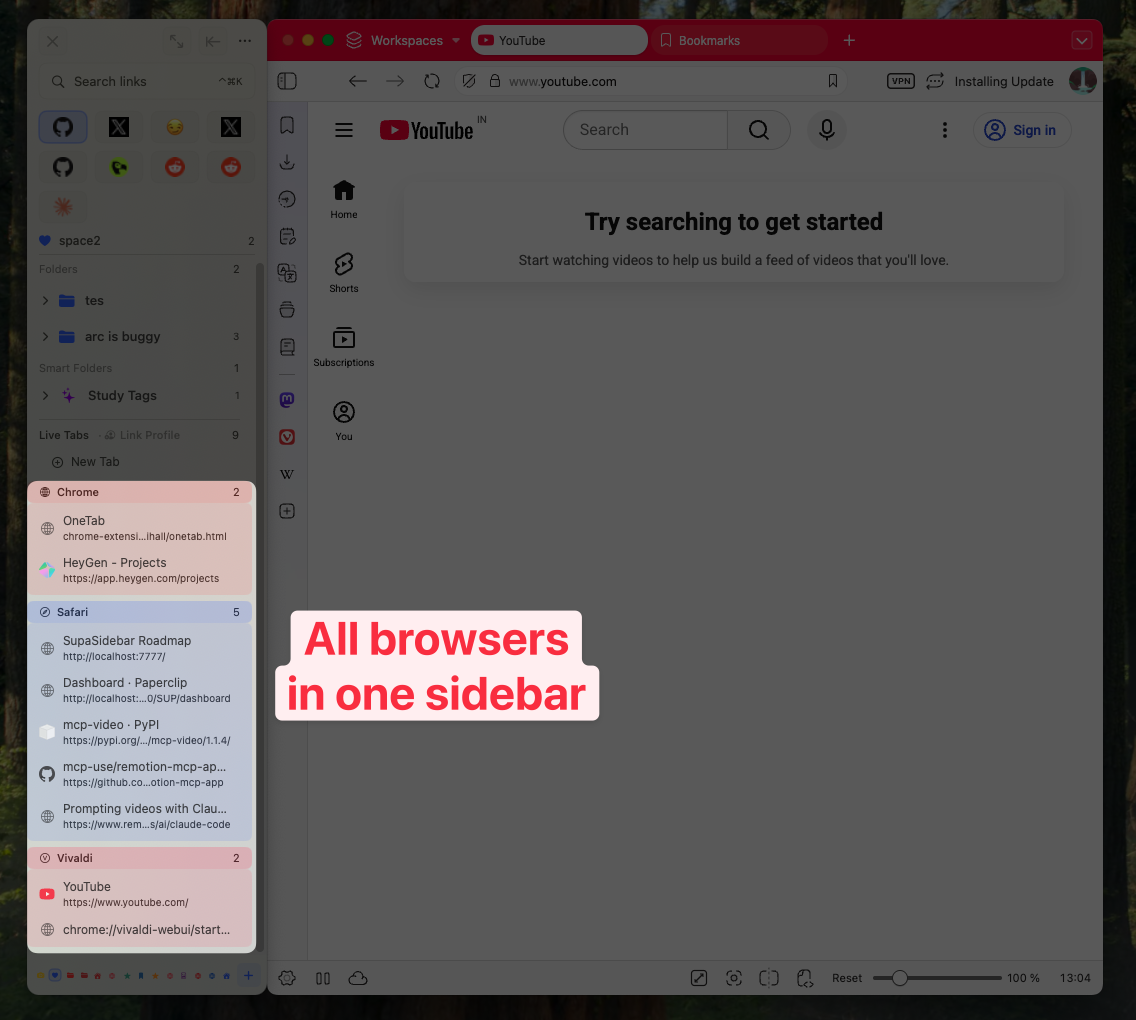
SupaSidebar is a macOS app that brings Arc's sidebar to every browser: one sidebar for tabs, bookmarks, files, and apps across 32+ browsers including Safari, Chrome, Firefox, Arc, Zen, Vivaldi, Brave, Helium, and Dia. For anyone who searched for an open-source Arc because they didn't want to lose the Arc workflow, it solves the actual problem: it keeps the persistent vertical sidebar, Spaces, command panel, and pinned items, on top of whatever browser already works, with no fork required and no engine switch required. A free version is available. Try SupaSidebar (free tier).
Written by Kshetez Vinayak, founder of SupaSidebar.
FAQ
Is there an open-source version of Arc browser?
No. Arc is closed-source software and has never had a public codebase. As of June 2026, there is no open-source release of Arc and no community fork, because there is no source code available to fork from.
Will The Browser Company open-source Arc?
There is no commitment or timeline. CEO Josh Miller said in May 2025 that Arc cannot be meaningfully open-sourced without also open-sourcing ADK, the internal toolkit that now powers Dia, and that ADK is "still core to our company's value." He left the possibility open for the future but the company has not announced any plan.
Is there an open-source Chromium browser with Arc-like UI?
Not a complete one. Open-source Chromium browsers like Helium, Thorium, Brave, and Ungoogled-Chromium are actively maintained, but none ship Arc's full workspace model (vertical sidebar with Spaces plus a command bar). Helium added experimental vertical tabs in 2026 and is the closest in appearance. Vivaldi covers the most Arc workflow ground but its UI is closed source.
Is there an Arc fork?
No. A "fork" requires a public source repository, and Arc's code has never been published. The closest thing to an "open-source Arc" is Zen Browser, which is not a fork of Arc. It's an independent, Firefox-based browser built from scratch to recreate Arc's sidebar and Spaces.
What is the closest open-source Arc alternative?
Zen Browser. It's Firefox-based, fully open source on GitHub, and designed specifically to replicate Arc's sidebar, Spaces, and minimal design. The main tradeoff is that it runs on Firefox's Gecko engine rather than Chromium, which matters if a workflow depends on Chrome-only extensions.
Can I get Arc's sidebar without switching browsers at all?
Yes. SupaSidebar is a macOS app that adds an Arc-style sidebar (tabs, bookmarks, Spaces, command panel, pinned items) on top of any of 32+ browsers, including Chromium ones like Chrome, Brave, and Helium. It's not open source itself, but it keeps the Arc workflow alive without requiring a fork or an engine change.
Is Zen Browser actually open source?
Yes. Zen Browser's full source code is published on GitHub under an open-source license, unlike Arc (closed-source) and Vivaldi (Chromium-based but closed UI layer).