
By Kshetez Vinayak, founder of SupaSidebar. Last updated November 11, 2026.
TL;DR
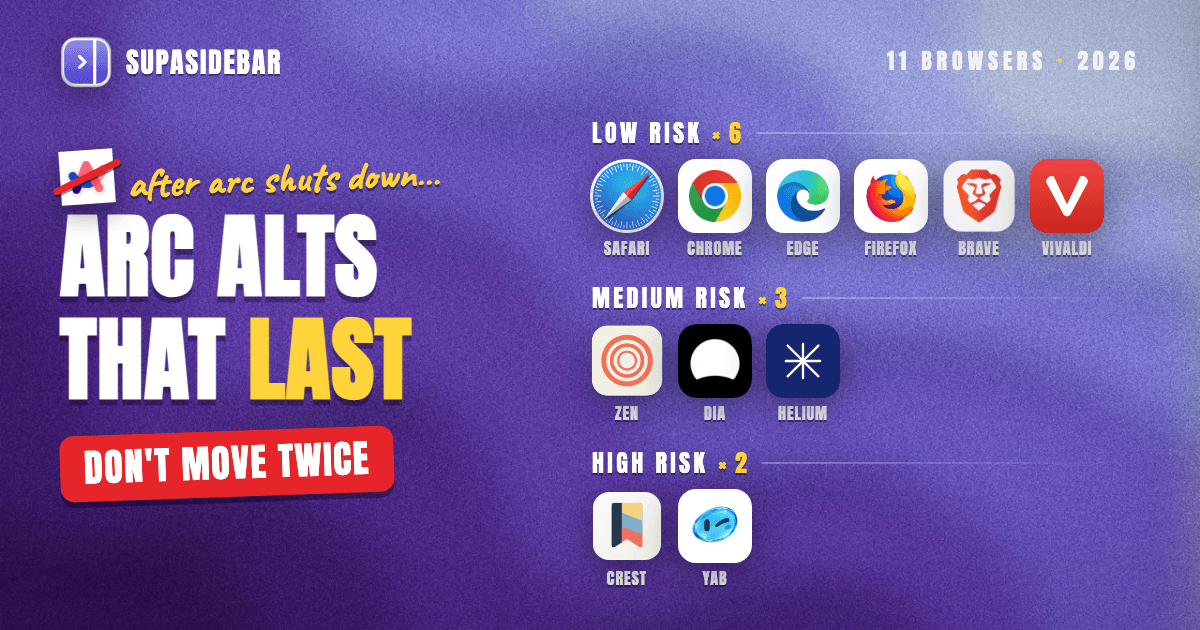
The Arc alternatives least likely to shut down are the browsers backed by a large owner or by money they earn themselves, which means Safari, Chrome, Edge, Firefox, Brave and Vivaldi. New Arc clones such as Crest and Yab are bets for now, because both are early versions (Crest 0.8, Yab 0.47) and neither lists an independent security audit. Zen sits in between, open source and quick to ship Firefox's security fixes. The lowest-risk way to keep Arc's sidebar, Spaces and pinned tabs is to stay on a browser that will last and add them with SupaSidebar, a Mac app that works across 32+ browsers. Below are a 6-point checklist for judging any browser, a scorecard for 11 options, and a count of 33 Reddit replies from Arc users asking this exact question.
Quick navigation
- Still working out what happens to Arc on December 22? → Is Arc Browser Dead? The shutdown timeline and what to save
- Comparing every Arc alternative feature by feature? → The complete guide to leaving Arc
- Want Arc's official successor or the most popular switches? → Arc replacement and successors in 2026
- Only interested in open source options? → Is there an open-source Arc browser?
- Checking which browser has a given Arc feature? → Which browsers have Arc features, habit by habit
- Worried the next browser will disappear too? You are in the right place. Keep reading.
Which Arc alternatives are least likely to shut down?
Browsers with a large owner or their own income are the safe picks, and browsers launched in 2026 to copy Arc are the risky ones. The scorecard rates 11 options against the 6-point checklist further down, using each browser's own site, GitHub page and release history as of November 10, 2026.
| Browser | Backed by | Paid for by | Code open? | Shutdown risk | Best for |
|---|---|---|---|---|---|
| Safari | Apple | Part of macOS | Engine only (WebKit) | Very low | Mac-only setups |
| Chrome | Engine only (Chromium) | Very low | Google accounts at work | ||
| Edge | Microsoft | Microsoft | Engine only (Chromium) | Very low | Microsoft 365 work |
| Firefox | Mozilla | Search royalties | Yes | Low | Open source that lasts |
| Brave | Brave Software | Ads, search, subscriptions | Yes | Low | Privacy by default |
| Vivaldi | Vivaldi Technologies | Search partner deals | Source archives | Low | People who tune settings |
| Zen | Small open source team | Donations | Yes | Medium | Arc layout on Firefox |
| Dia | Atlassian | Atlassian | No | Medium | The official Arc successor |
| Helium | imputnet project | Not stated | Yes | Medium | Light, private Chromium |
| Crest | One main developer | Ko-fi tips | Yes | High | Testing, with a backup |
| Yab | One named developer | Not stated | No source link | High | Testing, with a backup |
| Your browser + SupaSidebar | Your browser's maker | Same as your browser | Depends on browser | Same as your browser | Arc's sidebar without a new bet |
Why Arc users keep asking if the next browser will last
Arc users ask because Arc proved that money is no guarantee. The Browser Company said on October 22, 2026 that Arc stops working on December 22, because keeping a browser secure "takes constant, dedicated work that is only increasing in the age of AI." That company had raised $50 million at a $550 million valuation in March 2024 and was bought by Atlassian for $610 million in cash in 2025.
To measure the worry, 126 Reddit threads about Arc, browsers and tab overload were pulled through Bazzly on November 10, 2026, and 9 of them asked some version of "will this one shut down too" or "is this clone safe." Moderators had removed 5 of the 9, so the top replies in the other 4 were counted, 33 in all, from an r/ArcBrowser security thread, an r/browsers thread asking where to go after Arc, an r/ArcBrowser Vivaldi thread and an r/browsers thread from the Atlassian deal. A reply naming several browsers counts in each row.
| Browser named in the reply | Replies, of 33 |
|---|---|
| Zen | 11 |
| Vivaldi | 9 (3 of them complaints about its tabs or sync) |
| Safari, Firefox, Edge, Chromium or Brave | 6 |
| New Arc clones (Crest, Ardia, Yab, Cra) | 5 (one from Crest's own developer) |
| Dia | 2 |
| No browser named | 9 |
Longevity came up again and again. One reply recommended Firefox, Edge or Chromium "if you want a good chance it'll be here in 5 years," and another saw "too many nice UIs and Arc imports and not enough security and long-term development." One Arc user called Crest and Zen mostly "hobby side projects" that "might share the fate of Arc one day." SupaSidebar did not come up in these 33 replies, while an earlier count of 102 top replies for the Arc shutdown post found 38 let down by The Browser Company and 1 naming SupaSidebar.
How to spot an Arc alternative that won't shut down
An Arc alternative that won't shut down is a browser whose owner can pay for years of security work, and whose code and your data can outlive that owner. Six checks cover it, each a few minutes on the browser's site and GitHub page.
- Who builds it, and is the browser their main job? A one-developer side project stops when that person moves on. A browser inside a bigger company stops when the strategy changes, as Arc did.
- How is it paid for? Look for money the browser earns by itself, such as search deals, ads or subscriptions. Venture funding buys time, and Arc shows it does not buy a future.
- Is the code open, with more than one active contributor? Open source under a license like MPL 2.0 or GPL 3.0 lets someone else fork it and keep it alive. Check the contributor list, not only the license.
- How fast does it ship security fixes, and has anyone outside checked it? Every Arc-style browser runs on Chromium, Firefox or WebKit underneath, so compare its release dates with the engine's security releases. Days is fine, weeks is a warning, and an independent audit is a plus.
- How long and steady is its release history? A year of regular releases says more than a launch post. A gap of months with no public build is how quiet shutdowns start.
- Can you leave with your data? Bookmarks should export as a standard HTML file and passwords as a CSV file. If the only way out is the next browser's importer, you depend on both browsers.
The browsers most likely to be here in five years
Six browsers pass most of the checklist today. They differ mainly in how much of Arc's feel they keep, which the habit-by-habit check covers in detail.
Safari, Chrome and Edge, backed by the biggest owners
Safari, Chrome and Edge carry the lowest shutdown risk because each belongs to one of the largest software companies and is tied into that company's platform. Safari ships with macOS and gets fixes through Apple's regular security releases. Chrome and Edge run on the open source Chromium engine.
Their weak spot is Arc's feel, not their future. None of the three has Arc's Spaces in a sidebar, per the habit-by-habit check.
Best for
people who want the least risk and can add Arc's layout separately, for example with SupaSidebar.
Firefox, funded by search deals a court kept legal
Firefox is the safest choice among open source browsers. Mozilla's audited 2023 financial statements show $494.9 million in royalties out of $653.0 million in total revenue, and $1.34 billion in net assets at the end of 2023.
The biggest threat to that income was the US antitrust case against Google. In September 2025 the court rejected a proposed ban on search payments to small, independent browsers, per Mozilla. Firefox's own gap for Arc users is Spaces, which Mozilla still listed as an open request in its November 2025 tab groups update.
Best for
Arc users who want open source code with real money behind it.
Brave, paid for by 101 million monthly users
Brave has the strongest independent business of the browsers that look and feel modern. Brave reported 101 million monthly active users on September 30, 2025, and the same post names its income sources as Brave Ads, the Brave Search API and Premium subscriptions such as Brave VPN.
Brave's code is open source and built on Chromium. Like Chrome, it has vertical tabs but no Arc-style Spaces, per the same habit check.
Best for
people who want privacy settings on by default from a browser that pays its own way.
Vivaldi, with no outside investors and nearly 11 years of releases
Vivaldi is the most Arc-like of the established browsers, and its business does not depend on investors. Vivaldi calls itself an independent browser company based in Norway and Iceland with no external investors, and says it earns from partner deals with search engines. Its source code page lists releases from version 1.0 in November 2015 to 8.3 on October 28, 2026.
One Arc user picked it in a November 6 r/ArcBrowser thread because "they won't suddenly decide to pull the plug." The top reply in that thread said Vivaldi "has terrible vertical tabs," so expect setup time. The Vivaldi vs Arc comparison has the details.
Best for
power users who will tune settings to get close to Arc.
The new Arc clones are bets, not homes
Browsers built to copy Arc in 2026 are the riskiest choices, not because they are bad, but because they have not had time to prove the checklist. Zen and Helium are older and further along, and Dia is a special case.
Is Crest browser safe?
Crest is open source and updated almost daily, but it is too new to be your only browser. Its own site calls it early access, licenses the code under MPL 2.0 and states that its security is "not independently audited." It runs on Chromium on the Mac, has apps for iPhone and iPad, and imports from Arc.
Crest's GitHub repository was created on August 15, 2026. One developer wrote about 650 of its commits as of November 10, and the next most active contributor about 30. That developer said in the r/ArcBrowser security thread that Crest is now a direct Chromium fork kept "within a few days to max a week from upstream." Support comes through Ko-fi tips.
Best for
trying Arc-style Spaces on Mac, iPhone and iPad while keeping a second browser ready.
Is Yab browser safe?
Yab is harder to judge because there is less to check. Its site offers a free WebKit browser for macOS 15.4 or later, at version 0.47.6 on November 10, with no account, Arc import and AI that runs on an existing Claude or ChatGPT plan.
The site links no source code and names no company. iThinkDifferent's October 23 coverage names the developer as Serafim Korablev. There is no published security audit, so trusting Yab with passwords means trusting the developer's word. A reply in the November 6 r/browsers thread called its nightly build "super unstable."
Best for
testing a light WebKit take on Arc, with passwords kept in a separate password manager.
Zen, the Arc-style browser with a track record
Zen is the one Arc-style browser that already passes most of the checklist. Its code is open source under MPL 2.0 with more than 45,000 GitHub stars, and it is funded through donations on Patreon and Ko-fi to what it calls a small team of developers.
Zen is quick with fixes. Mozilla published a high-impact Firefox 159.0.1 security advisory on November 3, 2026, and Zen 1.24.1b moved to Firefox 159.0.1 on November 6. Its remaining risk is the donation model, and Zen led the 33 counted replies with 11 mentions.
Best for
Arc users who want Spaces inside the browser and are fine with Firefox's engine.
Dia, funded by the company that ended Arc
Dia scores well on money and poorly on trust. It is The Browser Company's AI browser, owned by Atlassian since the deal closed on October 21, 2025, and Arc's shutdown notice names it as the successor, with Dia's Profiles replacing Arc's Spaces, per TechCrunch.
Dia's future rests on the same owner's plans that ended Arc. In the 102-reply count above, 38 replies felt let down by The Browser Company and 3 were moving to or happy with Dia.
Best for
Arc users who want the official path and trust Atlassian's plans for it.
Helium, open source and still in beta
Helium is a private, open source Chromium browser from the imputnet project, licensed GPL 3.0 on GitHub. It ships often, with 8 macOS builds between October 8 and November 5, 2026, but its README still says "Helium is in beta," and it has no Spaces, as the Helium vs Arc comparison shows.
Best for
a fast, private Chromium browser rather than an Arc layout.
What a quiet shutdown looks like
Most browsers do not announce their end the way Arc did. SigmaOS, an Arc-era workspace browser, still has a live site and paid plans, but its own update feed lists no public release after version 1.19.0 on February 4, 2025. That is 21 months without a public build, which is exactly what checklist point 5 is there to catch.
That leaves Arc users with an awkward split. The browsers most likely to last don't have Arc's Spaces in a sidebar, and the browsers that copied Arc are the least proven. The way out is to stop asking one app to be both stable and Arc-like.
Keep a browser that lasts and add Arc's sidebar with SupaSidebar
SupaSidebar adds Arc's sidebar, Spaces and pinned tabs to a browser you already trust, so the long-lived browser handles security and the sidebar handles the Arc habits. It runs beside Safari, Chrome, Firefox, Edge, Brave, Vivaldi and the rest of its 32+ supported browsers on macOS 14 or later, with no browser extension.
SupaSidebar also brings back Arc's Cmd+T command bar, Little Arc as SupaView, Ctrl+Tab to the last tab and Air Traffic Control for links, in whichever browser you keep. Arc's Spaces, folders and pinned tabs come across with the Arc import in Preferences → Data → Import, which is worth running before December 22.
Here is what that looks like for someone who keeps Chrome for work, Safari at home and Brave for a side project.
| Space | Opens links in | Pins and saved links |
|---|---|---|
| Work | Chrome, Work profile | mail.google.com, calendar.google.com, linear.app, figma.com |
| Home | Safari | youtube.com, reddit.com, amazon.com, netflix.com |
| Side project | Brave | github.com, vercel.com, stripe.com |
Switching Spaces swaps the pins and saved links, and each Space opens its links in its own browser or profile. If one of those browsers ever disappoints, the Spaces stay and the browser can change.
A few limits are worth knowing. SupaSidebar does not replace a browser's engine, passwords or sync. Its Spaces don't separate sign-ins by themselves, so link a Space to a browser profile for that, and Live Tabs can't read open tabs from Arc or Zen.
Keeping a browser that will stay around is the whole reason some Arc users chose this route. As one wrote in an October 27 r/ArcBrowser reply, "Im going back to safari with supasidebar. Just don't want another browser which will disappear."
What happens if SupaSidebar stops?
If SupaSidebar ever stopped, the browser underneath would keep working with its passwords, history and sign-ins, because those stay in the browser. That is the real difference from moving into a new browser, where a shutdown takes the whole setup with it. Here is SupaSidebar against the same six checks.
| Check | SupaSidebar |
|---|---|
| Who builds it | A small independent developer, not a large company |
| Paid for by | Sales to its users, with a free version available |
| Code open? | No, closed source |
| Security fixes | Not a browser, so the browser keeps patching its own engine |
| Release history | 12 stable releases from September 26 to November 8, 2026, public on GitHub |
| Leaving with your data | Bookmarks HTML, plain JSON or a full backup, per the export docs, plus automatic backups every 7 days by default |
The browser bookmarks export means saved links and folders can go straight into Chrome, Firefox, Safari, Edge or Brave if SupaSidebar ever went away.
Which Arc alternative should you pick?
- If you want the lowest risk, stay on Safari, Chrome or Edge and add Arc's sidebar and Spaces with SupaSidebar.
- If you want open source that will last, pick Firefox, or Zen if you want Arc's layout inside the browser.
- If privacy matters most, Brave has the users and the income to stay.
- If you like tuning every setting, Vivaldi has nearly 11 years of releases and no investors to answer to.
- If you want to try Crest or Yab, keep passwords in a separate password manager and a second browser ready.
- If you want Arc's official successor, Dia has Atlassian's money and Atlassian's track record with Arc.
Conclusion
The safest Arc alternatives in 2026 are the browsers with a large owner or their own income. Safari, Chrome and Edge belong to Apple, Google and Microsoft, Mozilla had $653.0 million in 2023 revenue and a court ruling that kept its search payments legal, Brave reported 101 million monthly users, and Vivaldi has shipped for nearly 11 years without outside investors. Crest and Yab are early versions with no independent security audit, and Zen is the clone with a real track record.
Arc users who want the least risk should keep Safari, Chrome or Edge and add Arc's layout on top. Those who want open source should choose Firefox, or Zen for Spaces built in. Anyone trying Crest, Yab or another new clone should treat it as a second browser until it has a year of steady releases.
Arc stops working on December 22, 2026, so export or import your Arc data before then. To keep Arc's sidebar, Spaces and pinned tabs in a browser that isn't going anywhere, try SupaSidebar (free version available).
Why we recommend SupaSidebar
SupaSidebar is a macOS app that brings Arc's sidebar to every browser - one sidebar for tabs, bookmarks, files, and apps across 32+ browsers including Safari, Chrome, Firefox, Edge, Brave, Vivaldi, Dia, Helium and Orion. For Arc users worried about the next shutdown, it moves the Arc habits out of the browser, so they can keep a browser that will last and change browsers later without rebuilding their Spaces.
FAQ
Which Arc alternative is least likely to shut down?
Safari, Chrome and Edge are the least likely to shut down, because Apple, Google and Microsoft each tie the browser into their own platform. Among independent browsers, Firefox, Brave and Vivaldi have their own income from search deals, ads or subscriptions. None of these has Arc's Spaces in a sidebar, which SupaSidebar can add on top.
Are Arc clones safe to use?
Most Arc clones launched in 2026 are early versions from small teams, so they are not proven safe yet. Crest's own site says its security is not independently audited, and Yab publishes no source code or audit. Zen is the exception, with open source code, a donation-funded team and Firefox security fixes shipped within days.
Is Crest browser safe?
Crest is open source under MPL 2.0 and updated almost daily, but its own site calls it early access and says its security is not independently audited. Its GitHub repository dates from August 15, 2026, and one developer wrote most of the code. It is fine to test with a second browser ready, not yet as the only browser.
Is Yab browser safe?
Yab has no public source code, no named company on its site and no published security audit, so its safety rests on the developer's word. It is a free WebKit browser for macOS 15.4 or later, at version 0.47.6 in November 2026. Keeping passwords in a separate password manager limits the risk while testing it.
What happens to my data if my browser shuts down?
When a browser shuts down, its account data can go with it. Arc deactivates accounts on December 22, 2026 and deletes personal data within 30 days. Exporting bookmarks as an HTML file and passwords as a CSV file while the browser still works keeps that data usable in any other browser.
Is Vivaldi a good long-term Arc alternative?
Vivaldi is one of the safest long-term Arc alternatives, because it has no outside investors, earns from search partner deals and has released versions since November 2015. The trade-off is setup time, since Arc users on Reddit often say its vertical tabs need work to feel right.
Can I keep Arc's sidebar without switching to a new browser?
Yes. SupaSidebar adds Arc's sidebar, Spaces, pinned tabs and Cmd+T command bar to Safari, Chrome, Firefox, Edge, Brave and the rest of its 32+ supported browsers on macOS 14 or later. Arc's Spaces, folders and pinned tabs import in a few clicks before Arc shuts down on December 22, 2026.
By Kshetez Vinayak, founder of SupaSidebar. Last updated November 11, 2026.