
By Kshetez Vinayak, founder of SupaSidebar. Last updated July 1, 2026.
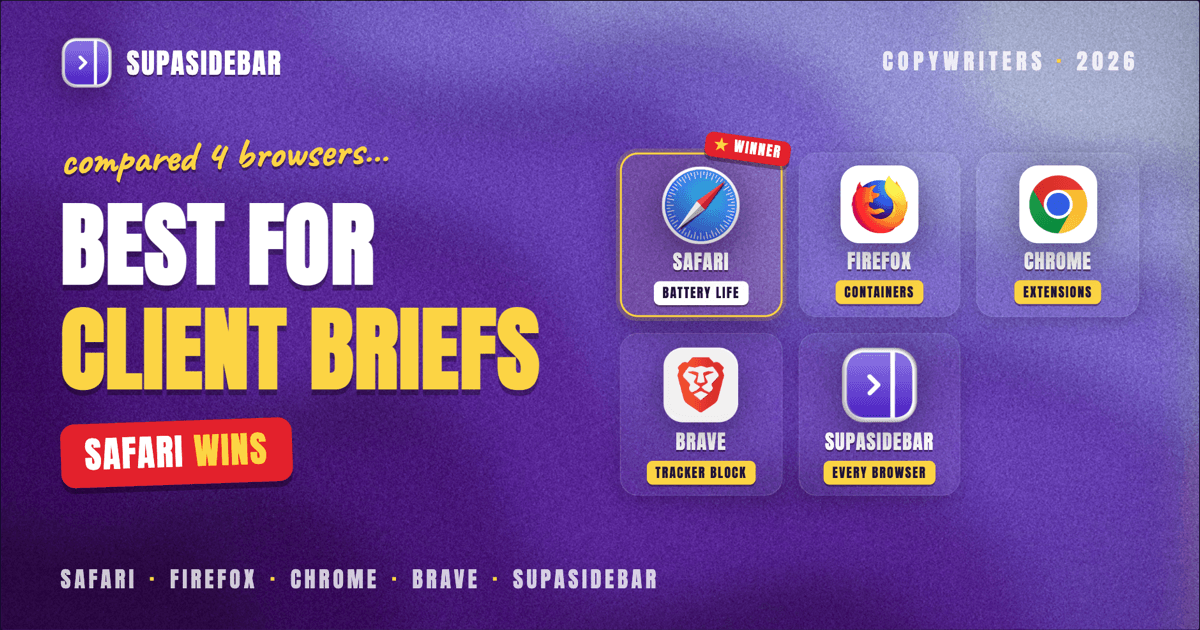
For most copywriters on a Mac in 2026, Safari is the best browser for the core problem of the job: it is the most battery-efficient option on Apple Silicon and its Reader mode and clean rendering keep research pages readable while a draft sits open for hours, which suits the long, focused sessions copywriting runs on. Firefox is the better pick when the work means juggling several clients at once, because Multi-Account Containers isolate each client's logged-in tools and portals in one window. Chrome is the default when the writing depends on extensions like grammar checkers, SEO bars, and clipping tools, since it has the deepest extension library. But the browser is rarely the real bottleneck. The harder problem is keeping each client's brief, research, style guide, and reference tabs together and switchable without drowning in an undifferentiated wall of tabs, and that is a workspace problem no single browser solves. SupaSidebar is the macOS sidebar that fixes it across whichever browser a copywriter runs.
Quick navigation:
- Comparing every Mac browser, not just the copywriting angle? → Best Browser for Mac in 2026
- Want the broader writers-and-research browser comparison? → Best Browser for Writers on Mac in 2026
- Looking for the full Mac app stack for copywriting? → Best Mac Apps for Copywriters in 2026
- Comparing how a sidebar fixes tab chaos across browsers? You are in the right place. Keep reading.
| Browser | Best for | Focus and research handling | Multi-client separation |
|---|---|---|---|
| Safari | Long, battery-friendly writing sessions | Reader mode strips clutter from research pages; deep macOS integration | Profiles (2022+), one window per profile |
| Firefox | Copywriters running several clients at once | Reader View plus per-container tab isolation in one window | Multi-Account Containers, per-tab isolation |
| Chrome | Extension-heavy workflows (grammar, SEO, clipping) | The deepest extension library for writing helpers | Profiles, durable per-client login sets |
| Brave | Distraction-free reading with tracker blocking | Shields strip ads and trackers from research pages by default | Profiles, plus per-profile Shields |
| SupaSidebar (layer, not a browser) | Keeping every client's research together across any browser | One Space per client or project, across all of the above | One Space per client, across every browser at once |
What copywriters actually need from a browser on Mac
The best browser for copywriters on Mac in 2026 is the one that handles three jobs at once: it holds a research session's worth of tabs without the writer losing the brief in the noise, it keeps each client's material separated so one account's style guide and portals do not bleed into another's, and it stays out of the way during the long stretches of focused writing the work depends on. This post compares the major Mac browsers on exactly those three jobs. It does not rank the writing apps themselves (the drafting tool, the grammar checker, and the project docs run alongside whichever browser you pick), and it is Mac-specific.
A copywriter's browser session looks nothing like a casual one. A single assignment can mean the client's brief open in one tab, their brand style guide in another, three or four competitor pages for tone reference, a keyword or SERP tab, the shared doc where the draft lives, and a swipe file of headlines that inspired the angle. The browser has to hold all of that at once, keep the reference material one glance away from the draft, and not turn into thirty identical tabs by mid-afternoon.
Most of a copywriter's raw material now lives in the browser. Client briefs arrive in web docs, brand guidelines sit in shared drives, and research is a spread of live pages rather than saved files, which makes the browser the actual workspace. When a copywriter runs work for several clients, the standard professional setup is a dedicated browser profile or container per client, precisely because it keeps each client's logins, docs, and reference sessions strictly separated (Google Chrome Help, add and manage Chrome profiles). That makes browser choice a real decision, but it also exposes the limit: a browser can hold the tabs, it just was not built to keep a dozen briefs' worth of them organized.
Safari: the efficient, distraction-free default
Safari is the best browser for a copywriter who works in long, focused sessions and wants the machine to stay cool and the battery to last. It is the most battery-efficient option on Apple Silicon and deeply integrated with macOS, which matters when a draft stays open for hours next to a dozen research tabs. Its Reader mode strips a cluttered article down to clean text, so pulling tone or a fact from a competitor page does not mean fighting through ads and pop-ups mid-thought.
Safari also runs Intelligent Tracking Prevention with no setup, which quietly limits the cross-site tracking a writer picks up while sampling competitor pages, ad landing pages, and swipe-file sources (Intego, most secure browser for Mac 2026). For research that ranges across a lot of unfamiliar marketing sites in a day, quiet default protection is a real convenience.
The honest limits are extensions and scale. Safari's extension catalog is thin on the writing-and-SEO tooling copywriters lean on compared with Chrome, so anyone who depends on a particular grammar or SEO helper will hit gaps. Safari supports Profiles for splitting "Work" from "Personal," but it was not built to hold a dozen distinct client contexts at once, and that ceiling arrives fast for a freelancer with a full client book.
Best for:
copywriters who value battery, macOS integration, and clean reading for long focused writing sessions.
Firefox: many client briefs at once
Firefox is the best browser for a copywriter who works with several clients and needs their material kept apart. Its standout feature is Multi-Account Containers, which sandbox cookies and logins per container, so one client's logged-in docs, CMS, and brand portal stay completely walled off from another's inside a single window (Mozilla Support, Multi-Account Containers). Where Chrome Profiles want a separate window per client, Firefox Containers let a writer run client A, client B, and client C as color-coded tabs side by side without logging anyone out.
Firefox also has a capable Reader View that clears the page down to text, which pairs well with research-heavy drafting where most tabs are articles to read rather than tools to operate. Between containers and Reader View, a freelancer can keep each client's live workspace separate while still reading source pages cleanly.
The cost is effort and, on Apple Silicon, efficiency. Firefox rewards configuration, so a writer gets the most out of containers only by investing the setup time, and its on-Mac battery life trails Safari during those long sessions.
Best for:
copywriters and freelancers who juggle multiple clients and want each client's tools and logins isolated inside one window.
Chrome: the extension and tooling workhorse
Chrome is the best default browser for copywriters whose writing leans on extensions, because Chrome has the deepest extension library of any browser. The everyday copywriting toolkit lives there: the grammar and style checkers, the SEO and keyword bars, the readability graders, and the clip-and-save extensions that pull a headline or a source into a swipe file. For a writer who runs a lot of helpers on the page, the breadth of the Chrome Web Store is the single biggest reason the browser stays open all day.
Chrome's Profiles also separate work cleanly: each profile carries its own cookies, logins, extensions, and bookmarks, so a profile per client becomes a durable, self-contained identity rather than an account you have to remember to log out of (Google Chrome Help, add and manage Chrome profiles). Profiles isolate at the profile level rather than the tab level, which is why the standard advice is one window per client, and why a writer moving between clients ends up switching whole windows (MakeUseOf, the Firefox productivity feature Chrome lacks).
The catch is resource use and focus. Chrome is known to eat RAM once a research day fans out across many tabs and windows, and a browser built around extensions and switching windows is not a naturally distraction-free place to write.
Best for:
copywriters who depend on grammar, SEO, and clipping extensions and want durable per-client Profiles.
Brave: distraction-free reading with tracker blocking
Brave is the best browser for a copywriter who wants research pages stripped of ads and trackers before they load. Brave Shields block trackers, cross-site cookies, and fingerprinting by default, and Brave reports blocking roughly 97% of trackers out of the box, compared with about 85% for Firefox's Enhanced Tracking Protection (Brave Shields). For a writer reading through competitor funnels and ad landing pages all day, aggressive default blocking makes the pages quieter to read and keeps those sites' pixels from following the device around.
Brave is built on Chromium, so it runs the same Chrome extension library a copywriter already relies on and the web apps the writing tools test against, while randomizing the browser fingerprint between sessions. That makes it the rare privacy-first browser that does not cost the writer their toolkit.
The trade-off is that Brave's default blocking can occasionally break a script-heavy client dashboard or a preview widget, so a writer checking how their copy renders in a client's CMS should be ready to lower Shields per-site.
Best for:
copywriters who want clean, tracker-free research reading while keeping the Chrome extension library.
The real problem: one browser cannot hold every brief
Here is the part the browser comparison misses. Pick the browser with the cleanest containers, the best Reader mode, and the deepest extension shelf, and a copywriter running four active clients still ends up with thirty tabs, a separate brief and style guide for each account, and no fast way to jump from one client's research set to another's. Containers and profiles help, but switching profiles means switching whole windows, and the bookmarks bar fills with client folders nobody opens mid-draft. The friction is not the browser, it is the lack of a workspace layer on top of it.
SupaSidebar is the macOS sidebar that solves this across any browser. It is a native Mac app, not a browser and not an extension, that adds a persistent sidebar beside whatever browser a writer runs. The relevant feature for copywriting is Spaces: one Space per client or project, each holding that client's pinned brief and style guide, its saved research and swipe-file links, and the tabs that belong to it. Switching from one assignment to another becomes switching a Space, not hunting through a wall of near-identical article tabs.
Because SupaSidebar's Live Tabs can show open tabs from supported browsers in one list, a copywriter running Safari for a battery-friendly reading session and Firefox containers for a separated client login sees both in a single sidebar instead of alt-tabbing between windows. The Command Panel (⌘⌃K) then searches saved links, recent pages, and live tabs across every browser at once, so pulling up the right client's brief is one keystroke rather than a memory test. SupaSidebar supports every major Mac browser, 32+ in total including Chrome, Firefox, Safari, Brave, Edge, Arc, and Vivaldi, so the writer's browser choice and the organization layer stay independent.
A concrete setup for a freelance copywriter might look like this:
| Space | What lives in it |
|---|---|
| Acme Rebrand (client) | the brief doc, Acme's brand style guide, three competitor pages for tone, the shared draft in docs.google.com |
| SaaS Email Series (client) | that client's CMS, the product page, the persona research, the keyword tab, the draft |
| Swipe + Craft | a swipe file of headlines, the grammar and readability tools, the invoicing tab, the pitch tracker |
Switching from "Acme Rebrand" to "SaaS Email Series" swaps the whole set of tabs and pinned references in one click, so the writer lands back in the right brief instead of rebuilding the research session from memory. It organizes the work, not the writing inside it: SupaSidebar is not a drafting app and does not check grammar, store documents, or edit copy, it groups the tabs and links around each brief. It also saves nothing about the pages themselves, so it inherits whatever privacy and login posture the underlying browser provides.
As one r/macapps user described why it fits a multi-browser workflow, SupaSidebar "is built for exactly this use case: people who use multiple browsers and need a way to consolidate browser context without paying a constant productivity tax every time they switch" (amerpie, r/macapps). That per-client separation is the most-requested SupaSidebar workflow across its users.
Why SupaSidebar fits a copywriting workflow
SupaSidebar is a macOS app that brings Arc's sidebar to every browser - one sidebar for tabs, bookmarks, files, and apps across 32+ browsers including Chrome, Firefox, Safari, Edge, Brave, Arc, and Vivaldi. For a copywriter, that means the reading decision (Safari for battery and clean Reader mode, Firefox containers for separated client tools, Chrome for extensions, Brave for tracker-free reading) and the organization decision (one Space per client or project) stop competing. Pick the browser that meets the research and tooling needs, then let SupaSidebar keep each brief's context together on top of it. It runs on macOS 14 and later, syncs across Macs through iCloud with no account required, and a free version is available to try the per-client Space workflow before committing.
The bottom line
For most copywriters on a Mac in 2026, run Safari as the daily browser when the core problem is long, focused writing on battery, because it is the most efficient option on Apple Silicon and its Reader mode keeps research pages clean. Choose Firefox when the work means juggling several clients at once, because Multi-Account Containers isolate each client's tools inside a single window. Keep Chrome when the writing depends on grammar, SEO, and clipping extensions and durable per-client Profiles. Reach for Brave when tracker-free reading of competitor pages is the priority. Whichever browser wins, the brief-juggling problem remains, and that is the gap SupaSidebar closes: one Space per client or project across every browser at once. Copywriters evaluating the full picture can start with Best Browser for Mac in 2026 for the general ranking, then Try SupaSidebar (free tier) to test the per-client workflow.
Written by Kshetez Vinayak, founder of SupaSidebar.
FAQ
What is the best browser for copywriters on a Mac in 2026?
For most copywriters, Safari is the best browser when the core problem is long, focused writing on battery, because it is the most battery-efficient option on Apple Silicon and its Reader mode keeps research pages clean. Firefox is the better pick when the work means juggling several clients at once, because Multi-Account Containers isolate each client's tools inside one window, and Chrome suits writers who depend on grammar, SEO, and clipping extensions. The browser choice matters less than having a workspace layer that keeps each brief's research separated, which SupaSidebar provides across any of them.
Which browser is best for keeping multiple clients' work separated as a copywriter?
Firefox is strong here because Multi-Account Containers sandbox cookies and logins per container, so several clients' docs and portals can stay logged in side by side in one window without colliding. Chrome Profiles also separate clients cleanly but isolate at the profile level, meaning one window per client. For a copywriter who switches between many briefs in a day, a sidebar app like SupaSidebar adds one Space per client on top of whichever browser they use, so each brief's tabs and reference links travel together.
What is the most distraction-free browser for copywriting on a Mac?
Safari and Brave both make research reading quieter: Safari's Reader mode strips an article to clean text, and Brave Shields block ads and trackers by default so competitor pages load without clutter. Neither one removes the deeper distraction, which is a screen full of undifferentiated tabs. Grouping each brief's tabs into its own SupaSidebar Space does more for focus than any single reading mode, because the writer only sees the tabs that belong to the assignment in front of them.
Do I need a special browser to be a copywriter, or is an organizer enough?
Any of the major Mac browsers can hold a copywriter's research; the friction is organization, not the browser engine. A writer running one or two clients on Safari with Reader mode is well served, and a writer running many clients benefits from Firefox containers or Chrome profiles. Adding a sidebar organizer like SupaSidebar on top matters more than switching browsers, because it keeps each client's brief, style guide, and reference tabs together and one keystroke away.
Does SupaSidebar replace my writing or grammar tools?
No. SupaSidebar organizes the tabs and links around each brief; it is not a drafting app and does not write, edit, check grammar, or store documents. It sits beside whatever browser and writing tools a copywriter already uses and keeps each client's research and reference pages grouped in its own Space. The drafting tool, grammar checker, and project docs stay exactly where they are.
By Kshetez Vinayak, founder of SupaSidebar.