
By Kshetez Vinayak, founder of SupaSidebar. Last updated July 1, 2026.
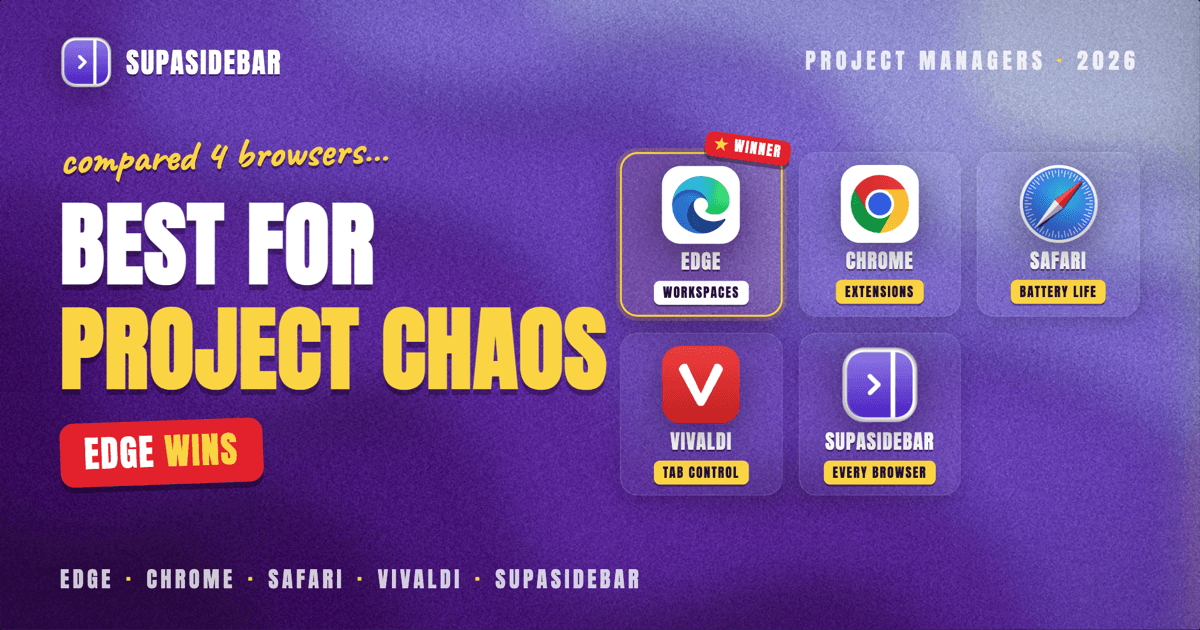
For most project managers on a Mac in 2026, Microsoft Edge is the best browser for the core problem of the job: its Workspaces feature gives each project its own named, color-coded set of pinned tools and tabs, so a PM can keep one project's Asana, docs, and stakeholder portals separate from the next project's without window-juggling. Chrome is the better default when the work depends on browser extensions and durable per-client Profiles, because it has the deepest extension library and each profile carries its own logins and tools. Safari is the efficiency pick for a PM who runs a lighter load and wants the longest battery on Apple Silicon. But the browser is rarely the real bottleneck. The harder problem is that a project manager runs many tools across many projects at once, and keeping each project's dashboards, docs, and tabs grouped and switchable is a workspace problem no single browser fully solves. SupaSidebar is the macOS sidebar that fixes it across whichever browser a PM runs.
Quick navigation:
- Comparing every Mac browser, not just the PM angle? → Best Browser for Mac in 2026
- Want the full Mac app stack for project work? → Best Mac Apps for Project Managers in 2026
- Mainly trying to organize tabs by project? → How to Organize Browser Tabs by Project on Mac
- Comparing how a sidebar fixes tab chaos across browsers? You are in the right place. Keep reading.
| Browser | Best for | Per-project separation | Tool and extension support |
|---|---|---|---|
| Edge | Keeping each project's tools together | Workspaces: one named, color-coded set of pinned tabs per project | Runs the Chrome extension library on Chromium |
| Chrome | Extension-heavy, multi-client work | Profiles, durable per-client login sets | The deepest extension library, every major tool tested on it |
| Safari | Lighter loads, battery on Apple Silicon | Profiles (2022+), one window per profile | Thin, few project-tooling extensions |
| Vivaldi | Power users who want maximum tab control | Workspaces plus Tab Stacks and split view | Runs the Chrome extension library on Chromium |
| SupaSidebar (layer, not a browser) | Keeping every project's tabs together across any browser | One Space per project, across all of the above at once | Inherits the browser's extensions; organizes tabs, not page content |
What project managers actually need from a browser on Mac
The best browser for project managers on Mac in 2026 is the one that handles three jobs at once: it keeps each project's tools and stakeholder logins cleanly separated so work for one client never bleeds into another, it runs the project-management tools the work depends on, and it survives the twenty-plus tabs a single coordination day spreads across the screen. This post compares the major Mac browsers on exactly those three jobs. It does not rank the project-management platforms themselves (Asana, Jira, Monday, Notion, and the like run inside or alongside whichever browser you pick), and it is Mac-specific.
A project manager's browser session looks nothing like a casual one. A single afternoon can mean one client's Asana board open in one tab, that project's shared Google Drive in another, a Jira backlog for a second project, a vendor portal, a status dashboard, a stakeholder's shared doc, and a separate logged-in identity for each organization under management. The browser has to hold all of that without mixing one project's session into another's, and without choking when the tab strip fills.
Most project tooling is now browser-based, which makes the browser the workplace. Boards, docs, dashboards, and client portals are web apps tied to a login, and the standard professional setup is a dedicated browser profile or workspace per project precisely because it keeps cookies, sessions, and login state strictly separated (Google Chrome Help, add and manage Chrome profiles). That makes browser choice a real decision, but it also exposes the limit: a browser can hold the logins, it just was not built to keep ten projects' worth of them organized.
Edge: a workspace per project, built in
Microsoft Edge is the best browser for a project manager who wants each project's tools grouped on their own, because its Workspaces feature was built for exactly this. A Workspace is a named, color-coded set of tabs a PM creates per project, pinning that project's board, docs, and portals so they reopen together and stay separate from every other project's tabs (Microsoft, Edge Workspaces). Where Chrome Profiles separate accounts, Edge Workspaces separate projects within the same identity, which maps cleanly to how a PM thinks about the day.
Edge is built on Chromium, so it runs the same Chrome extension library a PM's tools test against, and on a Mac it is one of the more resource-efficient Chromium browsers under a heavy tab load.
The honest limit worth naming is that Edge Workspaces changed in 2026. Microsoft retired the shared, collaborative side of Workspaces and migrated workspace data to the Edge sync service, so the feature is now personal-only: it still syncs across one user's own devices, but a PM can no longer hand a live shared workspace to a teammate (Topedia, Microsoft retires shared browsing in Edge Workspaces, February 2026). For a PM organizing their own projects, that is fine; for handing a curated tab set to the team, it no longer does the job it once advertised.
Best for:
project managers who want a built-in, per-project set of pinned tools and tabs without leaving the browser.
Chrome: the extension and multi-client workhorse
Chrome is the best default browser for project managers whose work leans on extensions and many separate client logins, because Chrome has the deepest extension library of any browser. The everyday PM toolkit lives there: the time-tracking helpers, screenshot and clipping extensions, the integrations that push a page into a board, and the dashboards that surface metrics on the page. For a PM who runs a lot of tooling, the breadth of the Chrome Web Store is the single biggest reason the browser stays open all day.
Chrome's Profiles also separate accounts cleanly: each profile carries its own cookies, logins, extensions, and bookmarks, so a profile per client becomes a durable, self-contained identity rather than an account you have to remember to log out of (Google Chrome Help, add and manage Chrome profiles). Profiles isolate at the profile level rather than the project level, which is why a PM coordinating five clients ends up switching whole windows rather than flipping between projects in one (MakeUseOf, the Firefox productivity feature Chrome lacks).
The catch is resource use and switching speed. Chrome is known to eat RAM once a coordination day fans out across many tabs and windows, and switching Chrome Profiles means switching whole windows, so a PM juggling several projects in an afternoon is opening, closing, and hunting through separate windows all day.
Best for:
project managers who depend on the full extension library and want durable, strictly separated per-client profiles.
Safari: the efficient lighter-load default
Safari is the best browser for a project manager who runs a lighter project load and wants the machine to stay cool and the battery to last. It is the most battery-efficient option on Apple Silicon, deeply integrated with macOS, and runs Intelligent Tracking Prevention with no setup, which quietly limits cross-site tracking picked up while checking vendor pages and references (Intego, most secure browser for Mac 2026).
The honest limits are extensions and scale. Safari's extension catalog is thin on professional project tooling compared with Chrome, so a PM who leans on a particular integration or tracking bar will hit gaps. Safari supports Profiles for splitting "Work" from "Personal," but it was not built to hold a dozen distinct project contexts at once, and that ceiling arrives fast for anyone coordinating a full book of projects.
Best for:
project managers running one or two projects who value battery and simplicity over extension depth.
Vivaldi: maximum tab control for power users
Vivaldi is the best browser for a project manager who wants to bend tab management to an exact system. It shipped native Workspaces in version 6.0, which show only their own tabs and persist across sessions, and combines them with Tab Stacks and split view so a PM can group a project's tabs, stack related ones, and view two side by side (Vivaldi 6.0 release notes). For someone who treats their browser layout as part of the workflow, no mainstream browser offers more control. See the full Vivaldi comparison for how the sidebar approaches differ.
Vivaldi runs on Chromium, so it keeps the Chrome extension library, and its 8.0 release in May 2026 rebuilt the tab-management backend. The trade-off is the learning curve: Vivaldi rewards configuration, and a PM who wants it to work well has to invest the setup time that Edge Workspaces or a sidebar layer asks for far less of.
Best for:
power-user PMs who want the deepest tab-management controls and will invest the setup time.
The real problem: one browser cannot hold every project
Here is the part the browser comparison misses. Pick the browser with the cleanest workspaces and the best profiles, and a project manager running ten active projects still ends up with thirty tabs, a separate login for each organization, and no fast way to jump from one project's Asana board to another project's vendor portal. Workspaces and profiles help, but Edge Workspaces live inside Edge, Chrome Profiles mean switching whole windows, and the bookmarks bar fills with project folders nobody opens. The friction is not the browser, it is the lack of a workspace layer that sits on top of whichever browser the work actually uses.
SupaSidebar is the macOS sidebar that solves this across any browser. It is a native Mac app, not a browser and not an extension, that adds a persistent sidebar beside whatever browser a PM runs. The relevant feature for project work is Spaces: one Space per project, each holding that project's pinned board and dashboards, its saved docs and portal links, and the tabs that belong to it. Switching projects becomes switching a Space, not hunting through a wall of identical-looking dashboard tabs. Per-client separation, kept as its own context, is the most-requested SupaSidebar workflow across its users.
Because SupaSidebar's Live Tabs can show open tabs from supported browsers in one list, a PM running Edge Workspaces for one project and Safari for a quick battery-friendly check sees both in a single sidebar instead of alt-tabbing between windows. The Command Panel (⌘⌃K) then searches saved links, recent pages, and live tabs across every browser at once, so finding the right project's board is one keystroke rather than a memory test. SupaSidebar supports every major Mac browser, 32+ in total including Chrome, Edge, Firefox, Safari, Brave, Arc, and Vivaldi, so the team's browser choice and its organization layer stay independent.
A concrete setup for a project manager might look like this:
| Space | What lives in it |
|---|---|
| Acme Rollout (client) | Acme's asana.com board, the project's drive.google.com folder, the client's status dashboard, the stakeholder's shared doc, the vendor portal |
| Internal Q3 (project) | the internal jira.com backlog, the team notion.so wiki, the budget sheet, the retro board |
| PM + Tools | toggl.com or the time tracker, the agency inbox, calendar, the master project list |
Switching from "Acme Rollout" to "Internal Q3" swaps the whole set of tabs and pinned tools in one click, so the PM is never updating one project's board while thinking it belongs to another. It organizes the work, not the data inside it: SupaSidebar is not a project-management tool and does not track tasks, assign work, or store status, it groups the tabs and links around each project. Its search covers titles and URLs, not the contents inside a doc or board.
As one r/macapps user described why it fits a multi-browser workflow, SupaSidebar "is built for exactly this use case: people who use multiple browsers and need a way to consolidate browser context without paying a constant productivity tax every time they switch" (amerpie, r/macapps).
Why SupaSidebar fits a project-management workflow
SupaSidebar is a macOS app that brings Arc's sidebar to every browser - one sidebar for tabs, bookmarks, files, and apps across 32+ browsers including Chrome, Edge, Firefox, Safari, Brave, Arc, and Vivaldi. For a project manager, that means the separation decision (Edge Workspaces for per-project tab sets, Chrome Profiles for durable per-client identities, Safari for battery, Vivaldi for tab control) and the organization decision (one Space per project) stop competing. Pick the browser that meets the work's tooling and login needs, then let SupaSidebar keep each project's context together on top of it. It runs on macOS 14 and later, syncs across Macs through iCloud with no account required, and a free version is available to try the per-project Space workflow before committing.
The bottom line
For most project managers on a Mac in 2026, run Edge as the daily browser when the core problem is keeping each project's tools grouped on their own, because Workspaces give every project a named, color-coded set of pinned tabs. Choose Chrome when the work leans on the deepest extension library and durable per-client Profiles for separated logins. Keep Safari for PMs running a lighter load who want the best battery on Apple Silicon, and reach for Vivaldi when maximum tab control is worth the setup time. Whichever browser wins, the project-juggling problem remains, and that is the gap SupaSidebar closes: one Space per project across every browser at once. PMs evaluating the full picture can start with Best Browser for Mac in 2026 for the general ranking, then Try SupaSidebar (free tier) to test the per-project workflow.
Written by Kshetez Vinayak, founder of SupaSidebar.
FAQ
What is the best browser for project managers on a Mac in 2026?
For most project managers, Edge is the best browser when the core problem is keeping each project's tools grouped on their own, because Workspaces give every project a named, color-coded set of pinned tabs. Chrome is the better default when the work depends on the full extension library and durable per-client Profiles, and Safari suits a PM running a lighter load who wants the longest battery on Apple Silicon. The browser choice matters less than having a workspace layer that keeps each project separated, which SupaSidebar provides across any of them.
Which browser is best for running many project tools and tabs at once on a Mac?
Edge and Safari are among the most resource-efficient browsers on a Mac under a heavy tab load, and Edge Workspaces let a project manager group each project's tools so the tab strip stays organized. Chrome handles the widest range of tools through its extension library but is known to use more memory once a coordination day spreads across many tabs and windows. For a PM moving between many projects in a day, a sidebar app like SupaSidebar adds one Space per project on top of whichever browser they use, so each project's tabs travel together.
How can a project manager keep different projects' tabs and logins separated in a browser?
Edge Workspaces and Chrome Profiles are the two built-in options: Workspaces group a project's tabs by project, while Profiles separate accounts and logins per client. Switching whole profiles or windows is slow when a PM coordinates many projects in a day, so a sidebar app like SupaSidebar uses one Space per project to keep each project's board, docs, and portal tabs grouped and switchable across any browser without changing windows.
Are Edge Workspaces still shareable with a team in 2026?
No. Microsoft retired the shared, collaborative side of Edge Workspaces in early 2026 and migrated workspace data to the Edge sync service, so the feature is now personal-only. A workspace still syncs across one user's own devices, but a project manager can no longer hand a live shared workspace to a teammate the way the feature once allowed.
Is SupaSidebar a browser or a project-management tool?
SupaSidebar is neither a browser nor a project-management tool. It is a native macOS app that adds a persistent sidebar beside whatever browser a project manager already uses, so it complements Chrome, Edge, Safari, or Vivaldi rather than replacing them. It organizes tabs and links around each project and does not track tasks, assign work, or store status, inheriting the underlying browser's privacy and login behavior.